1-888-601-9980
Sun Life offers a wide range of whole life insurance options for Canadians seeking lifelong coverage alongside value-added benefits. Its lineup includes the non-participating SunSpectrum Permanent Life II and two participating policies, Sun Par Protector II and Sun Par Accumulator II.
SunSpectrum Permanent Life II offers a guaranteed death benefit and guaranteed cash values without policy dividends. Meanwhile, Sun Par Protector II and Sun Par Accumulator II are two participating whole life policies that provide lifelong coverage for you and your beneficiaries while building cash value over time.
Quick review
- PolicyAdvisor ratings: 4.5/5
- Best for: Canadian individuals and business owners looking for participating whole life coverage with flexible dividend options
- Skip if: You want participating whole life coverage below $50,000

Sun Par Accumulator II
SunSpectrum Permanent Life II
15-pay
20-pay
Life Pay
About Sun Life
Sun Life Financial is one of Canada’s largest financial services companies, founded in 1865. The insurer has been offering life insurance in Canada since 1871, with a long history of participating whole life policies with dividends every year since 1877. As of 2026, Sun Life has maintained a 6.25% Dividend Scale Interest Rate (DSIR) across its participating whole life policies.
Sun Life’s financial strength (As of 2026)
| AM Best Rating | A+ (Superior) |
| Participating account fund size | $24.2 billion |
| LICAT ratio | 157% |
| Dividend scale interest rate (DSIR) | 6.25% |
Here’s why Sun Life stands out in Canada’s whole life market:
- Strengthens long-term performance through global diversification and multi-market earnings stability
- Supports long-term guarantees with exceptional capital strength and a 152% LICAT ratio
- Offers flexibility through multiple par product designs, including estate, accumulation, and multiple premium payment schedules
- Provides scalable planning advantages for affluent and corporate clients seeking tax-efficient wealth transfer and surplus management
See how much whole life insurance coverage you can get
Get instant quotes from Canada's top life insurance providers and find the perfect coverage for your family.
Powered by

What is Sun Life whole life insurance?
Sun Life whole life insurance is permanent life insurance that offers lifelong coverage as long as premiums are paid. Sun Life’s Sun Par Protector II and Sun Par Accumulator II are participating whole life policies, offering guaranteed cash value and non-guaranteed dividends during the policy period. Meanwhile, the SunSpectrum Permanent Life II is a non-participating permanent insurance policy.
A key strength of Sun Life’s whole life insurance is its Participating Account, which holds approximately $24.2 billion in assets and supports over 400,000 active policies and represents one of the strongest par fund structures in Canada. The policies offer single-life, joint first-to-die, and joint last-to-die options, which provide enhanced flexibility for Canadians.
Key features of Sun Life whole life insurance
| Plan names |
|
| Policy issue age |
|
| Minimum coverage amount |
|
| Coverage options |
|
| Payment options | Sun Par Protector II and Sun Par Accumulator II
SunSpectrum Permanent Life II
|
| Guaranteed cash value | Protector II: typically begins at the end of year 5.
Accumulator II: typically begins at the end of year 1. |
| Dividend options | Paid-up additional insurance, enhanced insurance, annual premium reduction, dividends on deposit, cash payment |
| Premium offset | Available. Uses the policy’s built-up value to help pay future premiums |
| Riders |
|
Who is eligible for Sun Life whole life insurance?
Sun Life whole life insurance is available to applicants who meet the insurer’s eligibility and underwriting requirements. Issue ages and minimum coverage amounts vary by product and payment option.
- Sun Par Protector II: Minimum coverage of $25,000 for ages 0-17 and $50,000 for adults
- Sun Par Accumulator II: Minimum coverage of $250,000.
- SunSpectrum Permanent Life II: Minimum coverage of $25,000 for ages 0-64 and $10,000 for ages 65-85
What is covered under Sun Life whole life insurance?
Sun Par Protector II and Sun Par Accumulator II offer permanent life insurance while building cash value over the years. Beyond this core role of financial protection, the policy offers several valuable features that make it more flexible than many traditional whole life insurance products.
Here are the primary benefits included with Sun Life whole life insurance:
- Guaranteed premiums: Premium payments stay fixed throughout the selected premium-pay period
- Guaranteed cash value: Your policy builds guaranteed cash value over time, which may be accessed while the policy is in force
- Dividend potential (for participating plans): Eligible policies may receive non-guaranteed annual policyholder dividends
- Access to cash value: Policyholders may access available cash through policy loans and eligible withdrawals
- Lifetime coverage: Your policy remains in force for life
- Tax-advantaged death benefit: Beneficiaries receive the death benefit tax-free
- Optional riders: Enhance coverage with riders such as accidental death, child term, disability waiver, or guaranteed insurability
- Flexible payment terms: Choose from life-pay, 10-pay, 20-pay, or life-pay options (depending on the plan)
Types of Sun Life whole life insurance
Sun Life offers both participating and non-participating whole life insurance policies, allowing policyowners to choose between lifelong coverage and greater long-term growth potential.
Here’s an overview of the different plans offered by Sun Life whole life insurance:
SunSpectrum Permanent Life II Insurance: Best for long-term guaranteed coverage
SunSpectrum Permanent Life II is ideal for Canadians who prefer predictable costs and steady value accumulation. It offers guaranteed lifelong coverage and stable premiums, without the variability of dividends. It is Sun Life’s non-participating whole life insurance option.
- Fixed premiums: Payments remain constant throughout your chosen payment period
- Cash value accumulation: Cash value grows at a guaranteed rate, typically starting in year three of coverage
- Coverage range: $25,000 to $25,000,000 for individuals ages 0-64, with a lower minimum coverage amount available from age 65
- Premium payment options: Life-pay, 20-pay, 15-pay, or 10-pay
- Optional riders: Term riders, accidental death, child term, and disability waiver
- Best for: Canadians seeking long-term coverage with guaranteed costs and no exposure to dividend fluctuations
Sun Par Protector II: Best for long-term estate growth
Sun Par Protector II is a participating whole life insurance policy ideal for Canadians who want lifetime protection with conservative, reliable cash value growth. It focuses on building guaranteed coverage and steady long-term value.
- Coverage: $50,000 (adults), $25,000 (children) to $15 million. Premium rates for illustrations over $15 million are subject to reinsurance and underwriting review. Special quotes are available for cases over $25 million.
- Cash value: Typically begins at the end of year 5
- Premium options: Life-pay, 10-pay, or 20-pay
- Dividend options: Paid-up additions, enhanced insurance, annual premium reduction, cash payment, or dividends on deposit
- Optional riders: Accidental death, child term, guaranteed insurability, disability waiver, owner waiver, business value protection
- Best for: Estate planners or families focused on preserving wealth for future generations while maintaining lifelong coverage
Sun Par Accumulator II: Best for early cash access
Sun Par Accumulator II is a participating whole life insurance policy designed for those who want to build cash value early and maintain flexibility. It offers faster accumulation and easier access to funds without sacrificing lifetime protection.
- Coverage: $250,000 to $15 million. Premium rates for illustrations over $15 million are subject to reinsurance and underwriting review. Special quotes are available for cases over $25 million.
- Cash value: Typically begins at the end of year 1
- Premium options: Life-pay, 10-pay, or 20-pay
- Dividend options: Paid-up additions, enhanced insurance, annual premium reduction, cash payment, or dividends on deposit
- Riders available: Accidental death, child term, guaranteed insurability, disability waiver, owner waiver, business value protection
- Best for: Professionals and business owners who want access to policy value sooner, or who plan to use the cash value strategically
These whole life policies can be used to insure a single person or two individuals. For two individuals, such as couples or partners, the following coverage structures are available:
- Joint first-to-die: Pays the death benefit after the death of the first insured
- Joint last-to-die, premiums to second death: Pays the death benefit after the death of the second insured. Premiums continue until the applicable paid-up date
- Joint last-to-die, premiums to first death: Pays the death benefit after the death of the second insured. Premiums end after the first insured dies. Premiums for certain optional benefits may continue.
Here’s a comparison of Sun Par Protector II, Sun Par Accumulator II, and SunSpectrum Permanent Life II whole life insurance policies by Sun Life:
| Category | Sun Par Protector II | Sun Par Accumulator II | SunSpectrum Permanent Life II |
| Ideal for | Wealth transfer or estate planning | Policy flexibility and liquidity | Guaranteed but simpler lifetime coverage |
| Cash value accumulation | Starts accumulating at the end of year 5 | Starts accumulating at the end of year 1 | Guaranteed cash value accumulation can begin as early as year 3 |
| Premium type | Life Pay, 10 Pay, and 20 Pay | Life Pay, 10 Pay, and 20 Pay | Fixed premiums with 4 payment options: Pay to age 100, 20 Pay, 15 Pay, and 10 Pay |
| Coverage amount range | ● $25,000 to $15,000,000 for children aged 0-17
● $50,000 to $15,000,000 for individuals aged 18 and older. Higher coverage up to $25M available, subject to reinsurance and underwriting review |
$250,000 to $25,000,000
Higher coverage up to $25M available, subject to reinsurance and underwriting review |
● $25,000 to $25,000,000 for individuals aged 64 and younger
$10,000 to $25,000,000 for individuals aged 65 and older |
| Dividend options | ● Paid-up additions
● Annual premium reduction ● Cash payment ● Dividends on deposit |
● Paid-up additions
● Annual premium reduction ● Cash payment ● Dividends on deposit |
No dividends |
| Policy loan availability | From $250, up to 100% of the total cash value minus one year’s interest | From $250, up to 100% of the total cash value minus one year’s interest | Available up to net cash value less one year of interest on the guaranteed cash value |
| Payment flexibility | Monthly or annually | Monthly or annually | Monthly or annually |
| Living benefits | ● Withdrawable premium fund (interest subject to taxation)
● Policy loans ● Payment equal to 50% of the basic insurance amount in case of terminal illness in the form of an advanced death benefit |
● Withdrawable premium fund (interest subject to taxation)
● Policy loans ● Payment equal to 50% of the basic insurance amount in case of terminal illness |
● Withdrawable premium fund (fully taxable)
● Policy loans Payment equal to 50% of the basic insurance amount in case of terminal illness |
| Death benefit guarantee | Guaranteed for life | Guaranteed for life | Guaranteed for life |
| Additional riders |
|
|
|
Sun Life Go Guaranteed Life Insurance: Best for easy, no-medical exam coverage
Sun Life also offers guaranteed issue whole life insurance through the Go Guaranteed policies. It provides guaranteed acceptance for Canadians aged 30 to 74, with no medical exams or health questions required. It is designed for those seeking simple, accessible protection, especially for final expenses or smaller coverage needs.
However, the limited coverage amount and higher premiums make it untenable for Canadians seeking comprehensive coverage. For individuals needing higher coverage amounts, it is recommended to purchase Sun Par Protector II, Sun Par Accumulator II, or SunSpectrum Permanent Life II.
Pros and cons of Sun Life whole life insurance
The pros and cons of Sun Life whole life insurance show its mix of lifetime stability and growth potential. With two participating plans and one non-participating plan, Sun Life’s whole life lineup offers something for every financial need. Here’s a quick look at the overall pros and cons:
How much does Sun Life whole life insurance cost?
The cost of Sun Life whole life insurance for a 20-pay whole life insurance policy with $100,000 in coverage ranges from $1013 to $4906 per month. Your premiums depend on the coverage amount and personal factors, such as gender, age, smoking status, and health.
Cost of Sun Life whole life insurance (2026)
| Age (in years) | Male | Female |
| 20 | $1,013 | $894 |
| 30 | $1,269 | $1,138 |
| 40 | $1,847 | $1,677 |
| 50 | $2,968 | $2,467 |
| 60 | $3,549 | $3,088 |
| 70 | $6,055 | $4,906 |
*Sample monthly cost of $100k coverage for a non-participating whole life insurance for 20-pay
What riders are available with Sun Life whole life insurance?
Sun Life whole life insurance can be customized with multiple optional riders, including accidental death benefit, child term benefit, total disability waiver, and others. These add-ons provide additional protection and benefits for individuals and families, offering well-rounded coverage.
Here is an overview of the riders available with a Sun Life whole life insurance policy:
| Optional benefit | What it does |
| Accidental death benefit | Pays additional insurance if the insured dies from a qualifying accident |
| Child term benefit | Provides term insurance for eligible children and can preserve their ability to buy additional insurance later |
| Total disability waiver | Waives qualifying premiums if the insured becomes totally disabled |
| Owner waiver – death | Can waive premiums if an eligible policyowner who is different from the insured dies |
| Owner waiver – disability | Can waive premiums if an eligible policyowner becomes totally disabled |
| Guaranteed insurability benefit | Allows additional life insurance to be purchased at specified dates or qualifying events without new medical evidence |
| Business value protection benefit | Helps business owners increase coverage without new medical evidence as the value of their business interest grows, subject to financial evidence |
| Term insurance benefit | Adds renewable and convertible temporary coverage alongside the permanent policy |
| Guaranteed return of premium on death benefit
(Available with SunSpectrum) |
Adds qualifying premiums paid to the death benefit |
Which limited-pay whole life insurance plans are available from Sun Life?
Sun Life offers limited pay options across its whole life plans, letting policyholders finish premiums early while keeping lifetime coverage.
Here’s a quick overview of the limited-pay options under each Sun Life whole life insurance plan:
SunSpectrum Permanent Life II
- 10 Pay
- 15 Pay
- 20 Pay
Sun Par Protector II and Sun Par Accumulator II
- 10 Pay
- 20 Pay
Where does Sun Life invest the participating account?
Sun Life has structured its investments across each asset class to meet the long-term objectives, liabilities, and liquidity requirements of its participating policies.
Here’s how the investment is spread out:
| Asset type | Allocation (As of Dec. 31, 2025) |
| Government bonds | 27.42% |
| Corporate bonds | 11.30% |
| Private fixed income | 15.27% |
| Commercial mortgages | 9.93% |
| Equities | 19.45% |
| Real estate | 14.47% |
| Cash and short-term assets | 2.16% |
What dividend options does Sun Life offer?
Sun Par Protector II and Sun Par Accumulator II offer five dividend options to policyholders, allowing them to use their dividends in many ways, such as purchasing additional paid-up insurance, placing them on deposit or receiving them in cash.
Here are the dividend options available with Sun Life whole life insurance:
| Dividend option | How it works |
| Paid-up additional insurance | Uses dividends to buy additional permanent insurance |
| Enhanced insurance | Uses dividends to fund a combination of yearly term insurance and paid-up additions |
| Annual premium reduction | Applies dividends toward the following year’s premium |
| Dividends on deposit | Leaves dividends on deposit with Sun Life to earn interest |
| Cash payment | Pays the annual dividend directly to the policyowner |
What is the Plus premium benefit in Sun Life Whole Life insurance?
The Plus premium benefit for participating policies like Sun Par Protector II and Sun Par Accumulator II lets policyowners make additional premium payments that can be used to purchase additional paid-up insurance. In addition, it can be used to accelerate cash-value accumulation, making it particularly useful for policyholders seeking to maximize a return on their investment.
The benefit is only available when the policy uses either paid up additional insurance or enhanced insurance dividend option. Availability also depends on the selected premium payment option.
Does Sun Life whole life insurance offer premium offset?
Yes, Sun Par Protector II and Sun Par Accumulator II policies may qualify for premium offset. With this feature, policyholders can use the dividends to help cover required premiums. However, this feature is not guaranteed. If future dividends decline, the insured may have to resume making regular premium payments. Additionally, premium offset may also rely on surrendering paid-up additional insurance after years of required premiums.
How does Sun Life compare to other whole life insurance providers?
Sun Life whole life insurance stands out for its variety of whole life products and a series of benefits and value-added features. With the choice between participating and non-participating policies, policyholders can choose a plan that aligns with their financial requirements.
Within the participating lineup, Protector II offers affordable permanent protection and longer-term value, while Accumulator II emphasizes high early cash values. The multiple joint-life structures, a substantial range of riders, premium offsets, and multiple dividend options make it a comprehensive and flexible choice for Canadian families, business owners, and individuals.
Dividend Scale - Participating Whole Life Insurance
Compare dividend rates from top Canadian insurers
| 2022 | 2023 | 2024 | 2025 | 2026 | |
|---|---|---|---|---|---|
| Equitable | 6.05% | 6.25% | 6.40% | 6.40% | 6.40% |
| Manulife | 6.10% | 6.35% | 6.35% | 6.35% | 6.35% |
| iA Financial Group | 5.75% | 6.00% | 6.25% | 6.35% | 6.35% |
| Desjardins Insurance | 5.75% | 6.20% | 6.30% | 6.30% | 6.30% |
| RBC Insurance | 6.00% | 6.00% | 6.25% | 6.30% | 6.30% |
| Sun Life | 6.00% | 6.00% | 6.25% | 6.25% | 6.25% |
| Empire Life | 6.00% | 6.00% | 6.00% | 6.25% | 6.25% |
| Foresters Financial | 5.50% | 5.50% | 5.50% | 6.25% | 6.25% |
| Co-operators | 5.90% | 5.90% | 6.00% | 6.00% | 6.00% |
| Assumption Life | 5.75% | 5.75% | 5.75% | 5.75% | 5.80% |
| Canada Life | 5.25% | 5.50% | 5.50% | 5.75% | 6.00% |
Powered by
Our advisor’s take on Sun Life whole life insurance
At PolicyAdvisor, we recently helped a 42-year-old business owner compare Sun Life’s permanent life insurance options. They were seeking lifelong coverage for estate and family protection, alongside building accessible policy value earlier in the policy. Based on these goals, Sun Par Accumulator II was the stronger fit since it combines participating whole life protection with higher early cash values.
Client profile
- Age: 42
- Family: Married with two children
- Primary concern: Estate protection and building long-term policy value
- Coverage goal: $500,000 in permanent life insurance
- Additional priority: Access to cash value for future personal or business needs
Why we recommended Sun Life’s Sun Par Accumulator II:
- Higher early cash values, making it suitable for the policyholder’s financial goals
- 20-year premium payment option, allowing them to complete the basic policy premiums within a defined period while maintaining lifetime coverage
- Plus premium benefit, offering the option to make additional payments toward paid-up additional insurance and accelerate cash-value accumulation
How to buy Sun Life whole life insurance in Canada
Ready to explore Sun Life whole life insurance? Get a personalized Sun Life whole life illustration and compare it to top Canadian insurers with PolicyAdvisor’s licensed experts.
Get covered in three easy steps:
- Speak with a licensed PolicyAdvisor expert
- Review Sun Par Protector II, Sun Par Accumulator II, and SunSpectrum alongside top competitors
- Receive a personalized illustration and finalize your application online
Whether you are looking to protect your family or secure affordable coverage, our advisors at PolicyAdvisor can help you choose the right coverage amount, premium term, and optional riders to fit your financial needs.
Frequently Asked Questions
Is Sun Life whole life insurance worth it?
Yes, Sun Life whole life insurance can be worth considering, especially if you are focused on estate planning, lifelong protection, or building tax-deferred cash value. It provides guaranteed lifetime coverage and stable long-term growth. Whole life insurance is a long term commitment, so it is important to consider whether the premiums, coverage amount, and cash value features fit your financial goals and budget.
Can I borrow against my cash value?
Yes, you can borrow against the cash value of your Sun Life whole life insurance policy, when sufficient cash value is available. Minimum and maximum loan limits vary by plan. Loans accrue interest and reduce your cash value and death benefit. If the loan balance plus interest exceeds your cash value, the policy may lapse and could trigger tax implications, so it is important to review your statements regularly.
This feature allows policyholders to access funds for short-term needs without surrendering their policy. However, any outstanding balance plus interest will reduce your death benefit if not repaid.
What happens if I stop paying premiums?
If you stop paying premiums, your Sun Life whole life policy will not immediately lapse. You can choose to activate the Automatic Premium Loan (APL) option, which uses your policy’s cash value to cover missed payments and keep coverage in force. The APL must be elected at issue or added later by request.
If the loan balance ever exceeds the total cash value, your Sun Life whole life insurance policy could lapse. To avoid lapse, you’ll need to repay or resume regular premium payments.
Does Sun Life offer participating policies with dividends?
Yes, Sun Life offers two participating whole life insurance plans, such as Sun Par Protector II and Sun Par Accumulator II. These plans may pay annual dividends, depending on the performance of Sun Life’s participating account. Par Accumulator has cash value growth as early as the first year, whereas Par Protector II begins in year five.
Dividends may include paid-up additions (to increase coverage and cash value), premium reduction, cash withdrawals, or interest on deposit. Dividends are not guaranteed and may change over time, and available options vary by plan.
What is Sun Par Protector II Life Insurance?
Sun Par Protector II is a participating whole life plan designed for affordable, long-term protection. It offers lifetime coverage, fixed premiums, and a guaranteed death benefit. The plan’s cash value starts building at the end of year 5, and policyholders can choose flexible payment options such as life-pay, 10-pay, or 20-pay. It also offers five dividend options: paid-up additional insurance (PUA), enhanced insurance, annual premium reduction, dividends on deposit, and cash payment.
What is Sun Par Accumulator II Life Insurance?
Sun Par Accumulator II is a participating whole life insurance plan built for faster cash value access and long-term growth. It offers lifetime coverage with premiums payable through life-pay, 10-pay, or 20-pay structures. Cash value begins accumulating at the end of year 1, and policyholders can benefit from annual dividends through options like paid-up additional insurance (PUA), enhanced insurance, annual premium reduction, dividends on deposit, and cash payment. This makes the Accumulator II ideal for those seeking both protection and early access to policy value.
What is SunSpectrum Permanent Life II Insurance?
SunSpectrum Permanent Life II is a non-participating whole life insurance plan that provides guaranteed lifetime coverage and steady cash value growth. Unlike participating policies, it doesn’t pay annual dividends. Premiums are fixed and can be paid through multiple structures, such as life-pay, 10-pay, 15-pay, or 20-pay. The plan’s cash value builds gradually over time and can be accessed through withdrawals or policy loans. It is a good fit for those who want predictable costs and long-term stability without dividend fluctuations.
Are par account investments affected by market conditions?
Yes, par account investments are affected by market conditions. While Sun Life employs a long-term investment strategy and diversifies across various asset classes to stabilize returns, fluctuations in interest rates and stock prices can still affect the account’s earnings.
Which Sun Life policy builds cash value fastest?
Sun Par Accumulator II generally provides the earliest guaranteed cash values, typically beginning at the end of year 1. Meanwhile, the SunSpectrum and Protector II typically begin accumulating cash value later on.
Does Sun Life offer joint whole life insurance?
Yes, Sun Life’s SunSpectrum Permanent Life II, Sun Par Protector II, and Sun Par Accumulator II offer joint-life options, including joint first-to-die and joint last-to-die structures.
Empire Life whole life insurance review (2026)
Empire Life offers whole life insurance with guaranteed lifetime protection, level premiums, and options for building cash value. Its portfolio includes both non-participating and participating whole life insurance plans. Empire Life’s non-participating plans include Solution 100 and Term to 100, while its participating portfolio includes EstateMax and Optimax Wealth, which offer the potential for dividends and additional wealth accumulation opportunities.
Quick review:
- PolicyAdvisor ratings: 4.5/5
- Best for: Limited-pay coverage, including the relatively uncommon 8-pay option available with Optimax Wealth
- Skip if: You want additional wellness benefits
About Empire Life
Empire Life is one of Canada’s most established insurers, recognized for consistent performance, client-focused service, and strong financial strength, including an A rating from A.M. Best. Founded in 1923, Empire Life’s whole life insurance offers lifetime coverage through participating and non-participating plans.
A key feature of Empire Life’s is its participating whole life insurance plans, EstateMax and Optimax Wealth, which are supported by a disciplined $1.32 billion par fund. With nearly a century of experience, Empire Life offers coverage that balances predictable growth, reliable cash value accumulation, and flexible options for long-term financial goals.
Empire Life’s financial strength:
| AM Best Rating | A |
| Participating account fund size | 1.32 billion |
| LICAT ratio | 159% |
| Dividend scale interest rate (DSIR) | 6.25% |
Disclaimer: Figures and ratings are based on the latest available information and may change over time
What is Empire Life whole life insurance?
Empire Life whole life insurance is a type of permanent life insurance designed to provide lifetime protection. Its portfolio includes non-participating policies, which provide guaranteed benefits and cash values, and participating policies, which provide guaranteed benefits while also giving policyholders the potential to receive dividends based on the performance of the insurer’s participating account.
Empire Life offers two participating plans, EstateMax and Optimax Wealth, and two non-participating plans, Solution 100 and Term to 100. Both EstateMax and Optimax Wealth offer coverage of up to $20 million, with limited-pay options including 10-pay, 20-pay, and life-pay. Optimax Wealth also offers an 8-pay option, giving policyholders an additional way to pay premiums over a shorter period.
Among the non-participating plans, Term to 100 is suited for those seeking permanent insurance protection without cash value benefits, while Solution 100 is designed for those who want permanent protection with access to cash values. Both plans can also be customized with riders, including waiver of premium, guaranteed insurability, accidental death and dismemberment, and others.
Key features of Empire Life whole life insurance:
| Plan names |
|
| Policy issue age (min & max) |
|
| Coverage range (maximum) | $20,000,000 (for all plan types) |
| Coverage options | Term 100 & Solution 100
EstateMax & Optimax Wealth: Single-life and joint coverage |
| Premium payments |
|
| Dividend options (participating plans only) |
|
| Riders |
|
Who is eligible for Empire Life whole life insurance?
Empire Life whole life insurance is designed for:
- Canadian residents who meet Empire Life’s underwriting requirements
- Individuals within the applicable issue ages: 18-75 for Term to 100; 0-75 for Solution 100; and 0-75 for EstateMax and Optimax Wealth under single-life coverage. Joint coverage for EstateMax and Optimax Wealth is available from ages 18-75
- Applicants seeking at least $ 10,000 in coverage (can vary depending on the age)
Key benefits of Empire Life whole life insurance
Empire Life whole life insurance offers lifelong protection with options for growth, stability, and estate planning. It combines guaranteed lifetime coverage with dividend-earning potential or guaranteed cash values, depending on the plan type. Here are its key benefits:
- Lifetime coverage: Your policy remains in force for life
- Death benefit: Provides a tax-free death benefit to beneficiaries when the insured person dies, provided the policy remains in force
- Fixed level premiums: Premium payments stay the same throughout your chosen premium-pay period
- Dividend potential (for participating plans): Eligible policies may receive annual dividends, which can be used to buy paid-up additions, reduce premiums, withdraw as cash, or earn interest
- Cash value: Cash values are available for all types, except Term 100 may depending on the circumstances
- Flexible payment choices and riders: Choose shorter pay options (10-pay or 20-pay) or life-pay for flexibility. Add riders such as accidental death, child term insurance, or disability waiver for customized coverage
- Living benefit: This is a non-contractual benefit that is approved on a case-by-case basis. It provides up to 50% of the death benefit, to a maximum of $50,000, if the insured is diagnosed with a terminal illness and has 12 months or less to live
Types of Empire Life whole life insurance
Empire Life offers four whole life insurance plans, including two participating plans and two non-participating plans. These plans are designed to meet different financial goals and payment preferences.
Participating whole life plans by Empire Life:
- EstateMax
- Optimax Wealth
Non-participating whole life insurance by Empire Life:
- Solution 100
- Term to 100
About Empire Life’s participating whole life insurance plans
Empire Life’s participating whole life plans provide lifetime protection, guaranteed premiums, and the potential for steady long-term cash value growth. Like all participating policies, they may earn annual dividends based on the performance of Empire Life’s participating account, which invests in a mix of bonds, equities, and real estate. While dividends aren’t guaranteed, they offer an opportunity to enhance coverage and overall policy value.
Currently, Empire Life offers two participating whole life plans:
EstateMax: Best for long-term estate and wealth transfer
EstateMax is built for Canadians who want strong long-term cash value growth. It’s ideal for those focused on estate planning or leaving a larger legacy. Coverage starts at $10,000 for ages 0-17 and 66-75, and $25,000 for ages 18-65. It offers 10-pay, 20-pay, and life-pay options, with dividend choices including paid-up additions, premium reduction, cash, enhanced coverage, and interest on deposit. The guaranteed cash value starts accumulating from year 5.
Optimax Wealth: Best for early cash value access
Optimax Wealth is designed for those who want faster early cash value build-up and lifetime coverage. It emphasizes liquidity and flexibility, allowing policyholders to access value early through loans or withdrawals to fund opportunities such as education, business expansion, or wealth-building goals.
It offers the same coverage range and limited-pay options as EstateMax, with the addition of an 8-pay option. Optimax Wealth also offers riders such as accidental death, child term, guaranteed insurability, and disability waiver, along with the optional Additional Deposit Option (ADO) for accelerated growth.
Key differences between EstateMax and Optimax Wealth:
| Feature | EstateMax | Optimax Wealth |
| Cash value accumulation | Starts from the 5th year of the policy | Starts after completing one year of the policy |
| Maximum issue age | 75 years for both individual and joint coverage plans | 75 years for both individual and joint coverage plans |
| Minimum coverage |
|
|
| Premium payment options | 10-pay, 20-pay, life-pay | 8-pay, 10-pay, 20-pay, life-pay |
| Maximum coverage | $20,000,000 | $20,000,000 |
| Coverage options |
|
|
| Dividend options |
|
|
About Empire Life’s non-participating whole life plans
Empire Life’s non-participating whole life plans provide straightforward lifetime protection with fixed premiums and guaranteed death benefits. No dividends are payable on non‑par plans. These plans are built for Canadians who want simple, predictable coverage without market fluctuations or dividend variability.
Non-participating plans can help meet goals such as estate preservation, funding final expenses, or leaving a small legacy for children, grandchildren, or charities. Currently, Empire Life offers two non-participating whole life plans:
Solution 100: Best for guaranteed value and flexibility
Solution 100 provides permanent coverage with fixed premiums and guaranteed cash surrender values that begin in policy year 10. It’s ideal for Canadians who want lifelong protection but also appreciate some accessible policy value if their needs change. The policy can be customized with riders such as waiver of premium, guaranteed insurability, AD&D, children’s life, and children’s critical illness riders, among others.
Term to 100: Best for simple, low-cost lifetime protection
Term to 100 offers permanent coverage with fixed premiums and no cash value. It’s a lower-cost option focused purely on lifetime protection, ideal for those who want straightforward coverage for estate or final-expense needs. It offers life pay, with guaranteed level premiums to age 100, and a 20-pay option, with guaranteed level premiums for 20 years. Like Solution 100, Term to 100 can also be customized with riders at an additional premium.
Key differences between Solution 100 and Term to 100:
| Feature | Solution 100 | Term to 100 |
| Primary focus | Cost-effective insurance option for kids, estate planning, and intergenerational wealth transfer or final debt payouts | Estate preservation, wealth for children and grandchildren, corporate legacy builder |
| Issue age | 0-75 | 18-75 |
| Minimum coverage | $25,000 up to age 65
$10,000 for ages 66 to 75 |
$25,000 up to age 65
$10,000 for ages 66 to 75 |
| Cash value growth | Cash value growth available, and cash can be accessed from the 10th year of the policy | Cash value growth not available |
| Payment options | Guaranteed premium level up to age 100 | Life-pay and 20-pay |
| Annual policy fee | $50 policy fee on the base plan | $50 policy fee on the base plan |
| Insurance riders |
|
|
| Additional benefits |
|
|
Pros and cons of an Empire Life whole life insurance policy
Empire Life whole life insurance offers several advantages, from flexible coverage options to unique wealth-building features, along with a few limitations depending on your age and plan type. Let’s take a closer look at the pros and cons of Empire Life Whole Life insurance below:
| Pros | Cons |
| EstateMax policy features prepayment solutions through Empire Life’s Side Account feature | The 8-pay option is only available with the Optimax Wealth plan |
| Living benefit available if a terminal illness is diagnosed | Maximum issue age is 75 (availability varies by product and underwriting) |
| Joint first-to-die coverage includes survivor and policy exchange options, offering 90 days of temporary insurance after the first death | |
| EstateMax and Optimax Wealth have policy features and prepayment solutions through Empire Life’s Side Account feature | |
| Kid-start wealth transfer helps grandparents secure their grandchildren’s financial future |
How much does Empire Life whole life insurance cost?
The cost of Empire Life whole life insurance for a male or female seeking $100,000 in coverage under a 20-pay participating whole life insurance plan ranges from $1,321 to $7,401 per month. The actual premium may vary based on factors such as your age, gender, coverage amount, payment option, and a few other factors.
Cost of Empire Life whole life insurance (2026):
| Age (in years) | Male | Female |
| 20 | $1,538/month | $1,321/month |
| 30 | $1,976/month | $1,735/month |
| 40 | $2,595/month | $2,300/month |
| 50 | $3,479/month | $3,079/month |
| 60 | $4,819/month | $4,221/month |
| 70 | $7,401/month | $6,381/month |
*Illustrating monthly cost of $100k coverage for a participating whole life insurance for 20-pay
See how much whole life insurance coverage you can get
Get instant quotes from Canada's top life insurance providers and find the perfect coverage for your family.
Powered by
Empire Life’s Dividend Scale Interest Rate (DSIR) history
The DSIR reflects Empire Life’s internal expectation of net returns after taxes, claims, and expenses. It is not a return paid directly to policyholders but drives dividend projections. Dividends depend on investment results, policyholder experience, and participating account surplus, and are approved annually by the Board. While dividends are not guaranteed, Empire Life’s narrow 6.0–6.25% band over the past decade showcases its disciplined approach.
Dividend Scale - Participating Whole Life Insurance
Compare dividend rates from top Canadian insurers
| 2022 | 2023 | 2024 | 2025 | 2026 | |
|---|---|---|---|---|---|
| Equitable | 6.05% | 6.25% | 6.40% | 6.40% | 6.40% |
| Manulife | 6.10% | 6.35% | 6.35% | 6.35% | 6.35% |
| iA Financial Group | 5.75% | 6.00% | 6.25% | 6.35% | 6.35% |
| Desjardins Insurance | 5.75% | 6.20% | 6.30% | 6.30% | 6.30% |
| RBC Insurance | 6.00% | 6.00% | 6.25% | 6.30% | 6.30% |
| Sun Life | 6.00% | 6.00% | 6.25% | 6.25% | 6.25% |
| Empire Life | 6.00% | 6.00% | 6.00% | 6.25% | 6.25% |
| Foresters Financial | 5.50% | 5.50% | 5.50% | 6.25% | 6.25% |
| Co-operators | 5.90% | 5.90% | 6.00% | 6.00% | 6.00% |
| Assumption Life | 5.75% | 5.75% | 5.75% | 5.75% | 5.80% |
| Canada Life | 5.25% | 5.50% | 5.50% | 5.75% | 6.00% |
Powered by
Which limited pay whole life insurance plans are available from Empire Life
Empire Life’s EstateMax and Optimax Wealth plans offer predictable long-term growth through a disciplined, conservative investment approach. These participating plans provide lifetime protection with 8-pay, 10-pay, 20-pay, and life-pay options. The 8-pay option is available only with the Optimax Wealth plan. Limited-pay options allow policyholders to pay premiums over a set period while keeping their coverage in force for life.
What is Empire Life’s side account?
Empire Life’s EstateMax and Optimax Wealth plans include a side account that can hold money for future premiums, policy fees, and rider costs. The account earns interest set by Empire Life, but because it is held outside the policy, the interest earned is taxable. Funds can be withdrawn at any time and are paid to the policyowner on surrender or to beneficiaries upon death. Funds in the side account can be used to pay future base premiums, policy fees, and premiums for eligible riders and additional benefits.
Can I get any living benefits with Empire Life?
Yes, Empire Life offers a Living Benefit Advance on all its life insurance policies as a non-contractual benefit. This benefit means that if the insured is diagnosed with a terminal illness with a prognosis of 12 months or less, they may receive 50% of the death benefit, up to $50,000. The advance plus interest is deducted from the death benefit when the claim is paid.
What is Empire Life’s Kid Start strategy?
Empire Life’s Kid Start is a whole life insurance strategy that uses the tax advantages of individually owned life insurance to help give children or grandchildren a financial head start. It involves purchasing EstateMax or Optimax Wealth when the child is young and healthy, allowing the policy to build cash value that can later be accessed through policy loans or cash value withdrawals. The policy can also be fully paid-up in 8, 10, or 20 years, while ownership can be transferred to the child at the age of majority or later.
What is Empire Life’s Additional Deposit Option?
Empire Life’s Additional Deposit Option (ADO) is available on eligible EstateMax and Optimax Wealth 10-pay, 20-pay, and life-pay participating whole life plans. It allows policyholders to make additional deposits to accelerate cash surrender value growth and increase life insurance. ADO is available for issue ages 0 to 75 and can be used with either paid-up additions or enhanced coverage dividend options. ADO deposits are optional and can be stopped anytime, at the will of the policyholder.
How does Empire Life compare to other whole life insurance providers?
Empire Life stands out for offering both participating and non-participating permanent life insurance, giving Canadians a choice between dividend potential and straightforward guaranteed protection. Its participating plans, EstateMax and Optimax Wealth, offer lifetime coverage, multiple premium-payment options, and the potential to earn dividends, while Optimax Wealth is one of the few plans to offer an 8-pay option. Its non-participating plans, Solution 100 and Term to 100, provide guaranteed lifetime protection, with Solution 100 also offering guaranteed cash values. To see how Empire Life compares with other leading insurers, read our guide to the best whole life insurance companies in Canada.
Our advisor’s take on Empire Life whole life insurance
At PolicyAdvisor, one of our expert advisors helped a 40-year-old client looking for permanent life insurance that could provide family protection while also building cash value over time. The client was particularly interested in participating whole life insurance, with the potential to earn dividends and access cash value during their lifetime.
Client profile:
- Age: 40-year-old non-smoking Canadian
- Coverage need: $500,000 in permanent life insurance for family protection and long-term financial planning
- Primary concern: Building cash value while maintaining guaranteed lifetime protection and flexible premium-payment options
- Our comparison: We compared Empire Life’s EstateMax and Optimax Wealth with participating whole life products from other leading Canadian insurers, focusing on dividend potential, cash value growth, limited-pay options, and policy flexibility
Why Empire Life stood out:
- Choice of participating plans: Empire Life offers EstateMax for long-term estate and wealth planning and Optimax Wealth for those who prioritize earlier cash value growth
- Flexible premium-payment options: Empire Life offers 10-pay, 20-pay, and life-pay options on both participating plans, while Optimax Wealth also offers an 8-pay option for those who want to complete premium payments sooner
- Multiple ways to use dividends: Policyholders can choose from several dividend options, including paid-up additions, premium reduction, cash payouts, and leaving dividends on deposit to accumulate
How to buy Empire Life whole life insurance with PolicyAdvisor?
Ready to buy Empire Life whole life insurance? Get a personalized Empire Life whole life illustration and compare it to top Canadian insurers with PolicyAdvisor’s licensed experts.
Get covered in three easy steps:
- Speak with a licensed PolicyAdvisor expert
- Review Empire Life non-participating and participating plans, EstateMax and Optimax Wealth, alongside plans from other top Canadian insurers
- Receive a personalized illustration and finalize your application online
PolicyAdvisor’s licensed experts help you compare options and find the perfect plan for your lifetime coverage and financial goals.
Frequently asked questions
Can I pause premiums if I face financial hardship?
You generally cannot simply pause premiums without affecting your policy. However, if your policy has sufficient cash value or dividends, you may be able to use them to help cover premiums temporarily. A policy loan may also be available, but interest applies, and outstanding loans can reduce the policy’s cash value and death benefit.
Does Empire Life offer coverage options for couples under a single policy?
Yes, Empire Life offers joint first-to-die and joint last-to-die coverage options, allowing couples to share a policy that provides benefits either after the first death or after both insured individuals die.
How can I use the cash value of my Empire Life policy without surrendering it?
You can access your policy’s cash value through a policy loan or by withdrawing dividends. This allows you to tap into your policy’s value for financial needs, such as education, a home purchase, or business investments, without losing coverage.
Does Empire Life’s Term to 100 have a cash surrender value (CSV)?
No. Empire Life Term to 100 does not include a cash surrender value. Premiums are applied to maintain lifelong coverage, keeping the plan more affordable.
Are dividends guaranteed on Empire Life’s EstateMax and Optimax Wealth plans?
No. Dividends are not guaranteed. They are declared each year and depend on the performance of Empire Life’s participating account, including factors like investment returns, expenses, and mortality experience.
What are the whole life insurance coverage types available for Empire Life?
Empire Life offers three coverage types for its life insurance policies: single life, joint first death, and joint last death. Single life covers one individual and pays the death benefit to beneficiaries when the insured dies. Joint first death covers two individuals, such as spouses or business partners, and pays the death benefit after the first insured person dies. Joint last death also covers two individuals, but the death benefit is paid after both insured individuals have died, making it particularly useful for estate planning and wealth transfer.
Can I get a loan against my Empire Life whole life insurance policy?
Yes, you can take a policy loan on Empire Life whole life insurance policies, provided the policy has accumulated enough cash value. The minimum loan amount is $250, allowing policyholders to access funds for personal or financial needs while keeping their policy active.
Policy loans are an attractive feature because they offer quick access to cash without the need for external credit checks. The loan amount is borrowed against the policy’s cash value, and interest is charged on the outstanding balance. Any unpaid loan balance, including interest, will be deducted from the policy’s death benefit or cash value if the loan is not repaid. However, policy loans can be subject to taxes, so it is better to go through your policy documentation before applying for a loan.
Why should I get Empire Life whole life insurance for my grandchildren?
Empire Life whole life insurance can help grandparents build lasting financial security for their grandchildren. Through the Kid-Start Wealth Transfer feature, they can gift a paid-up participating policy that grows in value over time, offering lifelong protection and a foundation for future goals like education or home ownership.
Are there any administrative fees associated with an Empire Life whole life insurance policy?
Yes, most individual Empire Life whole life insurance policies include an annual administrative fee of $50 as part of the base plan. This fee applies to both participating and non-participating plans and helps cover the cost of managing and servicing the policy, including maintaining records, processing dividends, and providing customer support. Some group or legacy policies may differ.
RBC Whole Life Insurance Review (2026)
RBC Insurance, backed by one of Canada’s largest banks, offers participating whole life insurance policies that build cash value, provide guaranteed lifelong protection, and the potential to receive policyholder dividends. RBC provides two whole life plans: Growth Insurance and Growth Insurance Plus, each with distinct features. While the former offers coverage starting at $25,000, Growth Insurance Plus starts at $250,000.
Quick review:
- PolicyAdvisor ratings: 4/5
- Best for: Parents seeking permanent coverage for children with a Juvenile Guaranteed Insurability Benefit
- Skip if: You want a 10-pay policy with the option to make additional deposits
About RBC Insurance
Recognized as Canada’s largest bank-owned life insurance company by total revenue, RBC Insurance serves almost 5 million clients globally. In addition to whole life insurance, RBC Insurance also specializes in offering health, home, auto, travel, wealth, and reinsurance advice and solutions to individual, business and group clients. Moreover, with a LICAT ratio of 132%, RBC demonstrates strong financial strength. Its estimated par fund size is $51.39 million, and it has maintained a stable dividend rate over the past few years.
RBC Insurance’s financial strength:
| AM Best Rating | A |
| Participating account fund size | $51.39 million |
| LICAT ratio | 132% |
| Dividend scale interest rate (DSIR) | 6.30% |
Disclaimer: Figures and ratings are based on the latest available information and may change over time
What is RBC whole life insurance?
RBC whole life insurance provides permanent life insurance coverage with guaranteed cash value growth. It has two participating whole life plans: Growth Insurance and Growth Insurance Plus; both offer limited pay options: 10-pay, 20-pay, or Life pay to age 100 and the flexibility to choose the coverage option from single life, joint first to die, and joint last to die.
RBC Growth Insurance is available with guaranteed cash value starting at the end of the fifth policy year. RBC Growth Insurance Plus is designed to accelerate tax-deferred growth and provides access to guaranteed cash value from the end of the first policy year. Both plans offer five dividend options, including paid-up additions, cash, premium reduction, dividends on deposit, and enhanced insurance.
Key features of RBC whole life insurance:
| Plan names |
|
| Policy issue age (min & max) |
|
| Coverage range |
|
| Coverage options |
|
| Payment options |
|
| Dividend options |
|
| Deposit options | Only available for 20-pay and life-pay policies with paid-up additions or enhanced insurance dividend options |
| Additional benefits |
|
| Riders |
|
Who is eligible for RBC whole life insurance?
RBC whole life insurance is designed for:
- Canadian residents who satisfy RBC Insurance’s underwriting guidelines
- Individuals aged 0 to 80 for single-life coverage and 18-80 years for joint-life policies, with specific eligibility for the Juvenile Guaranteed Insurability Benefit for children aged 0 to 17
- Applicants seeking a minimum of $25,000 in coverage for RBC Growth Insurance or $250,000 for RBC Growth Insurance Plus
What is covered under RBC whole life insurance?
RBC’s Growth Insurance and Growth Insurance Plus whole life insurance plans include the following:
- Death benefit: Provides a tax-free death benefit to beneficiaries when the insured person dies, as long as the policy remains in force
- Guaranteed cash value: Builds cash value over time, which can be accessed through policy loans or withdrawals, subject to the policy terms
- Dividend potential: Participating policies may earn dividends based on the insurer’s performance. The available dividend options include cash, premium reduction, dividends on deposit, paid-up additions, and enhanced insurance. Dividends are not guaranteed
- Optional coverage: Policyholders can add optional benefits and riders to customize their coverage based on their financial and protection needs
What are the different types of RBC whole life insurance?
RBC offers two participating whole life plans with lifetime coverage, guaranteed cash value growth, and the potential to earn dividends: RBC Growth Insurance and RBC Growth Insurance Plus. The premiums from participating policyholders are pooled in RBC’s participating account, and dividends may be paid based on the account’s experience.
- Growth Insurance: Coverage ranges from $25,000 to $25 million. This option is designed for individuals seeking permanent life insurance with long-term cash value growth. Guaranteed cash value becomes available at the end of the fifth policy year. It also includes the Juvenile Guaranteed Insurability Benefit, which allows the policyholder to purchase additional insurance after the child turns 18 without providing additional evidence of insurability
- Growth Insurance Plus: Offers almost the same core benefits of permanent coverage, cash value accumulation, and dividend potential, but is designed for faster cash value growth. Coverage ranges from $250,000 to $25 million, and guaranteed cash value is available from the first policy year, providing earlier access to guaranteed cash value compared with Growth Insurance
RBC Grow Insurance vs Grow Insurance Plus:
| Category | RBC Growth Insurance | RBC Growth Insurance Plus |
| Cash value accumulation | Accessible after 5 years | Accessible after the first year |
| Premium type | Fixed with flexible payment options:
Life Pay, 10 Pay, 20 Pay |
Fixed with flexible payment options:
Life Pay, 10 Pay, 20 Pay |
| Maximum issue age | Up to 80 years | Up to 80 years |
| Coverage amount range | $25,000 to $25,000,000 | $250,000 to $25,000,000 |
| Dividend options |
|
|
| Policy loan availability | Yes, you can borrow against your policy’s cash value if it’s not in the grace period | Yes, you can borrow against your policy’s cash value if it’s not in the grace period |
| Living benefits |
|
|
What are the dividend options available with RBC whole life insurance?
The dividend options for Growth Insurance and Growth Insurance Plus are the same. Annual dividends can be issued as:
- Cash: You can receive your dividends as cash, though they may be taxable
- Premium reduction: Dividends are applied to your premiums for the following year. Any excess dividends are paid to you directly
- Dividends on deposits: Dividends are deposited into an interest-bearing account, which you can access anytime. Any interest earned is taxable
- Paid-up additions: This option uses dividends to buy additional insurance coverage. The added coverage can earn dividends and build its own cash value over time
- Enhanced insurance: Your dividends can also be used to buy a mix of paid-up additions and one-year term insurance. The insurance purchased using paid-up additions can earn dividends and build cash value in the future
Pros and cons of RBC’s whole life insurance
RBC’s whole life insurance plans offer several advantages: multiple payment and dividend options, flexible use of cash value. However, there are also some downsides, like restricted deposit-option eligibility and delayed guaranteed cash value in Growth Insurance.
| Pros | Cons |
| Offers 5 dividend options | The deposit option is available only if the premium payment period is 20 Pay or Life Pay |
| Allows deposit option payments to purchase additional insurance | Growth Insurance Plus requires a higher minimum coverage amount of $250,000 |
| Provides a $25,000,000 coverage limit, subject to approval requirements | Juvenile Guaranteed Insurability Benefit is not available with Growth Insurance Plus or policies with substandard risks |
| Includes a juvenile guaranteed insurability benefit at no additional cost for insureds under 18 | |
| Flexible payment options: life pay, 10-pay, and 20-pay |
How much does RBC whole life insurance cost?
The cost of RBC whole life insurance for a male or female seeking $100,000 in coverage for participating whole life insurance for 20-pay ranges between $184 and $619 per month. The actual premium you pay, however, may vary based on factors such as your age, gender, coverage amount, payment option, and underwriting profile.
Cost of RBC whole life insurance (2026):
| Age (in years) | Male | Female |
| 20 | $198.54/month | $184.04/month |
| 30 | $236.41/month | $220.77/month |
| 40 | $285.39/month | $267.24/month |
| 50 | $349.34/month | $326.87/month |
| 60 | $442.64/month | $408.38/month |
| 70 | $619.31/month | $549.38/month |
*Illustrates the monthly cost of $100,000 in participating whole life insurance coverage with a 20-pay option and paid-up additions dividends
What is your Whole Life Insurance worth?
Get instant quotes from Canada's top life insurance providers and find the perfect coverage for your family.
Powered by
What riders are available with RBC whole life insurance policy
Listed below are some of the riders that you can include in your RBC whole life insurance policy to enhance its coverage:
- Guaranteed insurability benefit: This lets you get additional life insurance coverage without updating any health or lifestyle information. It can be exercised up to six times within 31 calendar days following your marriage or the birth or adoption of a child, or within 31 calendar days following every third policy anniversary
- Payor death and disability: It is only applicable to the payor of the life insurance policy and is helpful in waiving the premium if the payor dies or suffers disability. For disability, the waiver begins after six months and continues until the payor reaches age 60
- Children’s term rider: It provides term insurance coverage to all children of the life insured. The coverage continues until each child’s 25th birthday. Each insured child can convert the coverage to a permanent policy without providing new evidence of insurability
- Total disability waiver of premium rider: This rider will waive the premium in the event of permanent disability of the life insured. The protection continues until age 60, provided the policy remains in force
- Accidental death benefit rider: This provides additional death benefit if the life insured dies due to an accident. Coverage continues until the life insured reaches age 65
- Term insurance rider: Add RBC YourTerm 10, 15, 20, or 25 to your policy for affordable temporary life insurance coverage when you have additional short-term protection needs
How much dividend does RBC pay?
RBC’s dividend payments depend on its dividend scale, which changes annually. While the dividends in a par account are not guaranteed, historically, RBC has maintained a dividend scale interest rate of 6.00%. This was recently increased to 6.30%, effective April 2025, and remains the same for 2026. Policyholders can expect their dividends to be paid according to this new rate until March 31, 2027.
What factors affect the dividends of RBC whole life policy
Each year, dividends are determined based on the performance of the participating account backing RBC Growth Insurance and Growth Insurance Plus. The factors that affect the performance include investments, policy cancellations, mortality rates, and administrative costs.
- Investment returns: Premiums from all participating policyholders are combined into a shared fund called the participating account. Managed by RBC portfolio managers, this fund is then diversified across assets like bonds, equities, and real estate to achieve long-term, stable growth. The returns earned directly influence the level of dividends distributed
- Policy cancellations: Dividends also reflect experience with policy cancellations. These assumptions support stability and sustainability for policyholders
- Administrative costs: RBC’s ability to control administrative and operational costs also impacts the dividends. Efficient management means fewer expenses and more funds that can potentially be allocated to dividends
- Claims experience: The number and timing of death claims compared with the assumptions used by RBC can affect the participating account’s financial performance
Dividend Scale - Participating Whole Life Insurance
Compare dividend rates from top Canadian insurers
| 2022 | 2023 | 2024 | 2025 | 2026 | |
|---|---|---|---|---|---|
| Equitable | 6.05% | 6.25% | 6.40% | 6.40% | 6.40% |
| Manulife | 6.10% | 6.35% | 6.35% | 6.35% | 6.35% |
| iA Financial Group | 5.75% | 6.00% | 6.25% | 6.35% | 6.35% |
| Desjardins Insurance | 5.75% | 6.20% | 6.30% | 6.30% | 6.30% |
| RBC Insurance | 6.00% | 6.00% | 6.25% | 6.30% | 6.30% |
| Sun Life | 6.00% | 6.00% | 6.25% | 6.25% | 6.25% |
| Empire Life | 6.00% | 6.00% | 6.00% | 6.25% | 6.25% |
| Foresters Financial | 5.50% | 5.50% | 5.50% | 6.25% | 6.25% |
| Co-operators | 5.90% | 5.90% | 6.00% | 6.00% | 6.00% |
| Assumption Life | 5.75% | 5.75% | 5.75% | 5.75% | 5.80% |
| Canada Life | 5.25% | 5.50% | 5.50% | 5.75% | 6.00% |
Powered by
How can I access my RBC whole life cash value?
You can access the cash value of your RBC whole life policy in several ways:
- Policy loans: You can borrow up to 90% of your policy’s cash value, provided it’s not in the grace period. The minimum policy loan is $500, and interest applies
- Use policy as collateral: You can request to use your policy as collateral for a loan from a financial institution
- Cash withdrawal: You can withdraw a portion of your guaranteed net cash value by reducing your base life insurance coverage. This will decrease the death benefit your beneficiary could receive
- Premium offset: If your policy has sufficient cash value, you can use it to pay premiums. This option is not guaranteed and is available only once your policy reaches the earliest offset date, with no outstanding loans
Does RBC whole life insurance offer life limited-pay options?
Yes, both RBC Growth Insurance and RBC Growth Insurance Plus are available with limited-pay options. These plans let you choose from the available premium-paying options, including 10-pay and 20-pay. Limited-pay options can help you complete your premium payments over a set period while keeping the policy in force for life. You can choose a suitable premium pay option and enjoy coverage for life with RBC whole life plans.
What is the Juvenile Guaranteed Insurability Benefit?
The Juvenile Guaranteed Insurability Benefit is available only with RBC Growth Insurance and is automatically included at no additional cost. It is available to insured children aged 0 to 17 who are assessed as a standard risk when applying. This feature allows the insured to purchase additional term or permanent life insurance in the future without providing updated health or lifestyle information.
The Juvenile Guaranteed Insurability benefit can be exercised three times. Options become available after the child’s 18th birthday and within 31 days following marriage, the birth or adoption of a child, or every third policy anniversary. The benefit expires on the policy anniversary nearest the insured’s 40th birthday or once the maximum number of elections has been used.
Does RBC whole life insurance offer a deposit option?
Yes, RBC whole life insurance offers a deposit option with 20-pay or life pay premium payment options. The deposit option allows policyholders to make additional payments beyond their required premiums to purchase paid-up additional insurance. These optional payments can help increase the policy’s non-guaranteed cash value over the long term and are not part of the policy’s guaranteed premium.
How are premiums invested for RBC Growth Insurance and Growth Insurance Plus?
Premiums from Growth Insurance and Growth Insurance Plus policies are invested in a diverse mix of assets, including corporate and government bonds, private fixed income, commercial mortgages, common shares, and commercial real estate. RBC’s experienced portfolio managers invest these assets, so policyholders do not have to manage the investments themselves. These managers have more than 100 years of collective asset management experience and use the same investment philosophy as RBC Capital Markets and RBC Global Asset Management.
- Corporate bonds: RBC invests in high-quality corporate bonds to generate stable income while managing credit risk. These bonds help enhance the participating account’s long-term returns through diversification across sectors
- Government bonds: These include government bonds, which provide steady, low-risk returns and long-term financial stability for policyholders
- Private fixed income: These are debt investments issued through private agreements (e.g., corporate loans or infrastructure debt)
- Commercial mortgages: These are long-term loans secured by commercial properties such as office buildings, retail spaces, and industrial complexes
- Common shares: Investments are also made in stocks, with a portion linked to major equity indices like the S&P/TSX Composite Index
- Commercial real estate: RBC also invests in diversified commercial real estate funds holding retail, office, multi-residential, and industrial properties across major Canadian markets. These investments can provide relatively stable returns through the pooled funds’ diversified property holdings
Please note that while RBC uses “smoothing” techniques to manage short-term market fluctuations and maintain stable returns, changes in stock prices and interest rates can still influence the participating account’s surplus.
How does RBC Insurance compare to other whole life insurance providers?
RBC whole life insurance stands out for its participating plans, flexible premium payment options, and five dividend strategies. Growth Insurance includes a Juvenile Guaranteed Insurability Benefit for eligible children, while Growth Insurance Plus starts at $250,000 and is designed for faster cash value growth. Both plans offer single-life, joint-first-to-die, and joint-last-to-die coverage options, with 10-pay, 20-pay, and life-pay structures. To see how RBC compares with other leading insurers, read our guide to the best whole life insurance companies in Canada.
Our advisor’s take on RBC whole life insurance
At PolicyAdvisor, one of our advisors recently worked with a 52-year-old client who wanted permanent life insurance with cash value growth and a participating policy supported by a stable dividend scale history. The client’s priority was to choose a policy where dividend performance had remained relatively consistent over time, while still benefiting from the guarantees built into the whole life policy.
Client profile:
- Age: 52-year-old non-smoking Canadian
- Coverage need: $750,000 in permanent life insurance for family protection and future financial planning
- Primary concern: Stable dividend scale performance and predictable long-term policy growth
- Our comparison: We compared RBC’s Growth Insurance and Growth Insurance Plus with participating whole life products from other leading Canadian insurers, focusing on dividend scale history, cash value growth, dividend options, and limited-pay options
Why RBC stood out:
- Stable dividend scale history: RBC maintained a 6.00% DSIR from 2022 to 2023 before increasing it to 6.25% in 2024 and 6.30% in 2025 and 2026, giving the client a relatively consistent dividend scale history to consider
- Guaranteed policy values: Alongside potential dividends, RBC whole life policies provide guaranteed benefits and cash values
- Flexible rider options: RBC offers multiple riders, including the guaranteed insurability benefit, children’s term rider, accidental death benefit, waiver of premium, and YourTerm riders, allowing the client to customize their coverage as their protection needs change
How do you apply for RBC’s whole life insurance?
Choosing the right whole life insurance involves several important decisions, such as selecting the right plan, coverage level, and premium structure, that might become overwhelming. Here is how you can buy RBC whole life insurance policy with PolicyAdvisor:
- Speak with a licensed PolicyAdvisor expert
- Review RBC whole life insurance plans along with the other options available
- Receive a personalized illustration and finalize your application online
PolicyAdvisor offers free quotes at the best market rates and lifetime after-sales support to address any questions or adjustments you may need in the future. Schedule your free consultation with our licensed advisors today!
Frequently asked questions
Does RBC offer participating policies with dividends?
Yes. Both Growth Insurance and Growth Insurance Plus are participating policies that may earn dividends based on the participating account’s surplus. Dividends are credited on the policy anniversary and are not guaranteed. The available dividend options include cash payments, reduced premiums, interest-earning deposits, paid-up additions, and enhanced insurance.
What is the difference between RBC Growth Insurance and Growth Insurance Plus?
RBC Growth Insurance and RBC Growth Insurance Plus differ mainly in terms of their starting coverage amount and cash value accessibility. Growth Insurance offers lifetime coverage starting at $25,000, with cash value access after 5 years. Growth Insurance Plus requires a higher minimum coverage of $250,000 but offers cash value access after just one year.
What happens if I miss a premium payment for my RBC whole life policy?
If your policy has accumulated enough cash value, RBC may use it to cover premiums through an automatic premium loan. If the total loan balance, including interest, exceeds the policy’s net total cash value, the policy will lapse after 31 days unless the full outstanding balance is repaid.
Does RBC offer deposit option payments?
Yes, RBC offers a deposit option that lets you make payments in addition to the required premiums. These extra payments help increase the non-guaranteed cash value of your policy in the long term. The deposit option is available only if your chosen dividend option is paid-up additions or enhanced insurance and the premium payment period is 20-pay or life pay.
What is RBC’s current dividend scale interest rate?
RBC’s Dividend Scale Interest Rate (DSIR) is 6.30% for 2026. However, the DSIR is not a guaranteed return, and actual dividends can change based on the experience of RBC’s participating account.
Can I add riders to my RBC whole life insurance policy?
Yes, RBC offers several optional riders and benefits. Some of the riders that you can include in your policy are guaranteed insurability, children’s term insurance, accidental death benefit, waiver of premium, payor death and disability, and term riders.
Can I access the cash value of my RBC whole life policy?
Yes, you can access available cash value through policy loans, collateral, or withdrawals, subject to the policy terms. RBC also offers a premium offset option for eligible policies, allowing sufficient cash value to be used toward premium payments once the policy reaches the applicable offset date and other requirements are met.
Manulife whole life insurance review (2026)
Manulife offers permanent life insurance through Manulife Par, a participating whole life insurance policy designed to provide lifetime protection while building cash value over time. The policy combines guaranteed premiums, a guaranteed death benefit, and cash value growth with the potential to earn annual dividends. Manulife whole life insurance plans also come with limited pay options such as pay 10, pay 20, pay-to-90, and pay-to-100. Eligible applicants can also choose Manulife Par with Vitality Plus, which adds Manulife’s wellness rewards program and additional Vitality-related benefits to the core Manulife Par coverage.
Quick review
- PolicyAdvisor ratings: 5/5
- Best for: Added wellness rewards through the Vitality program
- Skip if: You want a broader range of dividend options than cash or paid-up insurance
See how much whole life insurance coverage you can get
Get instant quotes from Canada's top life insurance providers and find the perfect coverage for your family.
Powered by
About Manulife
Manulife operates as one of Canada’s largest participating life insurance platforms, supported by a $15.98 billion participating account. Its participating whole life insurance policies allow policyholders to share in the performance of the participating account through annual policy dividends, subject to the insurer’s dividend scale. For 2026, Manulife has maintained a 6.35% DSIR for participating whole life insurance policies.
Manulife’s financial strength
| AM Best Rating | A+ |
| Participating account fund size | $15.98 billion |
| LICAT ratio | 136% |
| Dividend scale interest rate (DSIR) | 6.35% |
Disclaimer: Figures and ratings are based on the latest available information and may change over time
What is Manulife whole life insurance?
Manulife whole life insurance is permanent life insurance that stays in place for life as long as the policy remains in force. Manulife’s core plan name is Manulife Par, and there is an option to opt for Manulife Par with Vitality Plus, which provides access to Manulife’s Vitality program. Both options offer cash value growth and guaranteed access to cash value in the early years. For 10-pay, 20-pay, and pay to age 90 plans, the coverage starts at $100,000. For pay to age 100, the coverage starts at $500,000.
Manulife Par with Vitality Plus™ gives the policyholder individual access to the maximum-value benefits of Manulife Vitality, the company’s flagship rewards program. Manulife Par with Vitality Plus™ offers only single life coverage, while Manulife Par offers single life and joint-last-to-die coverage options.
Key features of Manulife whole life insurance
| Policy issue age (min & max) |
|
| Coverage range (min) |
|
| Coverage options |
|
| Payment options |
|
| Policy fee | None |
| Dividend options | Cash or paid-up insurance (PUI) |
| Deposit option | Available with the paid-up insurance dividend option, subject to limits and administrative rules |
| Premium offset | Available. Uses the policy’s built-up value to help pay future premiums |
| Monthly Vitality charges |
– $15 for pay 10 years – $10 for pay 20 years – $6 for pay to age 90 – $4 for pay to age 100 |
| Riders |
|
Who is eligible for Manulife whole life insurance?
Manulife whole life insurance is available to those who meet the following requirements:
- Canadians who meet Manulife’s underwriting requirements
- Individuals aged between 0 and 80 years and 18-80 years for Manulife Par with Vitality Plus
- Individuals seeking at least $100,000 in coverage, although minimum coverage varies by payment option
What is covered under Manulife whole life insurance?
Manulife whole life insurance provides lifelong financial protection, with the policy’s key benefits including:
- Lifetime coverage: A guaranteed death benefit is paid to beneficiaries when the insured dies, or after the last death for joint last-to-die coverage
- Guaranteed cash value: The policy builds guaranteed cash value over time that can be accessed through withdrawals or policy loans
- Potential dividends: Participating policies may receive non-guaranteed dividends that can be taken as cash or used to purchase additional paid-up insurance
- Optional riders: Additional protection can be added through riders such as term insurance, total disability waiver, guaranteed insurability, and child protection riders
- Vitality benefits: Eligible policyholders can access wellness features and rewards through Manulife Vitality, depending on the policy and the insured person’s Vitality Status
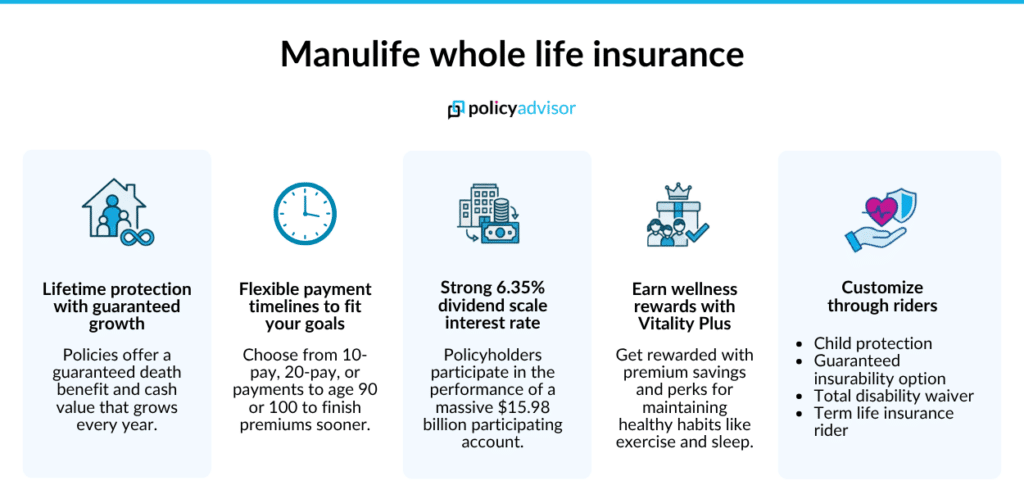
Types of Manulife Par whole life insurance
Manulife’s core participating whole life insurance product is Manulife Par, with an enhanced version that has Vitality Plus built in.
- Manulife Par: A participating whole life insurance plan that provides lifetime coverage, guaranteed premiums, guaranteed cash value growth, and a guaranteed death benefit. Policyholders may also receive annual dividends, which can be used to enhance the policy’s cash value and insurance coverage. The available coverage options are single life or joint last-to-die and include Vitality Go™ at no additional cost. The Vitality Go™ rewards you for leading a healthy lifestyle. Also, note that Vitality Go members can upgrade to Manulife Par with Vitality Plus anytime before the policy’s third anniversary
- Manulife Par with Vitality Plus: This version keeps the core participating whole life features of Manulife Par while building the Vitality Plus wellness program into the policy. With this policy, policyholders can earn rewards for participating in activities that promote healthier living, while the policy continues to provide guaranteed benefits and the potential for annual dividends. Manulife Par with Vitality Plus is available as single life coverage only
Manulife Par and Manulife Par with Vitality Plus:
| Features | Manulife Par | Manulife Par with Vitality Plus |
| Coverage amount | Starts at $100,000 for 10-year, 20-year, and pay-to-age-90 durations; $500,000 for pay-to-age-100 | Starts at $100,000 for 10-year, 20-year, and pay-to-age-90 durations; $500,000 for pay-to-age-100 |
| Payment duration options | 10 years, 20 years, to age 90, or to age 100 | 10 years, 20 years, to age 90, or to age 100 |
| Coverage options | Single life or joint last-to-die | Single life only |
| Eligibility for Vitality benefits | Access to Manulife Vitality Go™ benefits at no added cost | Access to maximum-value Manulife Vitality benefits |
| Upgrade option | Upgrade to Manulife Par with Vitality Plus before the 3rd anniversary (no underwriting required) | Not applicable |
| Issue age | 18-80 years | 18-80 years |
| Monthly Vitality® charge | Not applicable | – $15 for pay 10 years
– $10 for pay 20 years – $6 for pay to age 90 – $4 for pay to age 100 |
| Dividend options | Paid-up insurance or cash | Paid-up insurance or cash |
Pros and cons of Manulife whole life insurance
Manulife’s participating whole life policies offer a range of benefits such as immediate cash value growth, the option to choose the frequency and duration of premiums, and access to riders. Manulife also offers deposit option payments where the insured individuals can make direct premium payments and increase their protection.
A downside of Manulife’s whole life insurance is that Manulife does not offer non-participating plans, and some policy owners may find the dividend and returns structure complex.
| Pros | Cons |
| Choose from 10-pay, 20-pay, pay-to-90, and pay-to-100 options to match different financial goals | They offer only two dividend options, while other insurers typically offer more |
| Deposit option payments are available where policy owners can make additional premium payments to increase protection | Pay to age 100 requires at least $500,000 in coverage |
| Variety of riders offered by Manulife for different life events and needs | Joint coverage is not available with Vitality Plus |
| Manulife Par with Vitality Plus can provide wellness rewards and benefits in addition to life insurance coverage | |
| Available as single-life or joint-last-to-die coverage, depending on the policy type | |
| Immediate cash value growth and guaranteed cash value in the early years |
How much does Manulife whole life insurance cost?
The cost of Manulife whole life insurance for a 20-pay whole life insurance policy with $100,000 in coverage ranges from $246.20 to $620.71 per month. In the table below, we have listed the cost for a male and a female and how they vary with age.
Cost of Manulife whole life insurance (2026):
| Age (in years) | Male | Female |
| 20 | 246.20/month | 226.04/month |
| 30 | 291.59/month | 266.35/month |
| 40 | 331.71/month | 319.26/month |
| 50 | 394.61/month | 380.76/month |
| 60 | 459.84/month | 441.20/month |
| 70 | 678.46/month | 620.71/month |
*Illustrative monthly premiums for $100k of participating whole life insurance with a 20-pay premium period
What riders are available with Manulife whole life insurance?
Manulife offers several optional benefits with its whole life insurance, including waiver of premium, guaranteed insurability, child coverage, and additional term insurance.
- Total disability waiver rider: This rider can waive Manulife Par premiums if the insured becomes totally disabled for six months or longer. If the disability begins before age 60, premiums can be waived for as long as the disability continues. If total disability begins after age 60, premiums are waived until age 65, subject to the rider’s terms and conditions
- Guaranteed insurability option rider: This option allows you to purchase additional life insurance in the future without providing new medical evidence of insurability. The option can generally be exercised up to eight times on specified option dates in the policy contract or following qualifying life events, such as marriage or the birth or adoption of a child
- Child protection rider: This rider provides $10,000 of life insurance coverage for an eligible child of an insured person covered by the policy. When the child reaches age 25, they can purchase up to $250,000 of new life insurance coverage without additional underwriting, including up to $100,000 of critical illness coverage
- Term insurance rider: This option adds temporary term life insurance coverage to the permanent whole life policy. The coverage is available on a 10-year or 20-year renewable basis and can be structured on a single-life or combined basis. Through this, policyholders can convert the term coverage to a permanent Manulife life insurance plan available at the time of conversion up to age 75 without providing evidence of insurability
What factors affect the performance of Manulife’s participating account?
Manulife’s participating account is influenced by four key factors that can affect its performance and, ultimately, policy dividends:
- Claims experience: Higher-than-expected death claims can reduce the account’s funds, while lower claims can have a positive effect
- Policy cancellations: The number of policies cancelled or surrendered can affect the account’s expected cash flow and performance
- Expenses and taxes: Underwriting, administration, policy servicing, operating costs, and taxes affect the account’s overall performance
- Investment returns: Investment performance is a major factor. Returns above expectations can strengthen the account, while lower-than-expected returns can negatively affect it
Factors that influence Manulife’s participating accounts
| Factor | Predictability | Stability | Impact on performance |
| Claims experience | High | High | Low |
| Cancellations | Medium | Medium | Medium |
| Expenses & Taxes | High | High | Low |
| Investment Returns | Medium | Medium | High |
Does Manulife Par offer a disability benefit?
Yes, Manulife Par includes a built-in Disability Benefit that allows policyholders to access a portion of their policy’s cash value. The benefit can provide financial support if the insured becomes disabled.
To qualify, the insured must generally meet the definition of total disability or catastrophic disability:
- Total disability (ages 18 to 65): The insured is unable to perform their regular occupation or, if unemployed, their regular daily activities
- Catastrophic disability (from age 18): The insured is unable to perform an activity of daily living or experiences the total and permanent loss of sight, hearing, speech, or use of their hands or feet, or suffers qualifying cognitive impairment
This benefit comes with a 30-day elimination period, and only one payment can be made in any 12-month period. Since payments are taken from the policy’s cash value, each payment will also reduce the policy’s death benefit.
What is Manulife Vitality?
Manulife Vitality is a wellness-enhanced insurance program that rewards policyholders for maintaining healthy habits. It’s designed to encourage better lifestyle choices and make wellness a part of your insurance experience.
When you are enrolled, you earn Vitality Points for completing everyday health activities like walking, exercising, getting a flu shot, sleeping well, or meditating. As your points increase, your Vitality Status improves from Bronze to Silver, Gold, and Platinum, unlocking greater rewards and premium savings. These can include discounts on leading brands, fitness devices, and even travel or entertainment perks.
There are two versions of the program: Vitality Go™, which is included at no cost with all eligible plans, and Vitality Plus™, which offers enhanced benefits and exclusive rewards, such as the opportunity to earn a free Apple Watch®, for a small monthly fee. Manulife Vitality is also available with health and dental insurance to help members integrate wellness into both their financial and physical health goals.
What premium options does Manulife offer?
Manulife Par offers four payment schedules: 10-pay, 20-pay, pay to age 90, and pay to age 100. Each one lets you finish paying for the policy on a different timeline.
- 10-pay: Premiums are payable for 10 years, after which the policy becomes paid-up for life
- 20-pay: Premiums are payable for 20 years, and the policy is fully paid-up once that period ends
- Pay to age 90: Level premiums continue until the insured reaches age 90, with lifetime coverage following the final payment
- Pay to age 100: Level premiums continue until age 100. This option typically includes a higher minimum coverage amount, often $500,000 or more
For 10-pay, 20-pay, and pay to age 90, the coverage starts at $100,000, while for pay to age 100, the minimum coverage is $500,000.
Can a Manulife Par joint last-to-die policy be replaced with a single-life policy?
Yes, a Manulife Par joint last-to-die policy can be replaced with one or two single-life Manulife Par policies. This can be done without new evidence of insurability if their marriage or business partnership ends. This can help each policyholder maintain individual permanent life insurance coverage after the relationship or partnership is dissolved. The replacement option is available before the fifth policy anniversary, provided the policyholders are 65 or younger, and the original joint policy has a standard joint rating. Manulife must approve the replacement.
Can you change the premium payment period on a Manulife Par policy?
Yes, Manulife Par policyholders may be able to change their premium payment period to a longer duration, subject to Manulife’s administrative rules and policy conditions. The available changes include:
- 10-pay → 20-pay: Change from paying premiums for 10 years to paying them for 20 years. Request must be received before the 5th policy anniversary
- 10-pay → Pay-to-90: Extend the premium payment period from 10 years to payments up to age 90. Request must be received before the 5th policy anniversary
- 20-pay → Pay-to-90: Change from a 20-year premium period to payments up to age 90. Request must be received before the 10th policy anniversary
This option can help policyholders spread their premium payments over a longer period, potentially making the ongoing premium commitment more manageable. Moreover, you cannot change to a shorter premium duration, switch to Pay to age 100, or change only part of the policy’s premium duration. Changing the premium duration will also reduce the policy’s guaranteed cash value, with the released amount refunded to the policy owner.
Does Manulife Par offer compassionate assistance?
Yes, Manulife Par includes a complimentary, non-contractual Compassionate Assistance Program. If the insured person becomes terminally ill and death is imminent, the policy owner may request early access to a portion of the death benefit through a collateral loan from Manulife.
The loan is provided on a tax-free basis, subject to applicable tax laws, with the policyholder responsible for the loan interest and any physician fees required to complete the application. The policy remains in force after the loan is provided, but the outstanding loan amount plus accrued interest is deducted from the death benefit payable to beneficiaries. Once a Compassionate Assistance loan has been issued, no further withdrawals can be made from the policy under this benefit.
Compare dividend rates from top Canadian insurers
| 2022 | 2023 | 2024 | 2025 | 2026 | |
|---|---|---|---|---|---|
| Equitable | 6.05% | 6.25% | 6.40% | 6.40% | 6.40% |
| Manulife | 6.10% | 6.35% | 6.35% | 6.35% | 6.35% |
| iA Financial Group | 5.75% | 6.00% | 6.25% | 6.35% | 6.35% |
| Desjardins Insurance | 5.75% | 6.20% | 6.30% | 6.30% | 6.30% |
| RBC Insurance | 6.00% | 6.00% | 6.25% | 6.30% | 6.30% |
| Sun Life | 6.00% | 6.00% | 6.25% | 6.25% | 6.25% |
| Empire Life | 6.00% | 6.00% | 6.00% | 6.25% | 6.25% |
| Foresters Financial | 5.50% | 5.50% | 5.50% | 6.25% | 6.25% |
| Co-operators | 5.90% | 5.90% | 6.00% | 6.00% | 6.00% |
| Assumption Life | 5.75% | 5.75% | 5.75% | 5.75% | 5.80% |
| Canada Life | 5.25% | 5.50% | 5.50% | 5.75% | 6.00% |
Powered by
How does Manulife compare to other whole life insurance providers?
Manulife whole life insurance stands out for its participating Manulife Par product, multiple premium payment options, and guaranteed cash value growth. Its 10-pay, 20-pay, pay-to-90, and pay-to-100 options give you flexibility to match premium payments with your long-term financial goals. It also offers Manulife Par, with Vitality Plus adding wellness features and rewards to your whole life insurance plan. To see how Manulife compares with other leading insurers, read our guide to the best whole life insurance companies in Canada.
Our advisor’s take on Manulife whole life insurance
At PolicyAdvisor, one of our advisors recently helped a client, aged 45, who was looking for permanent life insurance with a clear premium payment timeline. The client’s primary goal was to finish paying for the policy before retirement while keeping lifelong coverage in place.
Client profile:
- Age: 45-year-old non-smoking Canadian
- Coverage need: $500,000 in permanent coverage to support family protection and long-term estate planning
- Primary concern: Finishing premium payments before retirement while keeping lifelong coverage in place
- Our comparison: We compared Manulife Par with participating whole life products from other leading Canadian insurers, focusing on premium payment periods, guaranteed values, dividend potential, and available riders and benefits
Why Manulife stood out:
- Multiple premium payment periods, including 10-pay, 20-pay, pay-to-90, and pay-to-100, allowing the client to choose a premium schedule that fits their long-term financial goals. For this client, the shorter payment options made it possible to structure the policy so premiums could be completed before retirement while the coverage stayed in force for life.
- Lifetime coverage with guaranteed values, providing permanent protection along with guaranteed cash value growth
- Manulife Vitality Plus option, providing wellness features and rewards that encourage healthy living while adding value to the permanent life insurance policy
- Flexible policy enhancements, including the Guaranteed Insurability Option, Term Insurance Rider, Total Disability Waiver, and Child Protection Rider, allowing the client to adapt coverage to changing needs
How to buy Manulife whole life insurance?
To apply for a Manulife whole life plan, you would need to choose the plan type (Manulife Par or Manulife Par with Vitality Plus™), choose your coverage options, fill in an application form, and submit it. Your policy may also require medical underwriting based on your plan specifics.
For the best Manulife whole life insurance policy quotes, speak to our experts at PolicyAdvisor. Our licensed advisors will help you choose a plan and coverage options that best suit your needs and budget. We will also support you with the application, making the entire process seamless and easy for you!
Frequently asked questions
Does Manulife offer participating policies with dividends?
Yes, Manulife offers participating whole life policies with dividends. Dividends can either be used to buy more insurance, or they can be withdrawn as cash. In case policy owners choose to withdraw the dividends, there may be some tax implications.
Is Manulife whole life worth it?
Yes, Manulife’s whole life insurance can be worth it, especially for people looking for a policy that builds cash value and provides long-term protection at affordable rates. Their policies are designed to help build wealth with dividend options that can be used to either buy more insurance or be withdrawn as cash. Manulife also offers exclusive benefits with its Vitality program, making its whole life insurance plans an ideal option for those looking for complete protection.
Can you borrow against the cash value?
Yes, you can request a cash loan, which is typically subject to Manulife’s administrative rules. The maximum amount you may borrow is 90% of the total available cash value minus any outstanding policy loan balance.
What are the premium payment options for Manulife whole life insurance?
Manulife Par offers four premium payment options: 10-pay, 20-pay, pay-to-90, and pay-to-100. This allows policyholders to select a payment schedule based on their financial goals and how quickly they want to complete premium payments.
What riders are available with Manulife whole life plan?
Manulife Par offers optional benefits such as the term insurance rider, total disability waiver, guaranteed insurability option, and child protection rider. These options can provide additional protection or help policyholders increase their coverage as their needs change, but they come with additional premiums.
What is Manulife Par with Vitality Plus?
Manulife Par with Vitality Plus combines participating whole life insurance with a wellness program that rewards eligible policyholders for healthy-living activities. It provides the same core whole life insurance features of Manulife Par while adding wellness-related benefits and rewards. It is available on a single life basis only.
What dividend options does Manulife offer?
Manulife offers paid-up insurance and cash that can be taken out or used for premium reduction. If you choose the paid-up insurance option, your annual dividends are used to automatically buy additional, fully paid-up insurance. This means that once your dividends have been used to purchase additional coverage, you do not need to make any further premium payments for the paid-up insurance. If you choose the cash option as your dividend strategy, the annual dividends you receive are paid directly to you. In this case, there may be some tax implications.
How are Manulife’s whole life insurance dividends distributed?
Dividends are allocated to Manulife Par policyholders using a dividend scale. A dividend scale is a formula used by all insurance companies to fairly and equitably distribute the dividends among all the policy owners. The dividend scale is not guaranteed and usually increases or decreases based on the participating account’s performance.
Where does Manulife invest the participating account’s premiums?
Manulife invests the participating account’s funds in public bonds, real estate, public and private equities, mortgages, and private debt. This diversified portfolio helps generate steady long-term returns while maintaining stability for policyholders.
Is Whole Life Insurance a bad investment in Canada? 2026 Guide
Whole life insurance is a popular kind of life insurance in Canada, offering lifelong coverage while building cash value over time. Participating whole life policies may also provide non-guaranteed dividends, providing additional opportunities to grow the policy value. Since whole life combines permanent financial protection with additional benefits, it can be a valuable tool for long-term financial planning.
Is whole life insurance a bad investment?
No, whole life insurance is not a bad investment option. It is primarily a permanent life insurance option that provides guaranteed lifelong coverage while building cash value. Whether it is a good choice or not depends on your financial goals and the duration of protection you are seeking for your beneficiaries.
Essentially, if you are only looking to temporarily replace income or secure a short-term financial obligation, a term policy will provide a basic, temporary safety net. However, if you are seeking to leave an inheritance or planning a tax-free inheritance for your family, a whole life policy may be a better fit for your needs.

Need insurance answers now?
Call 1-888-601-9980 to speak to our licensed advisors right away, or book some time with them below.
Common misconceptions about whole life insurance
Many people view whole life insurance as a bad investment because of common misconceptions around its higher premiums, slower cash value growth, and lower returns compared with market-based investments. Let’s separate the myths from the facts and look at what whole life insurance actually offers:
Myth #1: Whole life insurance is a bad investment
Whole life insurance is sometimes compared directly with investment options like stocks, mutual funds, or ETFs. However, this comparison fails to consider that whole life is primarily an insurance product.
Whole life insurance is purchased to provide a guaranteed death benefit, while also building cash value in the process. Essentially, it is better to regard whole life insurance as a long-term insurance and financial-planning tool rather than as a direct alternative for investment-focused options like stocks or other conventional methods.
A whole life insurance policy offers a guaranteed death benefit when you pass away, providing your beneficiaries with funds for financial protection and to cover final expenses. This makes it a great tool for leaving an inheritance or for tax-advantaged estate planning. Alongside this, the policy also grows cash value and non-guaranteed dividends over the years.
This cash value can be used as a policy loan, withdrawn, or even used as collateral in an eligible third-party loan. Additionally, if the policyholder receives dividends, they can use them to purchase additional paid-up insurance or reduce premiums.
Myth #2: Whole life insurance is too expensive
Permanent life insurance policies are indeed more expensive than term life insurance. In fact, whole life insurance premiums can be as much as 5 to 15 times more expensive than term policies. This difference can be significant for those looking for a more budget-friendly life insurance policy or higher coverage amounts at lower premiums.
However, this difference in premium cost is not without reason. Whole life insurance offers lifelong coverage, cash value, and an investment component in participating policies. Unlike term insurance, whole life coverage is designed to last a lifetime. It is also worth noting that many whole life policies offer guaranteed and level premiums. If you apply when you are younger and healthier, you essentially qualify for more reasonable rates.
With term life insurance, your premiums may increase with each term renewal or new application, since the cost is based on attained age and other underwriting criteria. Therefore, comparing term and whole life based on the initial premium alone does not provide a complete picture.
Myth #3: You have to surrender your policy to access the cash value
You do not necessarily have to surrender your whole life insurance policy to benefit from its cash value. While surrendering your policy gives you access to the accumulated cash value, you can also use that value in other ways. Depending on your policy and the terms, you may also be able to:
- Make a partial withdrawal
- Take a policy loan against the cash value
- Use the policy as collateral for a loan
This flexibility can be useful for business owners and corporate-owned policies. A business owner can borrow against the policy or use it as collateral and reinvest the borrowed funds into the business for expansion, acquisition, or other expenses without having to surrender the policy. As long as the policy remains in force, the coverage continues.
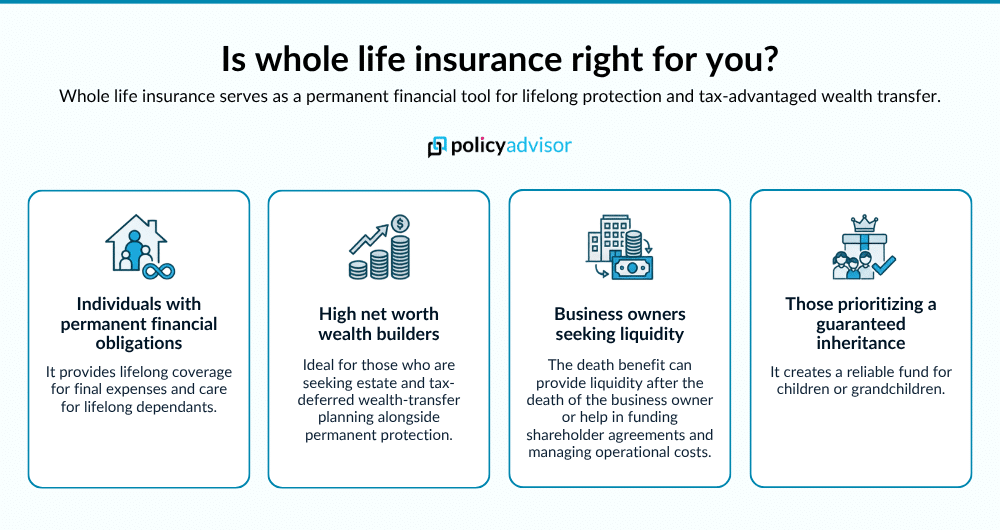
Is term life insurance better than whole life insurance?
Neither is universally better since the two policies solve different financial needs. While term is meant to offer protection for temporary financial obligations such as mortgages or loans, whole life policies are meant for lifelong coverage and wealth preservation.
Let’s say you purchase a ten-year term life insurance policy with $50,000 in coverage. The cost of term life premiums will be less than those for a whole life policy with the same coverage of $50,000. If you die during those 10 years, the term policy provides the same $50,000 death benefit at a lower premium cost. However, if you outlive the term and allow the policy to expire, your coverage ends.
On the other hand, whole life stays in force for life and provides a guaranteed death benefit whenever you die, as long as the premiums are paid. The major difference is that term life insurance protects against the possibility of passing away during a selected term, whereas whole life insurance is designed to provide coverage until the policyholder passes away.
If you are seeking to protect outstanding debts or short-term obligations like mortgages, term life insurance is the way to go. However, if you are looking for permanent protection while also building cash value, whole life insurance may be more aligned with your financial needs.

Should you use whole life insurance for retirement planning in Canada?
Whole life insurance can complement retirement and estate planning, particularly when you already need lifelong coverage. A participating life insurance policy can build cash value on a tax-advantaged basis and may provide non-guaranteed dividends.
However, whole life insurance should generally complement conventional savings options such as RRSPs and TFSAs. The key to this balance is structuring the policy so that the premiums and future policy value support your retirement goals.
Here are some factors you should keep in mind while using whole life insurance for retirement planning in Canada:
- Budget whole life premiums before retirement: If you expect to continue paying premiums after you retire, it is important to factor those payments into your projected retirement expenses
- Consider a limited-pay whole life policy: Limited-pay whole life policies allow you to complete your scheduled premium payment over a much shorter period, while maintaining lifelong coverage. This can help you finish paying premiums before retirement.
- Use participating policy dividends: If you receive dividends from participating policies, you can use them to purchase additional paid-up insurance or reduce premiums, making it great for retirement planning.
For a detailed overview, check out our guide on Whole life vs. RRSP vs. TFSA: Which builds more wealth in Canada?
What is your Whole Life Insurance worth?
Get instant quotes from Canada's top life insurance providers and find the perfect coverage for your family.
Powered by
Who should buy whole life insurance in Canada?
Whole life insurance is particularly valuable if you are seeking lifelong protection or want to use it as part of a broader strategy involving estate planning or wealth transfer to your beneficiaries, owing to the tax-free payout and tax-deferred growth.
Here are situations when whole life insurance in Canada makes sense:
You need permanent life insurance
Whole life insurance can provide coverage for final expenses, lifelong dependants, estate obligations, or other permanent needs. It is designed for broader protection, rather than covering temporary financial obligations like home loans or debts.
You are a high net worth individual
Whole life insurance is a great tool for high net worth Canadians who have already made effective use of conventional savings and investment strategies. The policy can help in broader estate and tax-deferred wealth-transfer planning. It offers an efficient way of transferring wealth to beneficiaries while providing permanent life insurance protection.
You want to leave an inheritance
Whole life insurance can create a guaranteed inheritance or fund for your beneficiaries such as children and grandchildren, provided you continue to pay your premiums until your death or until the end of the specified policy period.
You are a business owner
If you are a business owner, you can use whole life insurance to provide liquidity after you pass away. The death benefit can be used as a cash flow injection that can also help in funding shareholder agreements or to help address operational or structural challenges the business may face after the owner’s passing.
Who may want to skip whole life insurance?
While whole life is great for those seeking extended coverage for the duration of their lives, it might not be the perfect fit for individuals seeking affordable coverage or short-term protection. If you have temporary or reducing financial obligations, such as a mortgage or outstanding loans, a term life policy will offer you a higher coverage amount at similar premiums.
Similarly, if investment growth is your priority and you do not need permanent life insurance, whole life insurance may not be the right fit for you. Instead, you can invest in traditional options such as mutual funds, stocks, or ETFs.
Final verdict: Is whole life insurance actually bad?
No, whole life insurance is not inherently bad. It provides lifelong protection while building cash value, making it a good investment for Canadians planning long-term coverage. It is particularly well-suited for individuals planning to leave an inheritance or transfer wealth to their beneficiaries in a tax-advantaged manner.
For Canadians protecting a short-term financial liability, term life insurance is usually the most cost-effective option since it provides a large amount of coverage when it is needed the most.
On the other hand, if you are a high net worth individual or you have maxed out your RRSPs or TFSAs, you can consider whole life insurance to leave behind an inheritance or cover final expenses and other costs.
Still confused about whether whole life insurance is right for you? Speak to our advisors and compare quotes from leading Canadian insurers to see what best fits your financial situation and needs.
Frequently Asked Questions
Is whole life insurance worth it in Canada?
Whole life insurance can be worth it if you need permanent coverage and want to build cash value in the process. It may be particularly useful for Canadians seeking to leave an inheritance, transfer wealth, or cover permanent estate obligations.
How long does whole life insurance take to build cash value?
Whole life insurance begins building policy value according to the policy’s contractual schedule, but the cash value growth is usually slower in the earlier years. This is because most of your premiums go to administrative costs and paying for your death benefit.
Do beneficiaries receive the cash value of a whole life policy when you die?
No, beneficiaries only receive the death benefit when the policyholder passes away. However, the cash value can be used to take policy loans or pay future premiums.
Is whole life insurance a good investment for business owners?
Whole life insurance may be a good investment for business owners who are seeking permanent coverage, while protecting beneficiaries if the owner passes away suddenly. It is especially useful as corporate-owned life insurance, since it may provide liquidity after you pass away.
Can I own both term and whole life insurance?
Yes, you can own both. Canadians generally use term insurance for larger temporary needs such as mortgage protection or income replacement, while a whole life policy helps protect beneficiaries or leave behind an inheritance.
Whole life insurance cost in Canada: A complete guide
The cost of whole life insurance typically ranges from $54 to $2,552 per month, depending on your age, health, coverage amount, premium payment option, and the insurer you choose. While whole life insurance costs more than term life insurance, the higher premiums provide benefits that last a lifetime, including permanent coverage, level premiums, and tax-advantaged cash value growth. Some policies, such as participating policies, may also earn annual dividends, depending on the insurer and policy type, further increasing their long-term value.
Quick summary of whole life insurance costs in Canada
| Cost category | Typical monthly premium range |
| By plan type |
|
| By coverage amount |
|
| By applicant category |
|
| Payment option |
|
| By insurers |
|
Disclaimer: The illustrative monthly premiums below are based on the examples used throughout this guide. Your actual premium will vary based on your personal profile, coverage needs, and the insurer you choose.
How much does whole life insurance cost?
Get instant quotes from Canada's top life insurance providers and find the perfect coverage for your family.
Powered by
What affects the cost of whole life insurance in Canada?
The whole life insurance cost depends on your personal profile, coverage needs, and the type of policy you choose. The following factors affect how the cost of your whole life insurance policy will be determined in Canada:
- Age: Age is one of the biggest factors affecting whole life insurance premiums. Buying a policy at a younger age typically results in significantly lower premiums because insurers view younger applicants as lower-risk
- Health: Your overall health, medical history, and any pre-existing conditions affect your premium. Applicants in good health typically qualify for lower whole life insurance rates
- Smoking status: Smokers usually pay considerably higher premiums than non-smokers due to the increased health risks associated with tobacco and nicotine use. Many insurers offer non-smoker rates after you have been tobacco-free for at least 12 months
- Gender: Women often pay lower premiums than men because, on average, they have a longer life expectancy
- Coverage amount: Choosing a higher death benefit increases your premium since the insurer assumes a larger future payout
- Policy type: Participating whole life insurance generally costs more than non-participating policies because it offers the potential to earn annual dividends, which may increase your policy’s cash value and death benefit over time
- Premium payment option: The payment schedule you choose also affects your monthly premium. Policies with a 10-pay or 20-pay option have higher premiums because the policy is paid off in fewer years, while life pay spreads payments over a longer period, resulting in lower monthly costs
- Insurance company: Premiums can vary between insurers because each company uses its own underwriting guidelines, dividend scale, and pricing structure. Comparing quotes from multiple insurers can help you find the best value for your needs
- Policy riders: Adding optional riders, such as a child rider, disability waiver of premium, or guaranteed insurability rider, increases the overall cost of your policy but provides additional protection and flexibility
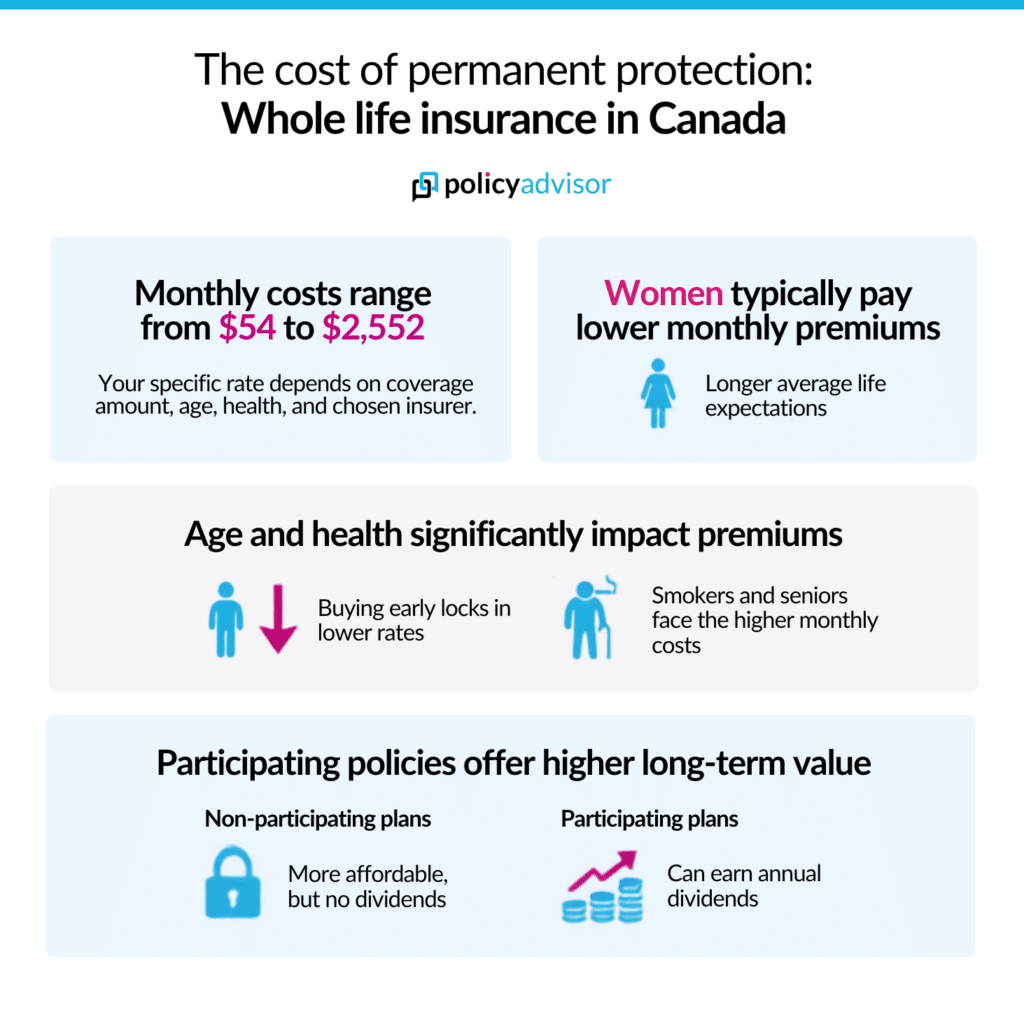
Whole life insurance cost in Canada by plan type
Different types of whole life insurance come with different premium costs and long-term benefits. In Canada, you can choose between participating and non-participating whole life insurance. Participating policies generally have higher premiums because they may pay annual dividends, while non-participating policies offer lower premiums with guaranteed benefits but no dividend potential.
What is the cost of participating whole life insurance?
The cost of participating whole life insurance typically starts at $138.42 per month for a 20-year-old non-smoker with $100,000 in coverage under a 20-pay premium option. For a comparable female applicant, the premium starts at $118. Participating policies may be suitable for individuals seeking lifelong coverage, guaranteed cash value growth, and the potential to earn eligible annual dividends, which may increase the policy’s cash value and death benefit over time.
Cost of participating whole life insurance
| Age (in years) | Male (non-smoker) | Female (non-smoker) |
| 20 | $138.42 | $118.89 |
| 30 | $177.84 | $156.15 |
| 40 | $228.96 | $207.00 |
| 50 | $292.23 | $270.81 |
| 60 | $382.14 | $351.81 |
*Illustrative monthly premiums for non-smoking male and female of various age ranges seeking a participating whole life insurance policy with $100,000 in coverage for a 20-pay premium option
What is the cost of non-participating whole life insurance?
The cost of non-participating whole life insurance typically ranges from $57 to $319 per month. It is generally more affordable than participating whole life insurance and may be a good option for individuals looking for permanent coverage, guaranteed cash value, and predictable premiums without dividend participation.
Cost of non-participating whole life insurance
| Age (in years) | Male (non-smoker) | Female (non-smoker) |
| 20 | $70.74 | $57.24 |
| 30 | $100.35 | $88.74 |
| 40 | $141.66 | $127.53 |
| 50 | $223.83 | $181.71 |
| 60 | $319.41 | $277.92 |
*Illustrative costs for non-smoking male and female of various age ranges seeking a non-participating whole life insurance policy with $100,000 in coverage for a 20-pay premium option
Whole life insurance cost by coverage amount in Canada
The amount of coverage you choose directly affects the cost of your whole life insurance policy. In general, higher coverage amounts come with higher premiums because the insurer assumes a larger death benefit payout. For instance, the cost of whole life insurance with $100,000 in coverage will be lower than that of $250,000 in coverage because the insurer is assuming a smaller death benefit. The tables below show illustrative monthly premiums for different coverage amounts.
How much is a $100,000 whole life insurance policy?
The cost of a $100,000 whole life insurance policy typically ranges from $57.24 to $382.14 per month for non-smokers. This coverage amount is well suited for covering final expenses, leaving a modest inheritance, or supplementing an existing life insurance policy. It also provides lifelong protection while building guaranteed cash value over time.
Cost of a $100,000 whole life insurance policy
| Age (in years) | Male (Non-participating) | Male (Participating) | Female (Non-participating) | Female (Participating) |
| 20 | $70.74 | $138.42 | $57.24 | $118.89 |
| 30 | $100.35 | $177.84 | $88.74 | $156.15 |
| 40 | $141.66 | $228.96 | $127.53 | $207.00 |
| 50 | $223.83 | $292.23 | $181.71 | $270.81 |
| 60 | $319.41 | $382.14 | $277.92 | $351.81 |
*Illustrative monthly premiums for non-smoking males and females of various age ranges seeking a whole life insurance policy with $100,000 in coverage for a 20-pay premium option
How much is a $250,000 whole life insurance policy?
The cost of a $250,000 whole life insurance policy ranges from $132 to $914 per month for non-smoking applicants, depending on age, gender, and whether you choose a participating or non-participating policy. This coverage amount may be suitable for individuals or families looking to replace a portion of their income, pay off outstanding debts, or help cover future financial obligations.
Cost of a $250,000 whole life insurance policy
| Age (in years) | Male (Non-participating) | Male (Participating) | Female (Non-participating) | Female (Participating) |
| 20 | $156.38 | $323.10 | $132.30 | $285.98 |
| 30 | $225.45 | $415.58 | $204.75 | $377.55 |
| 40 | $328.05 | $540.22 | $298.35 | $495.00 |
| 50 | $521.55 | $697.28 | $427.95 | $644.40 |
| 60 | $765.45 | $914.40 | $649.80 | $842.40 |
*Illustrative monthly premiums for non-smoking males and females of various age ranges seeking a whole life insurance policy with $250,000 in coverage for a 20-pay premium option
How much is a $750,000 whole life insurance policy?
The cost of a $750,000 whole life insurance policy typically ranges from $350 to $2,552 per month for non-smokers, male and female. This higher coverage amount is designed for individuals with more complex financial needs, such as protecting a family’s lifestyle, supporting estate planning goals, or preserving wealth for future generations.
Premiums are higher for $750,000 in coverage because the insurer guarantees a larger death benefit. Like all other whole life insurance policies, it also offers lifelong coverage and guaranteed cash value growth according to the policy terms. Participating policies may also be eligible to earn annual dividends.
Cost of a $750,000 whole life insurance policy
| Age (in years) | Male (Non-participating) | Male (Participating) | Female (Non-participating) | Female (Participating) |
| 20 | $450.00 | $892.35 | $350.77 | $801.90 |
| 30 | $666.00 | $1,162.35 | $581.62 | $1,059.07 |
| 40 | $980.55 | $1,522.12 | $881.77 | $1,401.30 |
| 50 | $1,523.25 | $1,966.95 | $1,241.10 | $1,829.93 |
| 60 | $2,167.65 | $2,552.18 | $1,891.12 | $2,382.75 |
*Illustrative monthly premiums for non-smoking males and females of various age ranges seeking a whole life insurance policy with $750,000 in coverage for a 20-pay premium option
Whole life insurance cost by applicant type in Canada
The cost of whole life insurance varies from one applicant to another because insurers assess each person’s level of risk before determining their premium. In general, younger applicants, women, and non-smokers tend to pay lower premiums, while older applicants and smokers typically pay more due to the higher likelihood of future insurance claims. The tables below show how whole life insurance premiums vary across common applicant types.
Cost of whole life insurance based on gender
The cost of whole life insurance for non-smokers typically ranges from $70.74 to $319.41 per month for males and $57.24 to $277.92 per month for females, depending on age. The cost of whole life insurance is generally lower for women, and they pay lower premiums than men. This is because females have a longer average life expectancy, resulting in a lower mortality risk for insurers over the lifetime of the policy.
Whole life insurance costs: Male vs female
| Age (in years) | Male | Female |
| 20 | $70.74 | $57.24 |
| 30 | $100.35 | $88.74 |
| 40 | $141.66 | $127.53 |
| 50 | $223.83 | $181.71 |
| 60 | $319.41 | $277.92 |
*Illustrative monthly premiums for non-smoking males and females of various age ranges seeking a non-participating whole life insurance policy with $100,000 in coverage for a 20-pay premium option
Cost of whole life insurance based on smoking status
The cost of whole life insurance for smokers typically ranges from $84.60 to $413.34 per month, compared to $57.24 to $319.41 per month for non-smokers. Smokers pay higher premiums because tobacco and nicotine use increase the risk of serious health conditions and reduce life expectancy, increasing the likelihood of future claims.
Whole life insurance cost for a smoker vs. a non-smoker
| Age (in years) | Male (Non-smoker) | Male (Smoker) | Female (Non-smoker) | Female (Smoker) |
| 20 | $70.74 | $100.08 | $57.24 | $84.60 |
| 30 | $100.35 | $139.14 | $88.74 | $118.53 |
| 40 | $141.66 | $205.07 | $127.53 | $177.17 |
| 50 | $223.83 | $289.29 | $181.71 | $246.55 |
| 60 | $319.41 | $413.34 | $277.92 | $349.26 |
*Illustrative monthly premiums for smoking and non-smoking males and females of various age ranges seeking a non-participating whole life insurance policy with $100,000 in coverage for a 20-pay premium option
Cost of whole life insurance for children
The cost of whole life insurance for children can start from $100 per month for a 20-pay participating whole life policy. Purchasing whole life insurance for a child at a young age allows parents or grandparents to lock in lower lifetime premiums while providing lifelong coverage and guaranteed cash value growth. Over time, eligible dividends may increase the policy’s cash value and death benefit, depending on the policy and dividend option selected.
Cost of life insurance for a male child
| Age | Monthly premiums | Accumulated cash value | Death benefit |
| 5 years | $100/month | $0 | $159,200 |
| 20 years | $100/month | $17,000 | $159,200 |
| 35 years | No payment of premiums after the first 20 years | $50,000 | $218,000 |
| 50 years | $129,000 | $347,000 | |
| 70 years | $401,000 | $634,000 |
*Illustrative accumulated cash value and death benefit for a $100/month, 20-pay participating whole life insurance policy issued to a healthy 5-year-old boy. Projected cash values and death benefits assume current dividend scales and are not guaranteed; the actual policy values may vary
Cost of whole life insurance for seniors
The cost of whole life insurance for seniors typically ranges from $277.92 to $960.57 per month for seniors aged 60 to 80 with $100,000 in coverage under a 20-pay option. Premiums are generally higher for seniors because the likelihood of future insurance claims increases with age. Despite the higher cost, whole life insurance can help cover final expenses, leave a tax-efficient inheritance, and support estate-planning goals for seniors’ beneficiaries.
Whole life insurance costs for seniors
| Age (in years) | Male (Non-participating) | Male (Participating) | Female (Non-participating) | Female (Participating) |
| 60 | $319.41 | $382.14 | $277.92 | $351.81 |
| 65 | $409.14 | $445.77 | $345.06 | $404.64 |
| 70 | $544.95 | $485.41 | $441.54 | $468.81 |
| 75 | $782.37 | $671.04 | $607.05 | $569.07 |
| 80 | $960.57 | $904.77 | $745.38 | $750.87 |
*Illustrative monthly premiums for non-smoking males and females of various age ranges seeking a whole life insurance policy with $100,000 in coverage for a 20-pay premium option
Whole life insurance costs by premium payment option
The cost of whole life insurance ranges between $38 and $323, depending on your age and the payment option you choose. Your premium payment option determines how long you will pay for your whole life insurance policy and how much you will pay each month. Shorter payment periods generally have higher monthly premiums because the policy is paid off sooner, while longer payment periods spread the cost over more years.
- 20 Pay: Pay premiums for 20 years, after which your policy remains fully paid up for life while your lifelong coverage and cash value continue to grow
- T65: Pay premiums until age 65, making it a popular option for those who want to complete payments before retirement while keeping lifelong coverage
- Life Pay: Pay premiums until age 100, resulting in the lowest monthly premiums by spreading the cost over the longest payment period
Whole life insurance cost by payment option
| Age (in years) | 20 Pay | T65 | Life Pay |
| 20 | $70.74 | $54.81 | $38.97 |
| 30 | $100.35 | $74.34 | $52.65 |
| 40 | $141.66 | $128.70 | $82.89 |
| 50 | $223.83 | $322.83 | $131.76 |
| 60 | $319.41 | – | $209.16 |
*Illustrative monthly premiums for a male non-smoker of various age ranges seeking a non-participating whole life insurance policy with $100,000 in coverage
Cost of whole life insurance by insurer in Canada
The cost of whole life insurance can vary noticeably between insurers, even for applicants with the same age, gender, coverage amount, and policy type. For example, a 20-year-old non-smoking male pays $70.74 per month with Foresters Life, compared to $113.49 per month with Canada Protection Plan for the same $100,000 of coverage. Differences in underwriting, pricing, and product design mean that the same applicant may receive different premiums from different insurers. Hence, comparing quotes from best whole life insurance companies helps you find the perfect combination of premium, policy features, and long-term value.
Whole life insurance cost by insurer
| Age (in years) | Foresters Life | Desjardins | Sun Life | iA Financial Group | Canada Protection Plan |
| 20 years | Male: $70.74
Female: $57.24 |
Male: $78.21
Female: $69.66 |
Male: $91.17
Female: $80.46 |
Male: $94.68
Female: $81.90 |
Male: $113.49
Female: $102.96 |
| 30 years | Male: $100.35
Female: $88.74 |
Male: $105.66
Female: $95.13 |
Male: $114.21
Female: $102.42 |
Male: $114.03
Female: $104.13 |
Male: $131.49
Female: $121.50 |
| 40 years | Male: $141.66
Female: $127.53 |
Male: $151.29
Female: $134.01 |
Male: $166.23
Female: $150.93 |
Male: $177.03
Female: $147.96 |
Male: $171.81
Female: $160.56 |
| 50 years | Male: $223.83
Female: $181.71 |
Male: $235.26
Female: $191.70 |
Male: $267
Female: $222.03 |
Male: $251.73
Female: $210.15 |
Male: $237.69
Female: $221.13 |
| 60 years | Male: $319.41
Female: $277.92 |
Male: $333.72
Female: $294.48 |
Male: $346.41
Female: $306.90 |
Male: $366.75
Female: $303.75 |
Male: $355.32
Female: $317.25 |
*Illustrative monthly premiums for non-smoking males and females of various age ranges seeking a non-participating whole life insurance policy with $100,000 in coverage for a 20-pay premium option
Is whole life insurance worth the cost?
Yes, whole life insurance can be worth the cost if you are looking for lifelong financial protection and long-term wealth-building benefits. Whole life insurance typically costs more than a comparable term life insurance policy, but the higher premiums provide lifelong financial benefits, including:
- Lifetime coverage that never expires as long as premiums are paid
- Guaranteed cash value growth that accumulates over time
- Level premiums that remain unchanged throughout the life of the policy
- Tax-advantaged cash value growth while the policy remains in force
- Support for estate planning and wealth transfer through a generally tax-free death benefit paid to beneficiaries
- Potential annual dividends on participating whole life policies, which may increase the policy’s cash value and death benefit over time
How does the cost of whole life insurance compare to term life insurance?
Whole life insurance generally costs more than term life insurance for the same coverage amount because it provides lifelong coverage and accumulates cash value over time. For example, a $100,000 whole life insurance policy costs approximately $57 to $382 per month, while a $100,000 term life insurance policy costs around $7 to $44 per month, making term life insurance the more affordable option for short-term coverage needs.
If you only need life insurance for a specific period, such as while paying off a mortgage or supporting your family, term life insurance may be the more cost-effective option. If you need lifelong coverage or want to build cash value over time, whole life insurance may be worth considering.
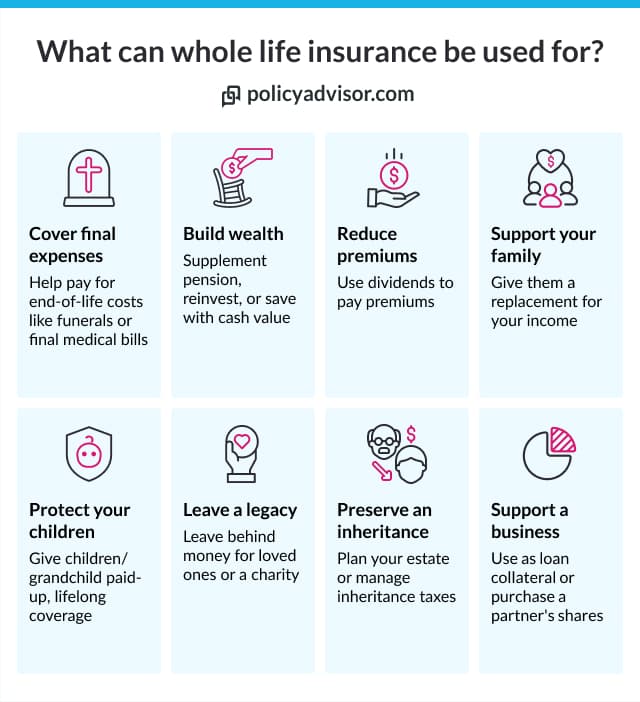
How to reduce the cost of whole life insurance
Although whole life insurance generally costs more than term life insurance, there are several ways to make coverage more affordable, such as buying early, choosing the right coverage amount, comparing quotes, and more. Here are some of the ways in which you can reduce the cost and get the cheapest whole life insurance:
- Buy coverage early: Purchasing whole life insurance at a younger age helps you lock in lower premiums for life
- Choose the right coverage amount: Choose a coverage amount that aligns with your financial needs without paying for more coverage than necessary
- Maintain a healthy lifestyle: Good overall health and remaining tobacco-free can help you qualify for lower premiums
- Consider a non-participating policy: If dividend potential isn’t important to you, a non-participating policy can provide permanent coverage at a lower cost
- Select a longer premium payment period: Options such as Life Pay generally have lower monthly premiums than shorter payment schedules like 20 Pay because premium payments are spread over the entire policy period
- Compare quotes from multiple insurers: Premiums can vary significantly between insurance companies for the same coverage. Comparing quotes through PolicyAdvisor lets you evaluate plans from Canada’s leading insurers and find the best value based on your budget and financial goals. Schedule a call now to get instant whole life insurance quotes!
Frequently asked questions
Why is whole life insurance more expensive than term life insurance?
Whole life insurance costs more because it provides lifelong coverage, guaranteed cash value accumulation, and a guaranteed death benefit. Participating policies may also be eligible to earn annual dividends, adding further long-term value. Term life insurance only covers you for a fixed period and does not build cash value, making it a more affordable option.
How does adding riders affect whole life insurance premiums?
Adding optional riders, such as critical illness coverage, accidental death benefits, or disability waiver of premium, increases whole life insurance premiums. Riders provide additional benefits tailored to individual needs but come at an added cost. For example, a critical illness rider might add 10-20% to the base premium.
Can I lower my whole life insurance premiums after buying a policy?
In most cases, your premiums are fixed when you purchase the policy and cannot be reduced later. However, you may be able to lower your overall costs by choosing a different payment option, reducing your coverage amount, or selecting a non-participating policy.
Can I switch from term life insurance to whole life insurance?
Yes, many term life insurance policies include a conversion option that allows you to convert some or all of your coverage to whole life insurance without completing a new medical exam. The conversion must usually be completed before a specified age or policy anniversary, depending on your insurer.
How much does a $250,000 whole life insurance policy cost?
The cost of a $250,000 whole life insurance policy ranges from $132-$914. The actual costs may vary based on your age, gender, health, smoking status, policy type, and insurer. In general, premiums are higher for $250,000 than for $100,000 in coverage.
Which premium payment option has the lowest monthly cost?
Life Pay typically offers the lowest monthly premiums because the cost of the policy is spread over the longest payment period. In contrast, 20 Pay policies have higher monthly premiums but are fully paid up sooner.
How can I reduce the cost of whole life insurance?
You can lower your whole life insurance premiums by purchasing coverage at a younger age, choosing an appropriate coverage amount, maintaining good health, selecting a non-participating policy, opting for a longer premium payment period, and comparing quotes from multiple insurers.
How much does life insurance cost in Canada in 2026?
The average cost of life insurance in Canada starts at around $7 per month for a healthy young adult purchasing a basic term life insurance policy. Depending on the type of policy, coverage amount, age, health, and insurer, premiums can range from $7 to over $3,276 per month. Individuals who smoke, have pre-existing medical conditions, work in high-risk occupations, or require larger coverage amounts generally pay higher premiums. On the other hand, young and healthy applicants typically qualify for lower premiums.
Quick summary: Average life insurance costs in Canada
| Cost category | Average cost (per month) |
| By plan type |
|
| By coverage amount |
|
| By applicant category |
|
| By term length |
|
| By insurers |
|
Disclaimer: The premiums shown above are illustrative estimates based on specific applicant profiles and policy assumptions, and your actual life insurance cost may vary depending on several factors such as your age, gender, health, smoking status, medical history, coverage amount, policy type, term length, and the insurer’s underwriting guidelines.
How much does Life Insurance cost?
Get instant quotes from Canada's top life insurance providers and find the perfect coverage for your family.
Powered by
Factors affecting life insurance cost in Canada
The cost of life insurance in Canada is mainly driven by factors like age, gender, health, coverage amount, and more. Some of these factors include:
- Age: The age of the individual directly affects the life insurance cost. The older the individual, the higher the premium
- Gender: Life insurance premiums may vary by gender, with women generally paying lower premiums than men due to their longer average life expectancy
- Coverage amount: The higher the coverage amount you choose, the higher the life insurance premium will be
- Health: An individual’s health also affects premium rates. A healthy individual, compared to someone with a history of medical conditions, qualifies for lower rates
- Smoking status: Any insurance company in Canada will charge a higher premium if you are a smoker. This is because the health risks associated with smoking are higher than those for a non-smoker
- Lifestyle: If you are involved in high-risk activities as a result of your hobby or occupation, then the insurer views you as higher risk. This increased liability will also result in you paying higher premiums
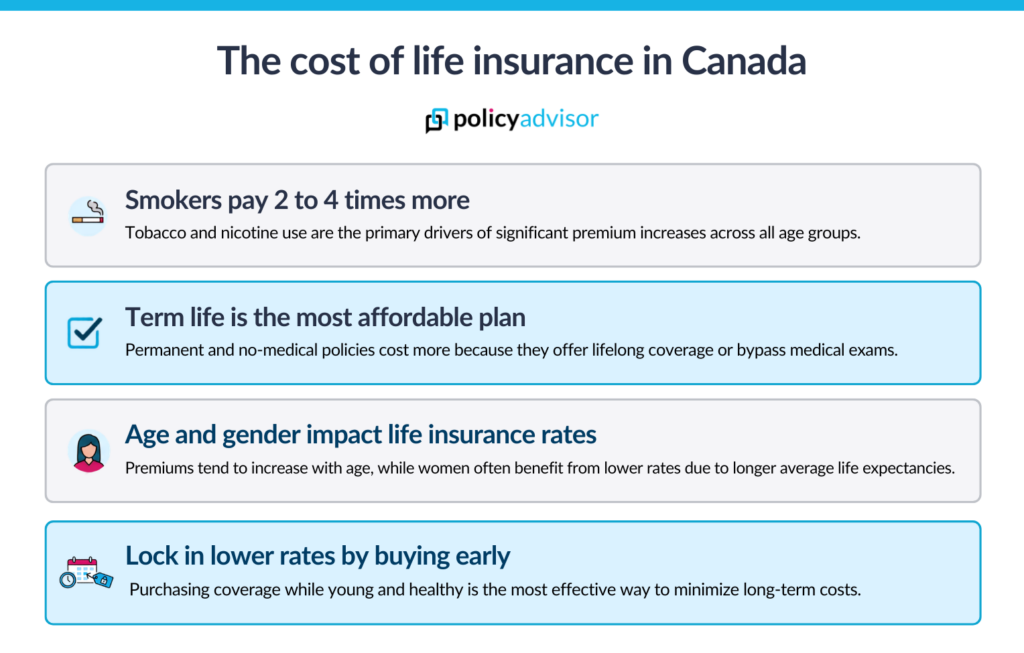
Life insurance costs by policy type
The type of life insurance policy you choose is one of the biggest factors affecting your premium. In general, term life insurance is the most affordable option, while permanent policies, such as whole life insurance, cost more because they provide lifelong coverage and can build cash value. No-medical life insurance also tends to have higher premiums since insurers assume more risk by offering coverage without requiring a medical exam.
What is the cost of term life insurance in Canada?
The cost of term life insurance in Canada with $500,000 in coverage can range from $14 to $200 per month, depending on the applicant’s age, gender, and health. Because term life insurance provides coverage for a fixed period and does not build cash value, it is the most affordable type of life insurance. It is well-suited for individuals and families looking to protect their income, cover a mortgage, or provide financial security during their highest-earning years.
Term life insurance cost in Canada
| Age | Male | Female |
| 20 years | $22 | $14 |
| 30 years | $22 | $15 |
| 40 years | $27 | $19 |
| 50 years | $61 | $45 |
| 60 years | $200 | $145 |
*Illustrative monthly cost of term life insurance for a 10-year period for individuals of various ages with $500,000 in coverage
What is the cost of whole life insurance in Canada?
In Canada, participating whole life insurance with $100,000 in coverage costs between $139 and $382 per month, whereas a non-participating policy may cost between $71 and $320 per month, depending on the applicant’s age and insurer. The cost of whole life insurance is generally several times more expensive than an equivalent term life policy because it provides lifelong coverage and builds cash value.
Participating whole life insurance may also pay policy dividends, depending on the insurer’s dividend performance. It is commonly chosen for estate planning, wealth transfer, tax-advantaged savings, and leaving a guaranteed financial legacy.
Cost of whole life insurance in Canada
| Age | Participating ($100k coverage) – Paid Up additions | Non-participating ($100k coverage) |
| 20 years | $139 | $71 |
| 30 years | $178 | $100 |
| 40 years | $229 | $142 |
| 50 years | $293 | $224 |
| 60 years | $382 | $320 |
*Illustrative monthly costs for a male individual of various age ranges seeking a whole life insurance policy with $100,000 in coverage for a 20-pay premium option
What is the cost of a no-medical life insurance policy in Canada?
The cost of a 20-year no-medical life insurance policy with $500,000 in coverage ranges from $39 to $380 per month. While no-medical policies offer faster approval and do not require a medical exam, they generally cost more than fully underwritten life insurance because insurers take on greater underwriting risk. These policies are often suitable for individuals with pre-existing health conditions, those who may not qualify for traditional life insurance, or applicants who need coverage quickly.
Cost of a no-medical life insurance policy
| Age | Male | Female |
| 20 years | $50.40 | $39.15 |
| 30 years | $54.90 | $45.90 |
| 40 years | $52.65 | $41.40 |
| 50 years | $105.30 | $87.75 |
| 60 years | $380.25 | $280.35 |
*Illustrative monthly cost of a 20-year no-medical plan with $500,000 in coverage
Life insurance costs by coverage amount
The amount of term life insurance coverage you choose has a direct impact on your monthly premium. Higher coverage amounts generally cost more, although the premium increase is not always proportional. The cost of a $100,000 term life insurance policy will be much lower than that of a $250,000 term life policy. The coverage amount in the section below details the cost of different coverage amounts in Canada.
How much does a $100,000 life insurance policy cost?
A $100,000 term life insurance policy in Canada costs approximately $7 to $44 per month. While premiums remain relatively affordable for younger applicants, they increase significantly with age due to the higher insurance risk. A $100,000 may be suitable for people looking to cover final expenses, smaller debts, or supplement existing life insurance. However, it may not provide enough coverage for someone with a mortgage, dependents, or significant income replacement needs.
Cost of a $100,000 life insurance policy
| Age (in years) | Male (non-smoker) | Female (non-smoker) |
| 20 years | $9.45 | $7.71 |
| 30 years | $9.45 | $8.19 |
| 40 years | $10.53 | $9.72 |
| 50 years | $18.00 | $15.12 |
| 60 years | $44.10 | $33.57 |
*Illustrative monthly cost of term life insurance for a 10-year plan with $100,000 in coverage for a male/female non-smoker
How much does a $250,000 life insurance policy cost?
The cost of a $250,000 term life insurance policy ranges from approximately $10 to $98 per month. A $250,000 coverage is a popular choice for individuals and families looking to cover obligations such as a portion of their mortgage, income replacement, children’s education costs, outstanding debts, or other long-term expenses.
Cost of a $250,000 life insurance policy
| Age (in years) | Male (non-smoker) | Female (non-smoker) |
| 20 years | $13.94 | $10.35 |
| 30 years | $13.94 | $10.58 |
| 40 years | $16.87 | $13.50 |
| 50 years | $34.20 | $26.55 |
| 60 years | $98.33 | $71.55 |
*Illustrative monthly cost of term life insurance for a 10-year plan with $250,000 in coverage for male/female non-smoker
How much does a $500,000 life insurance policy cost?
A $500,000 term life insurance policy costs between $13 and $177 per month for healthy non-smokers. The exact premium will vary, with younger applicants typically qualifying for significantly lower rates. A $500,000 coverage can help replace income, pay off a mortgage, cover childcare, education costs, and other major financial obligations.
Cost of a $500,000 life insurance policy
| Age (in years) | Male (non-smoker) | Female (non-smoker) |
| 20 years | $21.60 | $13.95 |
| 30 years | $21.60 | $14.85 |
| 40 years | $26.55 | $18.90 |
| 50 years | $57.60 | $44.55 |
| 60 years | $176.85 | $133.20 |
*Illustrative monthly cost of term life insurance for a 10-year plan with $500,000 in coverage for male/female non-smoker
How much does a $1,000,000 life insurance policy cost?
The cost of a life insurance policy with $1,000,000 in coverage is between $21 and $330 per month. This coverage amount is commonly chosen by high-income earners, homeowners, parents with young children, business owners who need substantial coverage to replace income, pay off significant debts, fund future education costs, or leave a substantial financial legacy.
Cost of a $1,000,000 life insurance policy
| Age (in years) | Male (non-smoker) | Female (non-smoker) |
| 20 years | $35.99 | $21.15 |
| 30 years | $35.54 | $22.95 |
| 40 years | $45.90 | $31.05 |
| 50 years | $108.00 | $78.75 |
| 60 years | $330.30 | $253.80 |
*Illustrative monthly cost of term life insurance for a 10-year plan with $1,000,000 in coverage for male/female non-smoker
How much does a $10,000,000 life insurance policy cost?
The cost of a $10,000,000 term life insurance policy ranges from $166 to $3,276 per month. Premiums are substantially higher than those for lower-value policies because the insurer assumes a much larger financial risk. A $10,000,000 life insurance policy is suitable for high-net-worth families, business owners, executives, and professionals with significant financial obligations, business succession needs, or those with complex estate planning goals.
Cost of a $10,000,000 life insurance policy
| Age (in years) | Male (non-smoker) | Female (non-smoker) |
| 20 years | $310.50 | $166.50 |
| 30 years | $310.50 | $184.50 |
| 40 years | $426.60 | $292.50 |
| 50 years | $1,044.00 | $725.40 |
| 60 years | $3,276.00 | $2,394.00 |
*Illustrative monthly cost of term life insurance for a 10-year plan with $10,000,000 in coverage for male/female non-smoker
Life insurance costs by applicant category
Life insurance premiums can vary significantly depending on your personal circumstances and risk profile. In general, smokers, seniors, and individuals with health conditions tend to pay higher premiums because they present a greater insurance risk. Couples may have the option to reduce costs through certain joint life insurance policies, although individual policies may be more cost-effective in some cases.
How much is life insurance per month for smokers and non-smokers?
The cost of $500,000 in term life insurance for smokers ranges from $42 to $504 per month, while comparable coverage for non-smokers ranges from $21 to $177 per month. Smokers pay premiums that are often 2 to 4 times higher than non-smokers because tobacco and nicotine use are associated with a higher risk of serious health conditions, including heart disease, stroke, and cancer.
The difference in premiums becomes more noticeable with age, as the combined impact of smoking and age increases an insurer’s expected risk. Quitting smoking can significantly reduce your premiums, but most insurers require you to remain tobacco-free for at least 12 months before you may qualify for non-smoker rates. The required tobacco-free period may vary by insurer.
Cost of life insurance for smokers and non-smokers (male) for varying age groups
| Age | Smoker | Non-smoker |
| 30 years | $42.30 | $21.60 |
| 40 years | $63.00 | $26.55 |
| 50 years | $180.45 | $57.60 |
| 60 years | $503.55 | $176.85 |
*Illustrative monthly costs for a male individual seeking $500,000 in life insurance coverage for a 10-year policy
How much is life insurance per month for seniors?
The cost of $100,000 in term life insurance for male seniors ranges between $18 and $267 per month, while comparable coverage for female seniors is between $15 and $179 per month. Female applicants generally pay lower premiums than male applicants because they tend to have a longer life expectancy. As you get older, the premiums for life insurance for seniors increase due to the higher likelihood of health issues and claims during the policy term.
Cost of life insurance for seniors
| Age | Male | Female |
| 50 years | $18.00 | $15.12 |
| 55 years | $26.28 | $22.32 |
| 60 years | $44.10 | $33.57 |
| 65 years | $76.41 | $53.73 |
| 70 years | $133.29 | $92.34 |
| 75 years | $267.48 | $178.92 |
*Illustrative monthly costs for non-smoker seniors in various age ranges seeking a term life insurance policy with $100,000 in coverage
How much is life insurance per month for children?
Children’s whole life insurance typically starts at around $100 per month. Whole life insurance policies for children provide lifelong coverage and can build cash value over time, making them a long-term financial planning tool as well as a source of insurance protection.
Cost of whole life insurance for a female child
| Age | Monthly premiums | Accumulated cash value | Death benefit |
| 5 years | $100 | $0 | $180,200 |
| 20 years | $100 | $16,400 | $180,200 |
| 35 years | No payment of premiums after the first 20 years | $50,000 | $250,000 |
| 50 years | $130,000 | $400,000 | |
| 70 years | $408,000 | $713,000 |
*Illustrative accumulated cash value and death benefit for a $100/month, 20-pay participating whole life insurance policy issued to a healthy 5-year-old girl. Projected cash values and death benefits assume current dividend scales and are not guaranteed; the actual policy values may vary
Cost of whole life insurance for a male child
| Age | Monthly premiums | Accumulated cash value | Death benefit |
| 5 years | $100 | $0 | $159,200 |
| 20 years | $100 | $17,000 | $159,200 |
| 35 years | No payment of premiums after the first 20 years | $50,000 | $218,000 |
| 50 years | $129,000 | $347,000 | |
| 70 years | $401,000 | $634,000 |
*Illustrative accumulated cash value and death benefit for a $100/month, 20-pay participating whole life insurance policy issued to a healthy 5-year-old boy. Projected cash values and death benefits assume current dividend scales and are not guaranteed; the actual policy values may vary
How much is life insurance per month for couples?
The cost of $500,000 in term life insurance for couples typically ranges from $33 to $550 per month for non-smoking couples and from $76 to $1,283 per month for smoking couples. Couples can choose between two individual life insurance policies or a joint life insurance policy, with the latter potentially offering lower premiums in certain situations. Joint policies also simplify policy management by covering both partners under a single contract. However, individual policies may provide greater flexibility and, in some cases, better value depending on the couple’s coverage needs.
Cost of life insurance in Canada for smoking and non-smoking couples
| Age group | Monthly premium (Non-smoking couples) | Monthly premium (Smoking couples) |
| 35 years | $33 | $76 |
| 45 years | $64 | $185 |
| 55 years | $168 | $518 |
| 65 years | $550 | $1,283 |
*Quotes based on a $500,000 joint term policy in coverage for smoker and non-smoker couples in regular health seeking coverage for a 10-year term
Life insurance costs by insurance company
The cost of term life insurance from Canada’s leading insurers typically charges between $14 to over $230 per month for the sample policy shown below. Premium differences occur because each insurer uses its own underwriting guidelines, pricing models, and risk assessment criteria. As a result, two insurers may offer different premiums for the same applicant and coverage amount.
The table below compares illustrative monthly premiums from some of Canada’s leading insurance companies for the same applicant profile.
Life insurance monthly costs by insurer
| Applicant age | Sun Life | Manulife | Empire Life | Equitable Life | Canada Life |
| 20 years | Male: $25.20 Female: $16.65 |
Male: $25.71 Female: $17.06 |
Male: $22.05 Female: $14.40 |
Male: $22.04 Female: $14.84 |
Male: $68.40 Female: $16.19 |
| 30 years | Male: $25.65 Female: $17.55 |
Male: $23.28 Female: $16.84 |
Male: $22.05 Female: $15.30 |
Male: $22.04 Female: $15.74 |
Male: $23.38 Female: $16.63 |
| 40 years | Male: $31.95 Female: $23.40 |
Male: $29.13 Female: $22.66 |
Male: $27.00 Female: $19.35 |
Male: $26.99 Female: $19.79 |
Male: $29.98 Female: $24.00 |
| 50 years | Male: $72.00 Female: $51.30 |
Male: $67.16 Female: $48.37 |
Male: $61.65 Female: $45.90 |
Male: $61.28 Female: $45.89 |
Male: $67.12 Female: $53.28 |
| 60 years | Male: $230.85 Female: $161.55 |
Male: $213.74 Female: $151.20 |
Male: $199.80 Female: $144.45 |
Male: $199.78 Female: $144.44 |
Male: $203.58 Female: $147.43 |
*Illustrative monthly cost of a 10-year term with $500,000 in coverage for a male/female non-smoker
How does term length affect life insurance premiums?
The cost of term life insurance ranges from about $22 to $144 per month in the example below, depending on your age and the length of the policy. For the same applicant and coverage amount, 10-year term policies are the most affordable, while 20-year and 30-year terms cost more because they provide coverage for a longer period and increase the likelihood of a claim during the term.
Cost of life insurance as per term length
| Age | 10-year term | 20-year term | 30-year term |
| 30 years | $22.04 | $28.80 | $42.75 |
| 35 years | $22.04 | $30.15 | $53.55 |
| 40 years | $26.99 | $42.75 | $85.05 |
| 45 years | $40.05 | $69.30 | $143.92 |
*Illustrative monthly cost of a 10-year, 20-year, and 30-year term life insurance with $500,000 in coverage for a male non-smoker
Do individuals with pre-existing health issues pay higher life insurance premiums?
Yes, individuals with pre-existing health conditions generally pay higher life insurance premiums because they pose a greater risk to insurers. The exact increase depends on the type and severity of the condition, how well it is managed, your age, and the insurer’s underwriting guidelines. In some cases, applicants may still qualify for standard premium rates if their condition is stable and well-managed.
Depending on your medical history, insurers typically make one of the following underwriting decisions:
- Standard premiums: If your condition is minor, stable, and well-managed, you may qualify for standard rates
- Higher (rated) premiums: If your condition increases the insurer’s risk, you may be approved with a higher premium or an additional rating applied to your policy
- Guaranteed issue or no-medical life insurance: If you are declined for traditional life insurance due to a serious medical condition, you may still qualify for guaranteed issue or no-medical life insurance. These policies don’t require a medical exam but generally come with higher premiums and lower coverage limits
How to lower your life insurance premiums?
There are several ways to reduce the cost of your life insurance premiums, such as maintaining a healthy lifestyle, choosing the right policy, comparing quotes from multiple insurers, and more. Listed below are the factors that will help you lower life insurance premiums:
- Buy life insurance early: Purchasing a policy when you are younger and in good health can help you lock in lower premiums for the duration of your coverage.
- Quit smoking: Most insurers offer significantly lower premiums to applicants who have remained tobacco-free for at least 12 months
- Maintain good health: Managing your weight, blood pressure, and other health conditions can improve your eligibility for preferred rates
- Choose the right coverage amount: Buy enough coverage to meet your financial needs without paying for more insurance than necessary
- Opt for term life insurance: If you only need coverage for a specific period, term life insurance is generally much more affordable than permanent life insurance
- Consider laddering life insurance policies: Instead of purchasing one large policy, you can combine multiple term life policies with different coverage amounts and durations. This allows your coverage to decrease as your financial obligations reduce, helping lower overall premium costs.
- Choose riders carefully: Only add optional riders, such as critical illness, child, or disability riders, if they meet a specific need. Unnecessary riders can increase your premium
- Select a shorter policy term: Shorter term lengths usually cost less than longer-term policies with the same coverage amount
- Pay your premiums annually: You may reduce your overall cost when you pay annually instead of making monthly payments
- Compare quotes from multiple insurers: Compare and find the best life insurance policy for your needs
To get the most affordable life insurance quotes, reach out to our expert advisors at PolicyAdvisor. Our advisors will help you get quotes from the top life insurance providers in Canada and choose the one that best fits your needs and budget.
What are life insurance premiums?
Life insurance premiums are the payments policyholders make to maintain their coverage. They can be paid monthly, quarterly, or annually, depending on the policy. The cost of your premium will be based on factors like age, health, smoking status, coverage amount, policy type, and the insurer.
What is the average cost of life insurance in Canada?
The cost of life insurance in Canada starts at around $7 per month for a healthy young adult purchasing a basic term insurance policy. The premiums can range from $7 to over $3,276 per month, depending on your age, health, coverage amount, policy type, and insurer.
What is the cheapest life insurance in Canada?
Term life insurance is generally the cheapest life insurance in Canada. Because it provides coverage for a fixed period and does not build cash value, premiums are significantly lower than those for whole life or universal life insurance.
Why are life insurance premiums different for men and women?
Life insurance premiums are generally higher for men because, on average, men have a shorter life expectancy than women. Insurers use actuarial data to estimate risk, which results in lower premiums for female applicants with similar health and lifestyle profiles.
Is it cheaper to buy life insurance when you are younger?
Yes, buying life insurance at a younger age usually results in lower premiums because younger applicants generally have fewer health risks and a longer life expectancy. Purchasing coverage early can help lock in lower rates for the duration of your policy.
Can I get life insurance without a medical exam?
Yes, many insurers offer no-medical or simplified issue life insurance that does not require a medical exam. These policies are easier and faster to obtain but usually have higher premiums and lower coverage limits than fully underwritten life insurance.
How much life insurance do I need?
The amount of life insurance you need depends on your income, financial obligations, and future goals. While it is recommended to get coverage equal to 10-15 times your annual income, the ideal amount varies based on factors such as your mortgage, outstanding debts, living expenses, your children’s future education costs, and any existing savings or life insurance coverage. The easiest way to determine the right amount is to use our life insurance calculator, which estimates your coverage needs based on your unique financial situation and helps you choose a policy that provides adequate protection for your loved ones.
How to Use Whole Life Insurance to Build Wealth: An Investment Guide
Whole life insurance is a powerful financial tool that combines lifelong coverage with a cash value component that can be used to achieve various financial goals. By leveraging the cash value policyholders can supplement their retirement income, plan their estates, and even grow their business. In this blog, we’ll answer a question many Canadians ask: how to use whole life insurance to create wealth.
Whether you’re looking to enhance your financial portfolio or secure your family’s future, a whole life policy can help you achieve both these goals.
What is your Whole Life Insurance worth?
Get instant quotes from Canada's top life insurance providers and find the perfect coverage for your family.
Powered by
Why do you need life insurance?
Life insurance is essential for ensuring your loved ones are financially secure in the event of your unexpected passing. A life insurance policy can help cover expenses such as:
- Funeral costs
- Outstanding debts
- Mortgages
- Daily living expenses
- Children’s education
- Retirement planning
A life insurance policy is a versatile financial tool that brings financial protection and peace of mind to you and your loved ones.
Need insurance answers now?
Call 1-888-601-9980 to speak to our licensed advisors right away, or book some time with them below.
How does whole life insurance work as an investment?
A whole life policy can help build wealth because of the two key components it offers: cash value for both participating and non-participating policies, and dividends for participating policies only. Policyholders can leverage either of these two components to create a source of income for various financial goals, supplement retirement income, fund large expenses, and even invest in new businesses.
The cash value component and dividends (for participating policies) can be accessed in different ways. The cash value can be:
- Withdrawn
- Accessed as a policy loan
- Used as a loan collateral
Withdrawing the cash value and taking a policy loan can be taxable if the amount exceeds the policy’s true value. When you use it as a loan collateral with a third party lender, it is not taxable.
Accessing cash value and its implications
| Cash withdrawal | Policy loan | Collateral loan | |
| Ideal for | Policyholders who want a small amount of cash for immediate use, and who may not intend to repay it | Policyholders who want a larger amount of cash and want to avoid a loan from a bank or other lender | Policyholders who want a large amount of cash and are comfortable with debt |
| Cash withdrawal/loan limit | Limited to the available non-guaranteed cash value | 90% of available cash value | 100% of available cash value |
| Intention to repay | Never | Typically in the short-term | At death |
| Tax implication | Taxable if the withdrawal amount exceeds the policy’s true value | Taxable if the withdrawal amount exceeds the policy’s true value | Not taxable |
Dividends on the other hand can be used in two different ways:
- Policyholders can reinvest the dividends into their policy (enhanced protection and paid-up additions)
- Get paid in cash or hold on deposit
When the dividends are reinvested into the policy, they are not liable to any taxes. If the policyholder chooses to get paid in cash or hold the dividend payout on deposit, it is subject to taxes.
| Feature | Reinvest dividends | Receive dividends in cash or hold on deposit |
| Purpose | Increase policy value through enhanced protection or paid-up additions | Provide liquidity for immediate use or savings |
| Impact on policy | Boosts the death benefit and cash value of the policy | No impact on the policy’s value |
| Tax implications | Not taxable when reinvested into the policy | Subject to taxes if received as cash or held on deposit |
| Ideal for | Policyholders looking for long-term growth and enhanced financial security | Policyholders seeking additional income or liquidity |
| Flexibility | Funds stay within the policy and contribute to future growth | Offers immediate access to funds for any purpose |
Whole life insurance for estate tax funding
When you pass away, it is assumed that you have disposed of all your assets and an executor will be required to pay any taxes before your estate is distributed among your beneficiaries. These assets include any Registered Retirement Savings Plan (RRSPs), capital gains, and more.
The substantial value of these assets are also subject to the highest tax rates. Paying off these taxes significantly reduces the value that your beneficiaries get.
If you pass away with an active whole life insurance policy, your beneficiaries (such as surviving family members) receive a tax-free cash payout from your insurance company. This payout is not considered part of your income or your beneficiaries’ incomes and is not taxed as such when you pass. This is because you paid your life insurance premiums using funds on which you paid income tax as well.
The payout from your whole life insurance policy offsets the taxes on your estate and provides immediate liquidity to meet any other estate settlement costs.
Retirement planning with whole life insurance
While the primary purpose of a whole life policy is the death benefit, retired individuals can use the cash value component and the dividends to supplement their income. The cash value serves as an emergency fund that can be used for medical emergencies, paying off debt, travelling post retirement, children’s weddings or education, and more.
The dividends can be reinvested in the policy to increase the death benefit and to buy additional coverage. This will enhance the legacy a policyholder leaves for their loved ones. Depending on the dividend strategy, policyholders can also access it as cash when required.
Using whole life insurance for businesses
Whole life insurance offers several benefits for business owners, including key person insurance, funding a buy-sell agreement, and serving as collateral for a business loan. A whole life policy ensures the stability and continuity of business operations. Here’s how:
Using whole life insurance for a business
| Aspect | Purpose | Benefit |
| Key person insurance | Protects the business against financial losses that could
result from the death of a key employee or owner |
Provides the business with a death benefit to cover the costs
of finding and training a replacement, offsetting lost revenue, and maintaining business operations during the transition period |
| Funding buy-sell agreements | Facilitates the smooth transfer of business ownership in the
event of an owner’s death |
Ensures that the remaining owners can buy out the deceased
owner’s shares without financial strain |
| Collateral for business loans | Provides a means to secure financing for business operations
or expansion |
The policy’s cash value can be used as collateral to obtain
business loans, potentially at more favorable terms |
Diversify your investment portfolio
A whole life insurance policy is a reliable way to diversify your investment portfolio. It offers stability and guaranteed cash value growth and death benefit, making it a more stable investment as compared to market-dependent assets.
Whole life insurance keeps you protected against market volatility especially during downturns.
What is whole life insurance?
Whole life insurance is a type of permanent life insurance that offers lifelong coverage, has a death benefit, and a cash value component, all of which remain active as long as premiums are paid. With its investment component, a whole life policy offers a unique blend of stability, growth, and flexibility, making it a powerful financial product.
The death benefit is the amount paid to beneficiaries upon the insured’s death, while the cash value is a savings feature that grows over time, offering guaranteed returns.
Key features of whole life insurance
The features of a whole life insurance policy can be different based on whether it’s a participating or non-participating policy. Participating policies allow policyholders to receive dividends, which can be used to reduce premiums, purchase additional coverage, or be taken as cash.
These dividends are not guaranteed but depend on the insurer’s financial performance. In contrast, non-participating policies do not offer dividends but often come with fixed premiums and guaranteed benefits, providing more predictable coverage.
Both types offer lifelong protection and a cash value component, but the choice depends on individual financial goals and risk preferences.
Features of a participating vs. non-participating whole life policy
| Feature | Participating Life Insurance | Non-Participating Life Insurance |
| Definition | Offers dividends to policyholders based on the participating account’s performance | Does not provide dividends; only offers guaranteed death benefits |
| Premiums | Higher due to the potential for dividends and additional benefits | Lower as it only includes guaranteed benefits and no profit-sharing |
| Dividends | Policyholders may receive dividends | No dividends are paid to policyholders |
| Cash Value Growth | Cash value grows faster | Cash value grows at a fixed rate |
| Suitability | Suitable for individuals seeking long-term growth | Ideal for those wanting a straightforward, cost-effective policy |
Whole life insurance vs other investment options
When compared to other investment options such as stocks, bonds, or real estate, whole life insurance proves to be a lower risk choice. This is because of the guaranteed cash value and dividends (in case of participating policies).
Here is how whole life insurance compares to other investment options:
Whole life insurance vs other investments
| Feature | Whole Life Insurance | Stocks | Bonds | Real Estate |
| Market dependency | Not dependent on market performance | Highly dependent on stock market performance | Dependent on interest rate environment | Dependent on real estate market conditions |
| Risk level | Low risk | High risk, subject to market volatility | Low to moderate risk, depends on issuer | Moderate to high risk |
| Cash value | Guaranteed, grows tax-deferred | Potential for high returns, but with high volatility | Fixed returns, generally lower than stocks | Potential for appreciation, but can be unpredictable |
| Liquidity | Moderate, can borrow against or withdraw from cash value | High, can sell stocks quickly | Moderate, can sell bonds, but may incur penalties | Low to moderate, depends on market conditions |
| Tax implications | Cash value grows tax-deferred; death benefit is tax-free | Capital gains tax on profits | Interest income taxed as ordinary income | Capital gains tax on property sales; rental income taxed |
| Income generation | Can borrow against cash value or withdraw for income | Dividends, selling stocks | Interest payments | Rental income or profits from sale |
| Protection / Guarantee | Death benefit is guaranteed | No guarantees, subject to market risk | Principal and interest typically guaranteed | No guarantees, subject to market risk |
| Ease of Access | Accessible via loans or withdrawals, but may reduce benefits | Easily accessible, can trade on stock exchanges | Accessible but may involve penalties for early withdrawal | Low accessibility; selling property takes time |
Can you make money on whole life insurance?
Yes, you can make money on a whole life insurance using the cash value and/or the dividends your policy generates. Both cash value and dividends are living benefits and can be accessed in different ways.
While the cash value is technically a portion of your death benefit, accessing it as a policy loan that you repay will ensure your policy’s value remains intact. You can use your cash value to for any small or large financial needs such as:
- Medical emergencies
- Weddings
- Children’s education
- Supplementing retirement income
- And more
The dividends can either be reinvested into the policy or taken as cash or deposit. If you take the dividends as cash or deposit, they may be subject to tax. Dividends can be used for similar purposes as cash value.
Do wealthy people use whole life insurance?
Yes, wealthy people use whole life insurance to grow, protect, and transfer their wealth. The death benefit from a whole life policy is tax-free, making it an ideal inheritance for the wealthy. High-net worth individuals with a whole life policy that has a significant cash value component can use it to invest in their businesses, take out a collateral loan, plan their estates, and more.
Common misconceptions about whole life insurance
Whole life insurance is often misunderstood due to its complex nature and the different investment options it offers. Some of the common misconceptions about whole life insurance are:
- It is too expensive: The high premiums of a whole life policy include the death benefit and the cash value or dividends. The investment components also grow in a tax-deferred manner, offsetting the high initial premium costs
- Other investment options are better: Unlike stocks, bonds, mutual funds, and real estate, whole life insurance is not subject to market risks. It is a less volatile investment option
- Whole life insurance is for the wealthy: This is a common misconception owing to the high premiums. But whole life insurance is for anyone who is looking for lifelong protection with guaranteed returns
How long does it take to build up money in a whole life insurance policy?
A whole life insurance policy typically starts building cash value after a few years, often around the second or third year of the policy. In the early years, most of the premium payments go toward covering the cost of insurance and administrative fees.
The growth of cash value depends on the policy’s design, premium payments, and investment performance within the insurer’s portfolio. The timeline varies based on the policy structure and premium allocation.
- Early years: Some cash value is generated, but most of the premium amount goes towards administrative costs
- 3-5 years: Cash value begins accumulating meaningfully
- 10+ years: Cash value growth accelerates, benefiting from compound interest
Start building wealth with whole life insurance
A whole life insurance policy is more than just a safety net for your loved ones—it is a versatile financial tool that offers guaranteed growth while you are alive. If you want to build wealth with a whole life policy but are unsure of how to go about it, schedule a call with one of our licensed advisors.
Frequently asked questions
How can I use the cash value of my whole life insurance policy to fund my retirement?
The cash value of your whole life policy can supplement your retirement income and help meet immediate financial goals. It can be accessed through loans or withdrawals to maintain your lifestyle post retirement, travel, and more.
What are the best strategies to create generational wealth with whole life insurance?
Whole life insurance can create generational wealth by providing a guaranteed, tax-free death benefit to your heirs. You can also use it to fund trusts or cover estate taxes, ensuring your assets are passed on intact. Additionally, reinvesting dividends and growing the cash value increases the policy’s long-term financial benefits, securing wealth for future generations.
How does whole life insurance compare to other investment options for wealth building?
Whole life insurance offers guaranteed returns, tax advantages, and lifelong coverage, making it a low-risk, stable component of a diversified financial plan. Unlike stocks or real estate, it is not subject to market volatility and provides a predictable way to build wealth.
Can I use whole life insurance to fund my children’s education expenses?
Yes, the cash value of a whole life insurance policy can be accessed to fund education expenses. You can withdraw or borrow against the cash value to pay for tuition, books, or other costs.
What are the tax implications of borrowing against the cash value of a whole life insurance policy?
Borrowing against the cash value is generally tax-free as long as the policy remains in force. However, if the policy lapses or is surrendered, the loan amount exceeding the adjusted cost basis may become taxable as income.
Canada Life whole life insurance review (2026)
Canada Life’s participating life insurance policies maintain a dividend scale interest rate of 6.00%. Additionally, Canada Life has consistently paid dividends for over 170 years, and its participating account has never missed a distribution year. This is a remarkable record that reflects the insurer’s financial resilience and reliability across economic cycles.
In this review, we explore Canada Life’s whole life insurance offerings, that provide lifelong protection, guaranteed cash value accumulation, and long-term dividend potential.

Wealth Select
My Par Gift
20-pay
pay-to-100
PolicyAdvisor rating
Canada Life whole life insurance earns a 4 out of 5 rating from PolicyAdvisor. It is a leading choice for Canadians who want to use whole life insurance to support charitable giving. Its My Par Gift plan is specifically designed for charitable contributions, with a single premium and cash value starting from year one. It is also known for its long history of dividend payments, a large and financially strong participating account, and disciplined long-term financial management.
Canada Life’s participating plans share in company earnings through annual, non-guaranteed dividends. Dividends depend on participating account investment returns, insurance claims, expenses, taxes, lapses, policyholder behaviour, and surplus management. Each year, Canada Life’s Board of Directors reviews and approves the dividend scale for the following policy year.
Canada Life participating account financials:
- Participating account size: $59.2 billion in total assets
- Policies in force: 1.4 million participating life insurance policies
- Participating account surplus: $3.06 billion
- Dividend history: Dividends paid to participating policyowners since 1848
- Participating account structure: Canada Life operates the largest combined open participating account in Canada
- Dividend drivers: investment experience, mortality experience, expenses, taxes, lapses, withdrawals, and policy terminations
Canada Life’s long dividend history and sizable participating account support stable long-term performance. However, like all insurers, dividends are not guaranteed and can increase or decrease depending on annual experience.
See how much whole life insurance coverage you can get
Get instant quotes from Canada's top life insurance providers and find the perfect coverage for your family.
Powered by
Canada Life offers two participating whole life options
- Estate Select: A traditional participating whole life policy focused on long-term guarantees and stable estate protection
- Wealth Select: A participating whole life policy designed for higher early cash value growth, long-term accumulation, and estate enhancement potential
Both plans provide lifetime coverage with guaranteed base values and the opportunity to enhance policy value through dividends.
Source: Canada Life Financial Facts 2024
Need insurance answers now?
Call 1-888-601-9980 to speak to our licensed advisors right away, or book some time with them below.
Canada Life whole life insurance costs and value
This example shows the projected premiums, cash value growth, and death benefit for a 30-year-old non-smoker female purchasing $100,000 of Canada Life whole life coverage with life pay and enhanced paid-up additions.
| Policy Year | Age | Annual premium paid | Total premiums paid | Total cash value | Death benefit |
| 0 | 30 | $800.00 | $800.00 | $0 | $100,000.00 |
| 10 | 40 | $800.00 | $8,000.00 | $1,745 | $100,000.00 |
| 20 | 50 | $800.00 | $16,000.00 | $13,419.00 | $100,000.00 |
| 30 | 60 | $800.00 | $24,000.00 | $36,739.00 | $100,000.00 |
| 40 | 70 | $800.00 | $32,000.00 | $68,267.00 | $121,507.00 |
| 50 | 80 | $800.00 | $40,000.00 | $118,346.00 | $164,409.00 |
| 55 | 85 | $800.00 | $44,000.00 | $151,779.00 | $192,112.00 |
| 60 | 90 | $800.00 | $48,000.00 | $190,882.00 | $224,144.00 |
* Values shown are non-guaranteed illustrations based on current assumptions and the insurer’s dividend scale. Actual premiums, cash values, and death benefits may vary. This example is for informational purposes only and does not constitute a policy guarantee.
What are the benefits of Canada Life’s whole life insurance?
Canada Life’s whole life policies provide lifelong coverage while building guaranteed cash value that you can use during your lifetime. They also allow you to pay off your policy quickly (in 10 or 20 years) or spread payments over a longer period of time (until age 100). Key benefits include:
- No maximum coverage: Canada Life’s whole life policies have no set upper limit, meaning you can get as much coverage as you need. However, amounts over $50 million require special underwriting
- Four dividend options: Dividends can be received in the form of cash payments, premium reductions, paid-up additions, and enhanced insurance
- Additional deposit option (ADO): You can increase your policy’s coverage and cash value by making extra payments. However, ADO is subject to MTAR limits, so excess payments may be restricted once the policy is close to the tax-exempt shelf
- Flexibility with premium offset: You can cover some or all of your premium payments using dividends. However, you must bear in mind that premium offset is not guaranteed and depends on investment performance, interest environment, and company experience
- Children’s term life insurance rider: You can include term life insurance on your children with these policies. Future children are added at no additional cost until you turn 55
When it comes to coverage, Canada Life offers several options, including:
- Single life: Covers one person and pays a death benefit upon their passing
- Joint-first-to-die: Covers two people and pays a death benefit when the first insured person dies. The surviving person remains covered for an additional 60 days, during which they can buy a new policy on their life, with no underwriting
- Joint-last-to-die (premiums to first death): Covers two people with premiums payable until the death of the first insured person. Premium payments are higher under this plan
- Joint-last-to-die (premiums to last death): Covers two people with premiums payable until the death of the second insured person. Premium payments are lower under this plan
Types of whole life insurance offered by Canada Life
Canada Life offers two participating whole life policies with lifetime coverage, cash value growth, and annual dividends. Here’s how they differ:
- Estate Select: Provides higher cash value and payout in later years and is ideal for parents looking to secure their children’s future
- Wealth Select: Offers early cash value growth and is ideal for business owners seeking near-term liquidity
| Category | Estate Select | Wealth Select |
| Premium type | Fixed, with flexible payment options (Max 10, Max 20, and Pay to age 100) | Fixed, with flexible payment options (Max 10, Max 20, and Pay to age 100) |
| Coverage amount range | $25,000 to no maximum | $100,000 to no maximum |
| Dividend options |
|
|
| Policy loan availability | Allow loans from cash value. However, ADO premium payments are paused while a loan is active. They resume after full repayment | Allow loans from cash value. However, ADO premium payments are paused while a loan is active. They resume after full repayment |
| Payment flexibility | Monthly or annually | Monthly or annually |
| Living benefits |
|
|
| Additional riders | Accidental death benefit, waiver of premium benefit, guaranteed insurability rider, business growth protection rider (if policy corporately-owned), and child’s term life insurance rider | Accidental death benefit, waiver of premium benefit, guaranteed insurability rider, business growth protection rider, and child’s term life insurance rider |
Source: Canada Life
What are the pros and cons of Canada Life’s whole life insurance?
Canada Life’s whole life policies offer several benefits, from unlimited coverage to multiple payment and dividend options. However, they also have some limitations. Let’s take a closer look at them:
| Pros | Cons |
| Offers unlimited coverage based on your needs (special quote needed for amounts over $50M) | Under the joint-last-to-die (first death) plan, Additional Deposit Option (ADO) payments stop after the first insured person’s death. That means the survivor can no longer enhance their policy using ADO contributions |
| Includes term life insurance rider for children that covers future children at no additional cost (until you turn 55) | Premium offset availability depends on the participating account’s earnings |
| Offers flexibility to increase coverage and cash value through the additional deposit option (ADO) | Canada Life has the lowest dividend rate compared to other insurers |
| Allows you to offset some or all of your premiums using dividends |
Highlights of Canada Life’s whole life insurance policy document
A Canada Life whole life insurance policy document (for Estate Select or Wealth Select) typically includes the following core sections and details:
- Policyholder and insured information: Names, birth dates, and identifying information for the policy owner and the insured person
- Coverage amount: The face amount payable as the death benefit, along with any additional coverage or riders selected.
- Premium schedule: The premium amount, payment frequency (monthly, annual, etc.), and payment duration (10-pay, 20-pay, or to age 100). This section also outlines grace periods and the consequences of missed payments
- Dividend options: The available choices for using annual dividends, such as receiving them in cash, reducing premiums, purchasing paid-up additions, or selecting enhanced coverage
- Guaranteed values: Tables showing the annual buildup of guaranteed cash value and death benefit. Non-guaranteed values based on current dividend scales are also typically included
- Policy loans and withdrawals: Rules for accessing cash value, including loan interest rates and how additional deposits are treated if a policy loan is active
- Riders and optional benefits: Information on add-on features such as children’s term insurance, accidental death benefits, waiver of premium, and guaranteed insurability, along with the conditions for each
- Beneficiary designation: Instructions for naming or changing beneficiaries and an explanation of revocable versus irrevocable beneficiary status
- Plan structures: Details on whether the contract is single life, joint-first-to-die, or joint-last-to-die, and any related privileges such as survivor purchase rights
- Termination and surrender conditions: Requirements and outcomes if the policy is cancelled or surrendered, including any surrender charges and the cash value payable to the owner
- Investment and participating account disclosure: Information on how premiums are invested within the participating account and how dividends are determined for policyholders
- Other legal provisions: Definitions, limitations, exclusions, such as the suicide clause, incontestability rules, reinstatement rights, and instructions on how to submit a claim
These sections are designed to give policyholders clear disclosure of their coverage, obligations, and available options throughout the life of a Canada Life whole life insurance policy.
What are the different limited-pay options offered by Canada Life?
Canada Life offers its participating whole life policies (Estate Select and Wealth Select) with three standard premium payment structures: 10-pay, 20-pay, and pay-to-age-100. The first two are true limited-pay designs, while pay-to-100 is a lifetime premium schedule that is often grouped with them as a third option.
- Max 10 (10-pay): All required premiums are paid over 10 years. After year 10, the base policy is fully paid-up as long as no new riders or additional deposits are added
- Max 20 (20-pay): Premiums are level and payable for 20 years. After year 20, the base policy becomes paid-up for life
- Pay to age 100: Premiums remain level and continue until age 100. This is not a limited-pay option in the strict definition, but it is one of the three standard payment patterns available
Estate Select and Wealth Select can be issued using any of the three premium schedules (Max 10, Max 20, or pay-to-100) for both single-life and joint-life structures. Policyholders can later use features such as premium offset, where dividends cover ongoing premiums, to reduce or eliminate out-of-pocket payments. Contractually, however, the three payment structures listed above are the available choices at issue.
What are the different whole life dividend options that Canada Life offers?
Canada Life offers four dividend options that allow policyholders to customize the performance of their participating whole life insurance to their financial goals.
- Cash payments: Dividends can be received as cash payouts, providing immediate flexibility, though the amount received may be taxable depending on the policy’s adjusted cost basis
- Premium reductions: Dividends can reduce or eventually eliminate out-of-pocket premiums through a premium-offset strategy, depending on long-term dividend performance
- Paid-up additions: Many policyholders reinvest dividends to buy paid-up additional coverage, which increases the death benefit, guaranteed cash value, and future dividend-earning potential, helping the policy compound over time
- Enhanced coverage: This option combines paid-up additions with a term insurance component, offering higher early protection while gradually transitioning to permanent paid-up coverage as the policy matures
How are dividends for Canada Life’s participating policies distributed
Dividends in Canada Life’s participating policies are distributed based on the earnings of the participating (or “par”) account. This account combines premiums from all participating policyholders and invests them in a diverse portfolio of assets.
“Par” account earnings depend on several factors, including investment returns, policy cancellations, insurance claims, and operational costs. When the account outperforms expectations, Canada Life shares the excess earnings with policyholders through dividends.
While dividends are not guaranteed and can vary, Canada Life has a strong track record of maintaining its dividend scale, having paid annual dividends at an interest rate of 5.25% to 6.00% over the past few years.
Dividend Scale - Participating Whole Life Insurance
Compare dividend rates from top Canadian insurers
| 2022 | 2023 | 2024 | 2025 | 2026 | |
|---|---|---|---|---|---|
| Equitable | 6.05% | 6.25% | 6.40% | 6.40% | 6.40% |
| Manulife | 6.10% | 6.35% | 6.35% | 6.35% | 6.35% |
| iA Financial Group | 5.75% | 6.00% | 6.25% | 6.35% | 6.35% |
| Desjardins Insurance | 5.75% | 6.20% | 6.30% | 6.30% | 6.30% |
| RBC Insurance | 6.00% | 6.00% | 6.25% | 6.30% | 6.30% |
| Sun Life | 6.00% | 6.00% | 6.25% | 6.25% | 6.25% |
| Empire Life | 6.00% | 6.00% | 6.00% | 6.25% | 6.25% |
| Foresters Financial | 5.50% | 5.50% | 5.50% | 6.25% | 6.25% |
| Co-operators | 5.90% | 5.90% | 6.00% | 6.00% | 6.00% |
| Assumption Life | 5.75% | 5.75% | 5.75% | 5.75% | 5.80% |
| Canada Life | 5.25% | 5.50% | 5.50% | 5.75% | 6.00% |
Powered by
| Asset class | % of Account | What it means for policyholders |
| Fixed income (Total 60.0%) | Stable returns that support guarantees | |
| Public bonds | 28.3% | Long-term stability and predictable income |
| Private placements | 14.9% | Higher yield with controlled risk |
| Mortgages | 9.8% | Strong cash flow and diversification |
| Cash & equivalents | 7.0% | Liquidity for claims and guarantees |
| Non-fixed income (Total 30.7%) | Helps support future dividend potential | |
| Public equity | 13.7% | Market growth participation |
| Real estate | 12.3% | Inflation hedge and rental income |
| Private equity | 4.7% | Long-term growth with low correlation |
| Other assets | 9.3% | Derivatives and other holdings used for risk management |
Source: Canada Life Combined Open Participating Account – June 30, 2025
Are “par” account investments affected by market conditions?
Yes. While Canada Life employs a long-term investment strategy and “smoothing” mechanism to spread investment gains and losses over several years, changes in interest rates, stock prices, and real estate can still affect the “par” account’s investments.
How can I access my Canada Life whole life cash value?
You can access your policy’s cash value through:
- Cash withdrawals: You can withdraw part or all of your cash value. A full withdrawal will result in your policy’s cancellation
- Policy loans: You can borrow against your cash value. However, you won’t be able to make Additional Deposit Option (ADO) payments while your loan is active
- Collateral loan: You can use your policy as collateral for a loan
- Premium offset: If you have enough cash value, you can use it to pay part or all of your due premiums
What additional benefits or riders does Canada Life offer on their whole life plans?
Canada Life offers several additional benefits or riders on its whole life policies, including:
- Total disability insurance benefit: Covers required premium payments if the insured experiences certain disabilities. To qualify, the insured must be 18 or older when the policy is issued
- Accidental death benefit: Provides a higher payout if death is caused by certain types of accident. This can help beneficiaries manage unexpected payments that may arise due to the covered accident
- Waiver of premium benefit: Covers required premium payments if the insured under this benefit becomes disabled
- Guaranteed insurability rider: Allows you to obtain new permanent policies on the insured person without medical underwriting
- Business growth protection rider: Allows you to purchase additional permanent policies on the insured person over a 10- or 15-year period
- Children’s term life insurance rider: Provides term life insurance coverage for your children, including adopted and stepchildren. Future children are automatically added at no additional cost until you turn 55
How to apply for Canada Life’s whole life insurance with PolicyAdvisor?
You can get a personalized whole life insurance quote for Canada Life through PolicyAdvisor, where you can compare different plans and policies from Canada’s top providers. Schedule a free consultation with our licensed advisors to explore the best options to protect your legacy.
Frequently asked questions
Is Canada Life’s whole life insurance worth it?
If you want lifelong protection with cash value growth that you can access in many ways, a whole life policy could be a smart choice. However, premiums for whole life insurance are generally higher than those for term life and may exceed some budgets.
Does Canada Life offer participating policies with dividends?
Yes. Canada Life offers two participating whole life policy plans, Estate Select and Wealth Select, with flexible payment options.
Do I need medical underwriting for a Canada Life whole life insurance plan?
Yes, Canada Life requires medical underwriting for new whole life insurance policies. However, if you already have whole life insurance, you can enhance your coverage using the Guaranteed Insurability Rider, without any underwriting.
How does the Canada Life participating account work?
Canada Life’s participating account pools premiums from all participating policyholders and invests them in a diversified portfolio of assets. The account’s earnings are influenced by various factors, including investment returns, mortality claims, policy cancellations, and operational expenses. When the account’s earnings exceed expectations, the surplus is distributed among policyholders as dividends.
What is the children’s term life insurance rider?
The children’s term life insurance rider is an optional add-on to Canada Life’s whole life insurance policies. It provides term life coverage for your biological, adopted, and stepchildren. Future children are automatically covered at no additional cost until you turn 55.
What happens if I stop paying my premiums?
If you miss a payment on your Canada Life whole life insurance policy, you have 31 days to make it up. If the premium remains unpaid after this period, Canada Life will automatically take out a policy loan on your behalf, provided your policy has enough cash value. This loan will keep your policy active as long as there’s sufficient cash value to cover future premiums and interest charges.
Equitable whole life insurance review (2026)
Equitable Life is one of Canada’s strongest mutual insurers, recognized for disciplined investment management, consistent dividend performance, and a clear focus on policyholder value.
The company’s 10-year average DSIR is approximately 6.24%, underscoring its reliability and competitive long-term cash value performance. In 2025, the company maintained a 6.40% dividend scale interest rate for its participating policies. This dividend scale rate remains unchanged from the previous year and is one of the highest among Canadian participating insurers, which may support steady cash value growth for policyholders.
In this review, we’ll explain how Equitable’s whole life insurance plans work, their key benefits, features, dividend performance, and why the company remains a top choice for Canadians looking to balance protection with long-term financial growth.

Equimax Wealth Accumulator
20-pay
pay-to-100
PolicyAdvisor rating
Equitable whole life insurance earns a 5 out of 5 rating from PolicyAdvisor for its mutual ownership structure, competitive dividend scale, and long-term focus on policyholder value. As a Canadian mutual life insurer, Equitable distributes profits back to participating policyholders rather than external shareholders, reinforcing long-term stability and strong participating performance.
Equitable’s participating whole life policies share in the company’s profits through annual dividends. The Dividend Scale Interest Rate reflects the participating account’s investment performance and is used to help determine dividend payments, which are not guaranteed and are declared at the sole discretion of Equitable’s Board of Directors each year.
Equitable’s participating account highlights (2025–2026):
- Estimated par block assets: $2.7 billion (largest Canadian mutual)
- Dividend scale interest rate (DSIR): 6.40%
- Par policyholders: 312,000+
- Expected dividends paid to policyholders: ~ $175 million
- Par business history: 102 years with uninterrupted participating business
- Dividend on deposit interest rate: 3.50%
- Policy loan interest rate: ~ 6.50% for most Equimax policies with qualifying policy numbers
- Dividends are not guaranteed and vary based on investment performance, mortality experience, expenses, and other participating account factors
See how much whole life insurance coverage you can get
Get instant quotes from Canada's top life insurance providers and find the perfect coverage for your family.
Powered by
Equitable offers two participating whole life plan options under the Equimax product line:
- Equimax Estate Builder®: Designed for long-term value and legacy goals
- Equimax Wealth Accumulator®: Designed for earlier cash value accumulation and financial flexibility
Equitable participating policies offer multiple premium payment options, including lifelong premiums, 20-pay, and 10-pay structures, giving policyholders flexibility to match their financial planning needs.
Rating methodology
PolicyAdvisor rates Equitable whole life insurance 5/5 based on factors similar to those used for other participating products including mutual company advantages, dividend scale stability, long-term cash-value performance, premium payment flexibility, participating account strength, and available riders.
Dividend Scale - Participating Whole Life Insurance
Compare dividend rates from top Canadian insurers
| 2022 | 2023 | 2024 | 2025 | 2026 | |
|---|---|---|---|---|---|
| Equitable | 6.05% | 6.25% | 6.40% | 6.40% | 6.40% |
| Manulife | 6.10% | 6.35% | 6.35% | 6.35% | 6.35% |
| iA Financial Group | 5.75% | 6.00% | 6.25% | 6.35% | 6.35% |
| Desjardins Insurance | 5.75% | 6.20% | 6.30% | 6.30% | 6.30% |
| RBC Insurance | 6.00% | 6.00% | 6.25% | 6.30% | 6.30% |
| Sun Life | 6.00% | 6.00% | 6.25% | 6.25% | 6.25% |
| Empire Life | 6.00% | 6.00% | 6.00% | 6.25% | 6.25% |
| Foresters Financial | 5.50% | 5.50% | 5.50% | 6.25% | 6.25% |
| Co-operators | 5.90% | 5.90% | 6.00% | 6.00% | 6.00% |
| Assumption Life | 5.75% | 5.75% | 5.75% | 5.75% | 5.80% |
| Canada Life | 5.25% | 5.50% | 5.50% | 5.75% | 6.00% |
Powered by
What are the key features of Equitable’s whole life insurance?
Equitable offers participating whole life insurance for individuals looking to safeguard their financial future. These insurance options can be availed by individuals within 80 years of age and have a minimum coverage range of $10,000 (for single policies). Policy loans and dividends are available in Equitable’s whole life insurance, with varying degrees of tax advantage. Find out more below:
| Category | Details |
| Policy type | Whole life insurance |
| Cash value accumulation | Available. Can be accessed after the first year of purchasing the policy |
| Maximum issue age | 80 years |
| Coverage amount range | $10,000 to no maximum |
| Dividend options | Paid-up additions, enhanced protection, or paid in cash/held on deposit |
| Policy loan availability | Available |
| Tax benefits | Tax-advantaged growth of cash value |
| Payment options | Life pay, 10 years, and 20 years payment options available |
| Additional riders | Disability waiver of premium, critical illness, Excelerator Deposit Option (EDO) |
Additional policyholder support (KIND program)
New Equimax participating whole life policies include Equitable’s built-in KIND program. It provides compassionate and snap advances, access to policy cash value in cases of severe disability, and bereavement counselling benefits.
What is Equimax by Equitable?
Equimax is Equitable Life’s flagship participating whole life insurance product, designed to provide lifelong protection while steadily building cash value. It combines guaranteed coverage and level premiums with the potential for long-term financial growth through annual participating dividends.
Equimax is available in two plan options tailored to different financial goals: Equimax Estate Builder®, ideal for long-term wealth transfer and legacy planning, and Equimax Wealth Accumulator®, suited for individuals or business owners seeking higher early cash values and financial flexibility.
How does Equimax’s participating whole life insurance work?
Equitable Life’s Equimax participating whole life insurance combines guaranteed lifelong protection with long-term growth through dividends. It’s designed for clients who want both security and a financial asset that builds value over time.
Here’s how the plan works:
- Permanent life insurance coverage: This type of policy provides lifetime protection with guaranteed premiums and death benefits, ensuring stability for estate and wealth transfer goals
- Guaranteed cash value: Equitable whole life builds cash value over time within the policy. Wealth Accumulator begins accumulating cash value early, while Estate Builder focuses on stronger long-term growth
- Participating policy and dividends: As a participating plan, Equimax is eligible to receive annual dividends based on the performance of Equitable Life’s participating account, which reflects factors like investment returns, expenses, and mortality experience
- Dividend options: Policyholders can choose how to use their dividends, receive them in cash, keep them on deposit to earn interest, buy paid-up additions (PUAs) for more coverage, or apply them to reduce premiums. The Enhanced Protection Option, available only at issue, combines PUAs with a one-year term addition for extra coverage flexibility
- Premium payment choices: Equitable offers flexible payment schedules-10 Pay, 20 Pay, or Pay to Age 100. Once the payment period ends, coverage remains in force for life
- Access to cash value: Policyholders can access built-up cash values through loans or withdrawals. Cash value can also serve as collateral for financing needs, though such actions may affect future dividends or death benefits
- Mutual company advantage: As a mutual insurer, Equitable Life operates without shareholders, meaning participating policyholders share in the company’s long-term success through dividends and stable account management
What are the different Equitable whole life insurance plans to choose from?
Equitable Life offers two participating whole life insurance plans under its Equimax product line, Equimax Estate Builder and Equimax Wealth Accumulator. Both plans offer lifetime coverage and the opportunity to build guaranteed cash values, but they cater to different financial goals.
- Equimax Estate Builder is designed for clients focused on long-term value, estate planning, and wealth transfer. It provides higher death benefits and steady cash value growth, making it ideal for individuals who want to leave a lasting financial legacy or support charitable giving
- Equimax Wealth Accumulator offers stronger early cash value growth and greater liquidity in the initial years. It’s suited for clients or business owners who may need access to cash value earlier for opportunities like funding education, buying property, or investing in a business
| Category | Equimax Estate Builder® | Equimax Wealth Accumulator® |
| Primary focus | Designed for long-term estate planning, wealth transfer, and legacy growth | Focused on higher early cash values and short-to-medium-term liquidity |
| Ideal for | Individuals and families aiming to grow and transfer wealth tax-efficiently | Business owners or professionals who value early access to cash within 20 years |
| Cash value growth | Moderate in early years, strong long-term accumulation | Higher early cash values, with slightly lower long-term accumulation |
| Death benefit growth | Higher long-term death benefit to offset estate or capital gains taxes | Moderate death benefit growth, emphasizing cash accessibility |
| Dividend options | Dividends can be received in cash, on deposit, or used to purchase paid-up additions (PUAs) | Dividends can be received in cash, on deposit, or used to purchase paid-up additions (PUAs) |
| Premium payment options | Available as 10 Pay, 20 Pay, or Pay to Age 100 | Available as 10 Pay, 20 Pay, or Pay to Age 100 |
| Liquidity and collateral use | Strong long-term value, typically used for estate purposes or future borrowing | High early cash values make it well-suited for collateral loans or funding business opportunities |
| Child or grandchild coverage | Ideal for lifelong coverage with gradual value growth for education or inheritance | Offers earlier access to cash values for education or financial milestones |
| Charitable giving | Well-suited for estate donations or legacy philanthropy | Allows more flexibility for lifetime charitable contributions |
| Business protection | Works well for long-term shareholder or key-person protection with stable growth | Better for businesses that prioritize early liquidity and short-term funding options |
| Coverage availability | Available as Single Life, Joint First-to-Die, or Joint Last-to-Die | Available as Single Life, Joint First-to-Die, or Joint Last-to-Die |
| Minimum sum insured | $10,000 (child) or $50,000 (adult) | $10,000 (child) or $50,000 (adult) |
| Maximum sum insured | Up to $25,000,000 total Equimax coverage | Up to $25,000,000 total Equimax coverage |
Equitable Life whole life insurance costs and value
This example shows the projected premiums, cash value growth, and death benefit for a 30-year-old non-smoker female purchasing $100,000 of Equitable Life whole life coverage with life pay and enhanced paid-up additions.
| Policy Year | Age | Annual premium paid | Total premiums paid | Total cash value | Death benefit |
| 0 | 30 | $818.47 | $818.47 | $0.00 | $100,000.00 |
| 10 | 40 | $818.47 | $8,184.70 | $4,608.00 | $100,000.00 |
| 20 | 50 | $818.47 | $16,369.40 | $21,481.00 | $100,000.00 |
| 30 | 60 | $818.47 | $24,554.10 | $46,652.00 | $118,700.00 |
| 40 | 70 | $818.47 | $32,738.80 | $90,510.00 | $163,023.00 |
| 50 | 80 | $818.47 | $40,923.50 | $163,638.00 | $228,448.00 |
| 55 | 85 | $818.47 | $45,015.85 | $214,083.00 | $272,181.00 |
| 60 | 90 | $818.47 | $49,108.20 | $274,165.00 | $323,796.00 |
* Values shown are non-guaranteed illustrations based on current assumptions and the insurer’s dividend scale. Actual premiums, cash values, and death benefits may vary. This example is for informational purposes only and does not constitute a policy guarantee.
What are the pros and cons of Equitable’s whole life insurance policy?
Equitable has several advantages, such as lucrative riders, availability for a collateral loan, multiple dividend payout options, and tax-free death benefits. However, there are some disadvantages, such as the non-availability of a non-participating whole life insurance option, higher premium costs, and slow cash value growth during the initial days of the Equitable Estate Builder plan.
| Pros | Cons |
| EquiLiving Critical Illness Rider provides a lump-sum payout for covered illnesses to cover medical costs or support recovery | This policy has higher premiums compared to term insurance, making it less accessible for tight budgets |
| Excelerator Deposit Option allows additional tax-deferred contributions to enhance the policy’s cash value growth | Equitable does not have a non-participating whole life insurance option to choose from |
| Variable dividend options provide flexibility to increase the death benefit, reduce premiums, earn interest, or receive cash | It is not ideal for short-term goals or individuals seeking immediate returns |
| Tax-advantaged growth offers long-term savings potential and typically tax-free death benefits for beneficiaries |
Highlights of Equitable’s whole life insurance policy document
An Equitable Life whole life insurance policy document includes:
- Policyholder and insured details: Names, ages and coverage start dates for the owner and insured
- Coverage amount: The death benefit and any additional term or rider coverage selected
- Payment and premium schedule: The chosen pay structure (10-pay, 20-pay or life pay), premium amount, billing frequency and premium guarantees
- Dividend options: How dividends can be used, including paid-up additions, cash payout, enhanced protection, premium reduction or left on deposit
- Guaranteed values: Tables showing guaranteed cash value and death benefit, along with illustrated non-guaranteed values based on the current dividend scale
- Policy loans and withdrawals: Rules for borrowing or withdrawing from cash value, including limits and interest rates
- Riders and living benefits: Available add-ons such as critical illness, term riders, accelerator deposit option and waiver of premium
- Beneficiary designation: How to assign or update primary and contingent beneficiaries
- Surrender and cancellation provisions: Steps to terminate the policy and access any guaranteed surrender value
- Participating account disclosure: How dividends are generated and how the participating account operates
- Legal and definitions: Key legal terms, exclusions, reinstatement rights and claim procedures
What are the different limited-pay options offered by Equitable?
Equitable Life offers three limited pay structures for its participating whole life insurance plans (Equimax Estate Builder and Equimax Wealth Accumulator):
- 10-pay: Premiums are paid for 10 years. Once the payment period ends, the policy is fully paid up and lifelong coverage continues with no further premiums
- 20-pay: Premiums are paid for 20 years, after which the policy is fully paid up for life
- Life pay: Premiums are paid for life or until age 100, depending on the contract. This option usually offers lower annual premiums than 10-pay or 20-pay plans
Why should you purchase Equitable Life whole life insurance for children?
By purchasing Equitable’s whole life insurance policies for your child or grandchild, you’re giving them more than just lifelong coverage;, you’re setting the foundation for their financial future. Equitable Life whole life insurance for children offers permanent coverage at children’s rates, with paid-up options in 10 or 20 years.
It provides tax-advantaged cash value growth, offering financial flexibility through loans or withdrawals for future needs. Also, ownership can transfer tax-free to the child upon adulthood, securing their financial foundation.
For example, if you buy a 20-pay whole life insurance for a 5-year-old child at an annual premium of $1,200, the policy’s value will continue to grow without any further premium payments after the first 20 years.
By simply paying $100 a month, parents can now secure the financial future of their children, ensuring they have enough coverage to fund important life events as well as emergencies and can also leave a fortune behind for their future generations.
How can you pay for Equitable whole life insurance?
Equitable Life provides three main payment options for its Equimax whole life insurance policies: Life Pay, 10 Pay, and 20 Pay. Each of these payment options can be beneficial to different individuals based on their unique situations.
- Life Pay: This option requires premiums to be paid throughout the policyholder’s lifetime or until death. It’s designed for those who prefer lower annual payments spread over a longer period
- 10 Pay: In this scenario, the premiums are paid for only 10 years, after which the policy is fully paid up. This option is ideal for individuals who want to secure lifelong coverage quickly and have the financial resources to afford higher annual payments
- 20 Pay: This option allows policyholders to complete premium payments over 20 years. It balances affordability and early completion, making it suitable for those who want to avoid lifetime payments but prefer a payment period longer than 10 years
Does Equimax help with tax payouts during death?
Yes, Equimax Estate Builder whole life plan can help with tax payouts upon death. This specific plan is designed to provide a larger death benefit, which can be used to offset estate taxes and other final expenses.
The death benefit is typically paid out tax-free to beneficiaries, providing them with the funds needed to settle the estate without the burden of additional tax liabilities.
The Equimax Estate Builder whole life plan provides a death benefit that can be used to:
- Cover estate taxes: The death benefit can help beneficiaries pay for estate taxes, ensuring the full value of the estate is passed on without forcing them to liquidate assets
- Leave a legacy behind: The policy ensures that the financial legacy you leave behind remains intact, allowing your beneficiaries to inherit more
How are whole life insurance dividends determined by Equitable?
Equitable Life’s whole life insurance dividends are determined by the performance of its participating (PAR) account. The financial performance of PAR accounts can depend on factors like investment returns, mortality payouts, premium lapses, and tax obligations.
Strong investment performance, fewer claims, and lower premiums lapsing can lead to higher dividends, while the opposite may result in lower payouts.
Dividends are paid at the sole discretion of Equitable Life’s board of directors. As such, dividends can vary from year to year depending on the insurer’s performance. The decision to distribute dividends is made with the aim of ensuring steady, predictable returns while minimizing volatility.
| Year | DSIR |
| 2025 | 6.40% |
| 2024 | 6.40% |
| 2023 | 6.25% |
| 2022 | 6.05% |
| 2021 | 6.05% |
| 2020 | 6.20% |
Now, let’s take a look at the average dividend scale returns by Equitable’s participating accounts and interest rates over the last 30 years:
| Timeframe | Equitable PAR account return | Equitable dividend scale interest rate |
| 5 years | 6.52% | 6.15% |
| 10 years | 6.26% | 6.37% |
| 20 years | 6.79% | 6.95% |
| 30 years | 7.35% | 7.72% |
| Standard deviation over 30 years | 1.79% | 1.31% |
Source: Equitable dividend scale interest rate, 2024
Which Equitable whole life plan type is right for you?
Equitable’s Estate Builder and Wealth Accumulator plans are built to suit the diverse needs of policyholders. From long-term goals to immediate cash value accumulation, individuals can choose the right Equimax plan for them based on their individual needs.
| What to look for | Equimax Estate Builder | Equimax Wealth Accumulator |
| If you are looking for higher long term benefits for planning your estate | ✓ | ✘ |
| If you’re looking for a higher death benefit that can reduce tax burden for your next of kin during transfer of property | ✓ | ✘ |
| If you’re looking for affordable insurance coverage to secure the financial future of your children or grandchildren | ✓ | ✓ |
| If you’re looking to build immediate cash value to start a business | ✓ | ✓ |
| If you’re looking to make philanthropic donations but also reduce your tax implications now and in the future | ✓ | ✓ |
| If you’re looking to create a steady retirement fund | ✓ | ✓ |
| If you’re looking for quick access to higher cash value through a policy loan or collateral loan | ✘ | ✓ |
What are the various dividend options on an Equimax whole life insurance plan?
Equitable’s participating whole life insurance has several dividend options to choose from, including cash payout, premium reduction, paid-up additions, on-deposit, and enhanced protection.
- Paid in cash: Dividends are paid directly to the policyholder each year
Best for: Clients who want annual income or flexibility rather than reinvestment - Premium reduction: Dividends reduce future premiums, lowering out-of-pocket costs while keeping coverage intact
Best for: Clients seeking immediate savings and simplicity - On deposit: Dividends are held in an interest-bearing account with Equitable Life and can be withdrawn anytime
Best for: Clients who prefer liquidity and guaranteed interest growth - Paid-Up Additions (PUA): Dividends buy additional permanent coverage that grows cash value and death benefit tax-deferred
Best for: Clients focused on long-term accumulation and estate enhancement - Enhanced protection: Combines base permanent coverage with a one-year renewable term (OYT) layer. Dividends first pay OYT costs; any remainder buys PUAs that gradually replace the term layer
Best for: Clients who want higher early coverage, faster growth, and stronger estate value
What is the living benefit offered by Equimax whole life insurance?
The living benefit offered by Equimax whole life insurance allows policyholders to access a portion of their policy’s cash value if the life insured becomes severely disabled due to a physical or mental impairment.
This benefit can be applied once per policy year and is subject to Equitable Life’s administrative guidelines. Any payment made under the Living Benefit will reduce the policy’s death benefit.
Individuals suffering from life-threatening conditions such as cancer, AIDS, coronary artery disease, myocardial infarction, chronic kidney or liver failure, Alzheimer’s disease, etc, can be eligible to receive Living Benefits under their whole life insurance policy. Also, the insured individual must have been impaired for a period of 90 days significantly affecting their day-to-day life, and their ability to continue employment.
What are the additional riders available with Equitable’s Equimax whole life insurance?
Whole life insurance by Equitable has customization options along with various riders such as critical illness, additional term life insurance, disability waiver, and more. Insured individuals can choose from these options to further enhance their chances for a higher payout in case of severe illness or disability.
- Disability waiver of premium rider: Waives premiums if the policyholder becomes disabled, ensuring continued coverage without financial strain
- Term life insurance rider: Available only with single policies, this allows you to add term life insurance coverage to your whole life policy, providing additional protection within a single plan
- EquiLiving critical illness rider: Offers financial protection in the event of a severe illness, allowing you to access benefits for medical or living expenses
- Excelerator Deposit Option (EDO): Enables you to make lump-sum contributions to your policy, boosting its cash value and increasing your death benefit
How to get the best whole life insurance quotes in Canada?
When it comes to finding the best whole life insurance quotes in Canada, you have a few options. You could spend hours browsing different websites and comparing policies on your own, but that can quickly become overwhelming and time-consuming. This is where PolicyAdvisor comes in!
What sets PolicyAdvisor apart is not just the competitive pricing and multiple options to choose from, but also the lifetime after-sales support. After you’ve secured your policy, you’re not left on your own. Our team of expert advisors is always available to help with any questions or adjustments you need, ensuring you have ongoing support every step of the way. It’s a stress-free way to get the best coverage while knowing you’re always taken care of, now and in the future.
Call 1-888-601-9980 to speak to our licensed advisors right away, or book some time with them below.
Frequently asked questions
Can I transfer ownership of my Equitable whole life insurance policy to my children or grandchildren?
Yes, Equitable allows you to transfer ownership of your whole life insurance policy to your children or grandchildren when they reach the age of majority.
This is a great way to start building generational wealth, as they can access the policy’s cash value for future expenses such as education or a down payment on a house.
Can I add extra coverage to my Equitable whole life insurance policy in the future?
Yes, Equitable offers various options to increase your coverage over time. With features like paid-up additions, you can use dividends to purchase additional life insurance, increasing your death benefit and cash value. This flexibility allows you to tailor your policy as your life circumstances evolve, ensuring that you always have the coverage you need.
What happens to my Equitable whole life policy if I stop making premium payments?
If you stop making premium payments on your Equitable whole life policy, it won’t necessarily lapse immediately. The policy’s cash value can be used to cover the premiums for a period of time, depending on how much cash value you’ve accumulated. However, once the cash value is exhausted, your coverage may likely end. It’s important to keep track of your policy’s status from time to time.
Can a person with pre-existing conditions be eligible for the Living Benefit of a whole life insurance policy?
No, a person with pre-existing conditions may not be eligible for the Living Benefit under Equitable’s whole life insurance policy if the condition existed at the time the policy was first issued or at the date of the last reinstatement.
© PolicyAdvisor Brokerage (PAB) Inc., is an insurance brokerage licensed to sell life insurance products in Ontario, British Columbia, Alberta and Manitoba. Not available in other provinces. Policy obligations are the sole responsibility of the issuing insurance company. Issuance of coverage is subject to underwriting by the respective insurance company. Please see policy documents for full terms, conditions, and exclusions. The logos and trademarks used here are owned by the respective entities. Refer to our Privacy Policy and Terms of Service sections for additional information.