
 1-888-601-9980
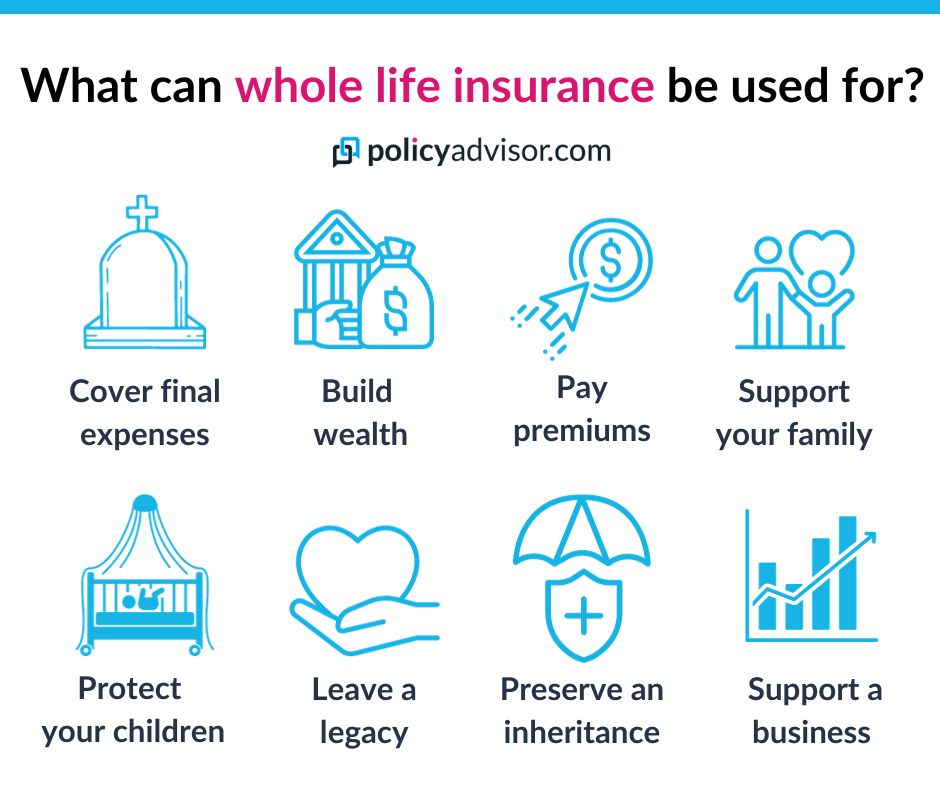
Whole life insurance can provide lifelong financial protection while offering features that go beyond a traditional term policy. It can be used for estate planning, leaving a legacy, covering final expenses, or building cash value. It comes as no surprise that many Canadians choose it for lifelong protection and tax-advantaged cash growth. This article explains whole life insurance and how it works so you can invest in a policy that keeps you and your loved ones protected.
Whole life insurance explained
Whole life insurance is a type of permanent life insurance that provides coverage for your entire life rather than a limited term. In exchange for regular premium payments, the insurer guarantees a generally tax-free death benefit (unless it exceeds the policy’s adjusted cost basis) to your beneficiaries when you pass away.
Unlike term life policies, whole life insurance also includes a guaranteed cash value component that accumulates over time. Depending on the policy you select, the plan may also earn annual dividends that can further supplement your death benefit and cash value. As a result, premiums are typically 7 to 10 times higher than those of comparable term life policies.
For example, a healthy non-smoker 30-year-old parent may be able to purchase $100,000 in term life coverage for somewhere between $10 per month. The same amount of coverage could cost around $70 per month for whole life insurance. While whole life policy costs significantly more, the higher premiums reflect its lifelong coverage, guaranteed cash value, and potential dividend growth.
Key features of whole life insurance:
| Feature | Details |
| How it works | Pay premiums to receive guaranteed lifetime coverage while building cash value |
| Coverage period | Lifetime |
| Cash value | Guaranteed cash value grows over time and may be accessed through policy loans or withdrawals |
| Death benefit | Generally tax-free payment to your beneficiaries |
| Dividends | Available on participating whole life policies (dividends are not guaranteed) |
| Premiums | Usually fixed for life or for a limited payment period |
| Typical coverage amounts | $25,000 to $10 million or more |
How does whole life insurance work in Canada?
Whole life insurance combines lifelong financial protection with a built-in savings component. As long as you continue paying your premiums, you remain covered for the entirety of your life. Additionally, a portion of your premiums contributes to your policy’s guaranteed cash value, which grows over time.
Here’s how a whole life insurance policy usually works:
Step 1: Choosing the right coverage amount: Choose a coverage amount that would secure the financial future of your family and protect your loved ones from outstanding debts or other costs. Many applicants choose anywhere between 7 and 15 times their annual income
Step 2: Choose your policy type: Next, you will select the type of whole life insurance that best aligns with your financial goals.
Step 3: Complete your application and pay your premiums: Once you have chosen your coverage amount and payment period, you will need to complete your application and name the beneficiary. Most applicants choose their close relatives, such as their spouse, children, or parents, as the beneficiary. Additionally, they can choose one or more beneficiaries
Step 4: Your policy builds cash value: One of the defining features of whole life insurance is the cash value. Each premium payment contributes toward a guaranteed cash value that grows over time on a tax-advantaged basis. Additionally, if you choose a participating whole life policy, you may earn dividends based on how the insurer performs financially
Step 5: Your beneficiaries receive the death benefit: If you pass away while your policy is active, your beneficiaries submit a claim to the insurance company. Once the claim is approved, the insurer pays the death benefit as a tax-free lump sum
Types of whole life insurance in Canada
While whole life insurance provides permanent coverage to policyholders as long as premiums are paid, many insurers offer the policy in different structures to suit different financial goals. The most common options are participating and non-participating, and limited-pay whole life insurance.
Participating whole life insurance
Participating whole life insurance is one of the most popular permanent life insurance policies in Canada. Alongside guaranteed lifetime coverage and cash value growth, eligible policies may also receive annual dividends based on the insurer’s financial performance.
These dividends can be used to purchase additional paid-up insurance, increase the policy’s cash value, reduce future premiums, or even repay policy loans. While the dividends are not guaranteed, most major Canadian insurers have historically paid them.
Best for: Participating whole life insurance is a good choice for those who are looking for long-term wealth accumulation and estate planning.
Non-participating whole life insurance
Non-participating whole life insurance provides guaranteed lifetime protection with fixed premiums and guaranteed cash value growth. However, unlike participating whole life policies, it does not pay dividends.
Since there is no dividend component, these policies are simpler and more predictable. The returns and death benefit are guaranteed when the policy is issued, providing greater certainty over the life of the policy.
Best for: This policy is well-suited for those looking for seeking predictable lifelong coverage.
Limited-pay whole life insurance
Limited-pay whole life insurance policies allow you to complete all premium payments within a predetermined period while keeping coverage for life. Common payment schedules include:
- 10 Pay
- 20 Pay
- Pay to Age 65
Although the premiums are higher since they are paid in a shorter period, policyholders no longer need to make payments once the policy becomes fully paid up. As the premiums are paid, the cash value increases on a tax-deferred basis if the policy is “exempt” under the Income Tax Act.
Once enough cash value has accumulated, you can borrow or withdraw from it (subject to policy rules) for retirement income, emergencies, or other financial needs. However, this may reduce the death benefit and cash value.
Best for: Those who want lifelong coverage but prefer to finish paying premiums within a set period.
What is a children’s whole life insurance policy?
Whole life insurance for children provides lifelong protection with added financial benefits such as growing cash value over time. Here’s why whole life insurance for children can be a smart choice:
- Cost-effective payments: Premiums for children’s whole life policies are generally lower, making it an affordable way to secure coverage for life. Since rates are locked in early, you avoid higher costs later
- Guaranteed lifetime coverage: Once a policy is in place, the child is covered for life, regardless of future health changes. As long as premiums are paid, the policy cannot be cancelled by the insurer.
- Securing insurability: Buying insurance early ensures that the child has coverage even if they develop health issues later. This helps avoid challenges in obtaining insurance as an adult
- Cash value that builds over time: Children’s whole life policies build cash value over time, offering a financial asset they can access later for education, a home, or other needs. The cash value grows tax-deferred, adding long-term benefits
How much whole life insurance coverage do you need?
You generally need whole life insurance coverage that is 10 times your salary. Choosing the right amount of whole life insurance depends on your financial goals and the needs of your loved ones. While it offers lifelong coverage and cash value growth, it’s essential to determine how much coverage will adequately protect your family.
Two common strategies to help you decide are the ‘Ten times salary’ and the ‘Years to retirement’ rules.
The ‘Ten Times Salary’ Rule: This rule suggests buying a policy with a death benefit equal to ten times your annual salary. For example, if you earn $80,000 per year, you would aim for a policy with an $800,000 death benefit. This method ensures that your family can maintain their current lifestyle, cover debts, and manage expenses in the event of your passing. It’s a straightforward approach that offers a solid financial cushion.
The ‘Years to Retirement’ Rule: This strategy focuses on covering your income until retirement. Multiply your annual income by the number of years left until you retire. If you earn $80,000 annually and plan to retire in 20 years, you would need $1.6 million in coverage. This method ensures that your family can replace your income until you’re no longer working.
Using the DIME method to estimate whole life insurance
Another method of calculating how much coverage you need is to use the debt, income, mortgage, and education (DIME) method. It is a simple way to estimate how much term life insurance you may need by considering four key financial obligations your family could face.
Let’s assume Michael, a 45-year-old business owner, wants to ensure his family is financially secure while also leaving an inheritance.
Here’s a projection of whole life insurance coverage using the DIME method:
| DIME Factor | Amount |
| Debt (credit card balance and personal loan) | $75,000 |
| Income replacement (10 years of annual income at $180,000) | $1,800,000 |
| Mortgage (remaining mortgage balance) | $600,000 |
| Education (future education savings for one child) | $150,000 |
| Total estimated life insurance needed | $2,625,000 |
Based on the DIME method, Michael may consider approximately $2.6 million in life insurance coverage. However, because he also wants to leave an inheritance and reduce the tax burden on his estate, he may choose a higher coverage amount through a whole life insurance policy.
While it is a handy index, your ideal coverage amount may differ based on factors such as savings, investments, and long-term financial goals.
Pros and cons of whole life insurance
How much does whole life insurance cost in Canada?
The cost of a whole life insurance policy ranges between $57 and $382. The premium depends on the policy type, coverage amount, and personal factors, such as gender, age, smoking status, and health.
Cost of $100,000 whole life insurance policy:
| Age (in years) | Male (Non-participating) | Male (Participating) | Female (Non-participating) | Female (Participating) |
| 20 | $70.74/month | $138.42/month | $57.24/month | $118.89/month |
| 30 | $100.35/month | $177.84/month | $88.74/month | $156.15/month |
| 40 | $141.66/month | $228.96/month | $127.53/month | $207.00/month |
| 50 | $223.83/month | $292.23/month | $181.71/month | $270.81/month |
| 60 | $319.41/month | $382.14/month | $277.92/month | $351.81/month |
*Illustrative monthly premiums for non-smoking males and females of various age ranges seeking a whole life insurance policy with $100,000 in coverage for a 20-pay premium option
How are whole life insurance premiums calculated?
Life insurance companies calculate your premium by assessing how likely you are to make a claim over the life of the policy. It is primarily based on your age, smoking status, health conditions, coverage amount, and other related factors.
Personal factors:
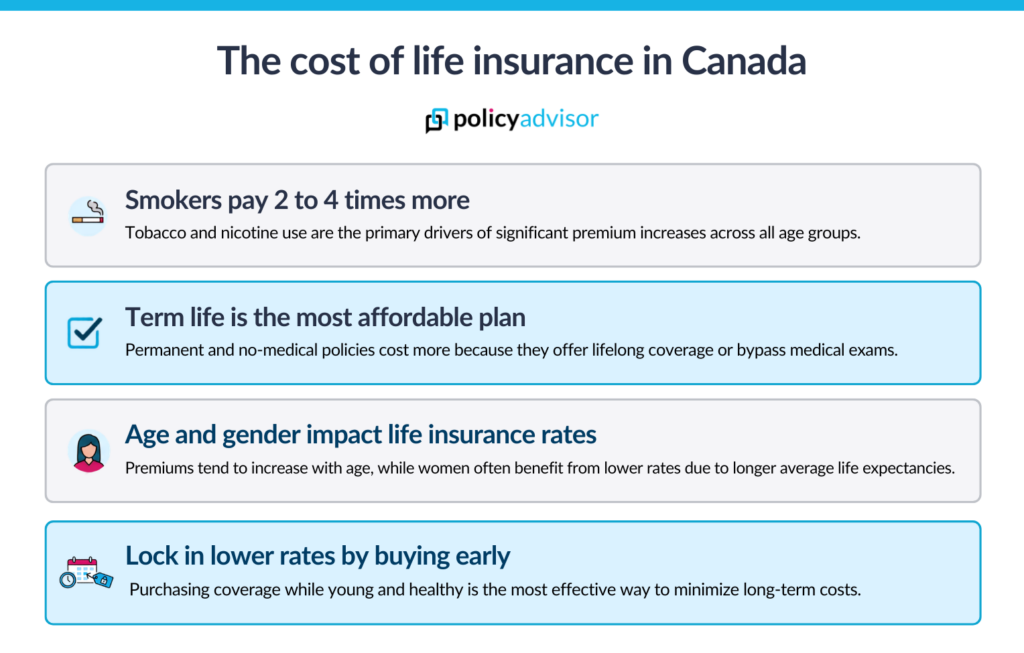
- Age: Younger applicants generally qualify for lower premiums. A 30-year-old male non-smoker pays $100.35/month for a non-participating policy with $100,000 in coverage, while a 40-year-old male non-smoker can pay $141.66/month
- Health: Good overall health can help you secure more favourable rates
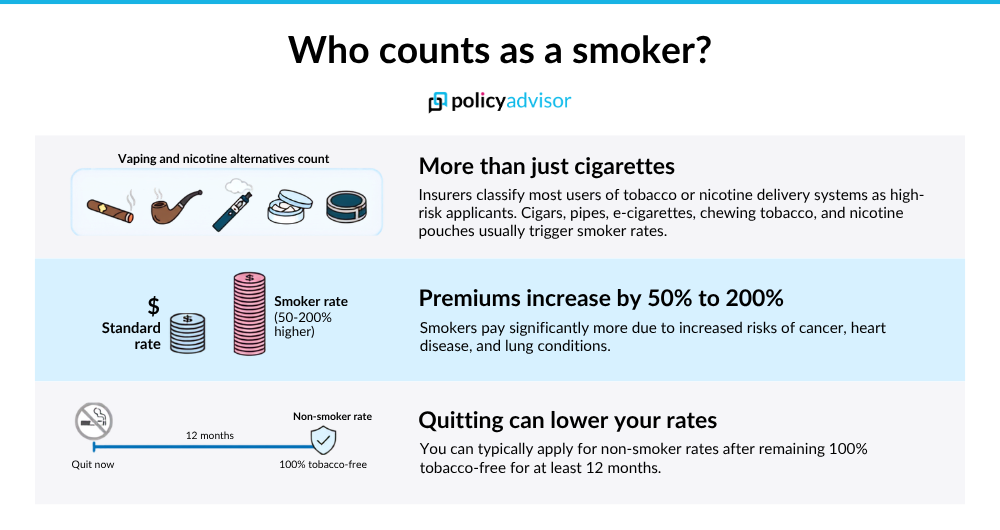
- Smoking status: Smokers and tobacco users typically pay significantly more than non-smokers
- Gender: Women often pay slightly lower premiums because they generally have longer life expectancies
- Occupation: High-risk occupations may increase premiums depending on the insurer
- Lifestyle and hobbies: Activities such as skydiving, scuba diving, or motor racing may result in higher rates
Policy and coverage factors:
- Coverage amount: Higher death benefits result in higher premiums. A $500k policy will cost more than a $250k whole life insurance policy
- Policy type: Participating whole life policies usually cost more than non-participating policies because of their dividend potential
- Payment period: Limited-pay policies often have higher annual premiums than lifetime-pay policies since payments are compressed into fewer years
- Policy riders: Optional add-ons, such as critical illness, child, or disability riders, increase the overall cost of your policy
- Payment frequency: Some insurers offer modest savings if you pay annually instead of monthly
How do whole life insurance premiums work?
A whole life insurance policy will offer coverage as long as you pay the premiums. Here’s how it works:
- The premiums will remain fixed, and the coverage remains active as long as you pay the premiums
- A part of the whole life insurance cost goes towards life insurance coverage, and the other part builds the cash value
- The greater the cash value, the more interest will be accrued, and the greater the cash value
Why is whole life insurance expensive?
Whole life insurance costs more than term life insurance because it provides lifetime coverage and builds cash value. Unlike term insurance, which covers you for a set period, whole life insurance is designed to pay a guaranteed death benefit whenever you die, provided the policy remains in force. Premiums also help fund the policy’s cash value and other guarantees, which contribute to the higher cost.
What is the cash value of whole life insurance?
Cash value in life insurance is essentially an accumulated savings component funded by a portion of the premiums you pay. This cash value amount grows over time at a guaranteed rate and can be accessed tax-deferred during your lifetime through policy loans, withdrawals, or even to cover premium payments.
It is also worth noting that this amount is separate from the death benefit. At death, beneficiaries receive the policy’s death benefit (base amount plus any paid‑up additions and dividends on deposit, minus loans/interest). The accumulated cash value generally remains with the insurer and is not paid out in addition to the death benefit.
How does cash value grow?
During the early years of the policy, a larger portion of your premium goes toward insurance costs and administrative expenses. As a result, the cash value grows gradually. However, as the policy matures, the cash value typically increases at a faster pace.
Additionally, if you own a participating whole life policy, annual dividends may further increase your cash value and death benefit. Unlike market-based investments, guaranteed cash value is not affected by volatility. This makes it a relatively stable long-term commitment.
How to use cash value in whole life insurance?
You can access the cash value of a whole life insurance policy by taking out a policy loan, making a partial withdrawal, using the cash to pay premiums, or fully surrendering the policy.
Each option has different tax implications and may affect your policy’s cash value or death benefit, so it’s important to understand how they work before accessing your policy.
Here’s an overview of how you can use the cash value of your whole life insurance policy:
| Method | How it works | Tax implications | Impact on policy |
| Policy loan |
|
|
|
| Cash withdrawal |
|
|
|
| Pay premiums |
|
|
|
| Surrender the policy |
|
|
|
What happens to cash value when the insured dies?
When the insured dies, the cash value is not paid out to the beneficiaries and is returned to the insurance company. In most whole life policies, the insurer pays the beneficiaries only the death benefit, while the accumulated cash value is generally not paid separately. The cash value, however, helps the insurer fund the guaranteed death benefit.
What are whole life insurance dividends?
If you purchase a participating whole life insurance policy, you may receive annual dividends from your insurer. These dividends are based on the performance of the insurer’s participating account and may be paid to eligible policyholders.
The dividends are issued when the participating account performs better than expected in terms of investment returns, claims experience, and operating expenses. Additionally, dividend scale interest rates and payouts vary by insurer and can change over time. While these amounts are not guaranteed, they add flexibility and long-term value to your policy
How to use your whole life insurance dividends?
Similar to the cash value component, you can use your dividends to purchase additional paid-up life insurance, receive cash payments, or even repay your outstanding policy loans.
- Paid-up additions: Purchase additional fully paid-up life insurance, increasing both cash value and the death benefit
- Cash payment: Receive the dividend directly as cash
- Premium reduction: Use dividends to pay some or all of your premium payments
- Deposit with the insurer: Leave dividends on deposit to earn interest, subject to the insurer’s rates
- Loan repayment: Apply dividends toward outstanding policy loans
Can you cancel your whole life insurance policy?
Yes, most whole life policies can be cancelled at any time. However, since these policies build cash value, cancelling them differs from cancelling a term life policy. If you surrender your whole life insurance policy, the insurer generally pays you the available cash surrender value after deducting any applicable surrender charges, outstanding policy loans, or unpaid interest. Once cancelled, your coverage ends, and your beneficiaries will no longer receive a death benefit.
Like most life insurance policies in Canada, whole life insurance also includes a free-look (cooling-off) period, typically lasting 10 to 30 days after you receive your policy. During this period, policyholders can review and cancel the policy, receiving a full refund of any premium paid.
What is your Whole Life Insurance worth?
Get instant quotes from Canada's top life insurance providers and find the perfect coverage for your family.
Powered by

What does whole life insurance not cover?
While whole life insurance covers natural and accidental death, there are certain exclusions and situations where a claim may be denied or the policy may become void.
Common exclusions and limitations include:
- Suicide: Most policies have a two-year suicide exclusion. If death occurs during this period, the death benefit is generally not paid, although premiums may be refunded
- Risky activities: Activities such as skydiving or scuba diving may result in higher premiums, standard coverage, or an exclusion, depending on the insurer’s underwriting assessment
- Fraud or misrepresentation: False or incomplete information on an application can result in claim denial or policy cancellation
- War and terrorism: Some policies may restrict or exclude coverage for deaths related to war, armed conflict, or terrorism
- Undisclosed medical conditions: Failing to disclose requested health information can lead to claim denial, policy cancellation, or the policy being declared void
Exclusions vary by insurer and policy. Review policy wordings for specific limitations and definitions that apply to your coverage.
What other types of life insurance can I get in Canada?
If you are looking for alternatives to whole life insurance, these are the other types of life insurance that you can get in Canada, such as term life insurance, term-to-100 insurance, universal life insurance, funeral insurance, and no-medical life insurance.
- Term life insurance: A type of life insurance that lasts for a certain number of years, called a term. Usually inexpensive and great for short-term needs
- Term-to-100 life insurance: A type of life insurance policy that covers you for your entire life, but does not have a cash value or investment component as whole life does
- Universal life insurance: A type of permanent life insurance that gives the policyholder more control over the investment part of the policy
- No-medical life insurance: A type of insurance coverage that does not require a medical exam, and can ask just a few or no health questions at all. Usually gives lifelong coverage but comes with a lot of downsides
How does whole life compare to other life insurance policies available?
Whole life insurance is one of the many types of life insurance available in Canada. Depending on your financial goals, you may also consider term life insurance, universal life insurance, or no-medical life insurance.
Here’s a quick overview of how whole life compares to other popular life insurance options:
| Feature | Whole life insurance | Term life insurance | Term to 100 insurance | Universal life insurance | No-medical life insurance |
| Coverage duration | Lifetime | Fixed term (e.g., 10, 20, or 30 years) | Lifetime (coverage to age 100) | Lifetime | Term or permanent |
| Premiums | Higher but generally fixed for life | Lowest and fixed during the term | Fixed until age 100 (or for life, depending on the policy) | Flexible within policy limits | Higher than comparable medically underwritten policies |
| Cash value | Yes (guaranteed growth) | No | No | Yes (investment-linked) | Usually, only if it is a permanent policy |
| Medical exam required | Usually required | Often required, but non-medical options are available | Usually required | Usually required | No medical exam required, but it has a waiting period |
| Investment component | Guaranteed cash value accumulation | None | None | Flexible investment options | Depends on the policy type |
| Death benefit | Guaranteed for life | Guaranteed if premiums are paid during the term | Guaranteed for life if premiums are maintained | Can be adjusted within policy rules | Guaranteed if policy terms are met |
| Policy flexibility | Moderate (cash value options with fixed coverage) | Limited (renew or convert before expiry) | Low | High (flexible premiums, investments, and death benefit) | Moderate, depending on the insurer and policy type |
| Best for | Estate planning, lifelong financial protection, and leaving an inheritance | Income replacement, mortgage protection, raising a family, and temporary financial obligations | Lifelong coverage without paying for cash value or investment features | High-income earners seeking lifelong coverage with investment flexibility | People with health conditions or those needing quick approval |
| Typical cost | Highest | Lowest | Lower than whole life but higher than term life | Higher than term; varies based on investment choices | Higher than comparable medically underwritten policies |
For a detailed comparison of the plans, check out the different types of life insurance in Canada.
Best whole life insurance providers in Canada
In Canada, you can buy whole life insurance from some of the best companies, including Sun Life, Canada Life, Equitable Life, Manulife, and a few others. The right insurer depends on your coverage amount, participating-account objectives, payment period, financial strength, underwriting, policy guarantees, and dividend history.
You can also read our blog on the best whole life insurance companies in Canada to compare the top options available. Here is a quick overview of some of the best companies you can consider:
- Equitable Life: A strong option for those who value a mutual-company structure and participating whole life coverage.
- Manulife: Offers multiple premium payment options, including 10-pay, 20-pay, pay-to-90, and pay-to-100, along with its Vitality Plus option
- Empire Life: Known for balanced whole life offerings through EstateMax and Optimax Wealth, with options for different long-term financial goals
- Sun Life: Offers high coverage amounts and flexible policy features that can suit high-net-worth estate planning needs.
- Foresters Financial: Offers competitive whole life options for smokers, including a Quit Smoking Incentive
Is whole life insurance worth it?
Yes, whole life insurance can be worth it if you are seeking lifelong financial protection, guaranteed cash value growth, and estate planning benefits. Unlike term life insurance, whole life insurance is not designed solely to replace your income for a limited period. It provides permanent financial protection while building cash value, in exchange for comparatively higher premiums.
Who is whole life insurance best suited for?
Whole life insurance is a good choice for those who:
- Want guaranteed lifetime coverage
- Want to leave a tax-free inheritance for your family
- Need funds to cover estate taxes or final expenses
- Have dependents who will rely on your financial support
- Want to build guaranteed cash value over time
Who may not need whole life insurance?
Whole life insurance may not be an ideal choice if:
- Your priority is affordable coverage at lower premiums
- You want temporary coverage
- You have limited financial obligations
Can whole life insurance be used for corporate business planning?
Yes, whole life insurance can be used for corporate and business planning in Canada, particularly by incorporated business owners. With a corporate-owned life insurance (COLI) policy, the corporation owns and pays the premiums and is generally named as the beneficiary.
The policy can help with business succession, shareholder agreements, estate planning, and providing liquidity to cover financial obligations when an insured business owner dies. Depending on the policy structure, the corporation may also build cash value that can support longer-term financial planning.
Is whole life insurance tax deductible?
While premiums paid for personal whole life insurance aren’t tax deductible, the policy offers several tax advantages, such as:
- Tax-deferred cash value growth: Whole life policies entail a cash value component that grows on a tax-deferred basis. That means you won’t incur taxes on the cash value growth until you withdraw it
- Tax-free death benefit: The death benefit paid to beneficiaries isn’t taxable
- Tax-free loans against cash value: If you borrow against your whole life policy’s cash value, the loan amount isn’t subject to taxes
- Tax-free interest-earning deposits: If you choose to receive your annual dividends in an interest-earning deposit, they remain tax-free unless withdrawn
How many years do you pay on a whole life policy?
The number of years you pay for a whole life insurance policy depends on the payment structure chosen at the time of purchase. Typically, whole life policies offer lifetime payments, limited payments, or single-premium policies.
- Lifetime payments: You pay premiums throughout your entire life to keep the policy active. This option spreads the cost over time, resulting in lower annual premiums
- Limited payment policies: You pay premiums for a set number of years, such as 10, 20, or 30 years, or until a specific age (like 65). After this period, the policy is fully paid, but coverage continues for life
- Single premium: You make a one-time lump sum payment upfront, and the policy remains active for your lifetime without any further premiums
Do you get your money back at the end of a whole life insurance?
No, you don’t get your premiums back at the end of a whole life policy. Instead, you get a cash surrender value that depends on the total cash value minus any applicable charges that the insurer may levy.
If your policy has a cash value of $50,000 and has accumulated $5,000 in dividends, but has $2,000 in surrender charges, your cash surrender value would be $53,000. This is calculated in the following way:
$50,000 + $5,000 – $2,000 = $53,000.
The cash value can be withdrawn or used as collateral for a loan. The death benefit is paid to beneficiaries upon your passing, provided the policy remains active.
Does your money grow in Canadian whole life insurance?
Yes, your money grows in a whole life insurance policy through its cash value component. It not only provides lifelong protection but also builds cash value over time.
A portion of your premiums is allocated to this cash value, which grows at a guaranteed rate, often supplemented by dividends if you have a participating policy.
The cash value can serve as a valuable financial resource; you can borrow against it, use it for future premiums, or even access it for retirement or other expenses.
This growth is tax-advantaged, meaning you won’t pay taxes on the cash value growth as long as it remains within the policy. Whole life insurance offers both security and a way to build wealth over time, making it a popular choice for Canadians seeking long-term financial planning.
Do you need a medical exam for whole life insurance?
In many cases, yes. Most traditional whole life insurance policies in Canada require medical underwriting, particularly if you are applying for a higher coverage amount. Depending on your age, health, and smoking status, insurers may require you to take tests to assess your health conditions.
However, many insurers also offer simplified issue and guaranteed acceptance whole life insurance with little or no medical underwriting. It is worth noting that simplified issue and guaranteed issue whole life insurance policies will typically have lower coverage limits and higher premiums, compared to traditional policies with medical underwriting.
What age to get whole life insurance?
Although there is no ideal age to get a whole life policy, the sooner you buy one, the better it will be for you. The youngest age limit to get life insurance in Canada is 18 years. Starting early on it can have certain benefits such as:
- Lower premiums: Premiums are significantly cheaper when you’re young and healthy
- Guaranteed coverage: Secures lifelong coverage, even if health conditions develop later
- Builds cash value early: More time for your policy to accumulate cash value, creating a financial safety net
- Long-term savings: Spread costs over a longer period, making it more affordable
- Future financial security: Provides stability for dependents and can be used for estate planning or retirement
Case study: A whole life insurance example
Let’s look at how whole life insurance works in a real-world example. John is a 30-year-old Canadian who’s thinking about estate planning. He wants lifetime insurance coverage so he can leave a financial benefit for his family after he dies.
The chart below shows the cash value of his policy over time.
- Age: 30
- Gender: Male
- Policy type: Whole life (non-participating)
- Death benefit: $250,000
- Annual premium: $1,565
- Payment type: Life pay (premiums paid annually for life)
| Features | Whole life insurance |
| Cash value | Yes |
| Dividends | No, non-participating policies do not pay dividends |
| Premiums | Typically fixed for the life of the policy |
| Death benefit | Paid tax-free to the beneficiary |
| Cash value access | May be accessed through a policy loan, withdrawal, or surrender, subject to the policy terms and potential tax consequences |
Figures are based on an insurance illustration for a Desjardins non-participating whole life policy purchased through PolicyAdvisor.com for a 30-year-old male in normal health.
John can access the cash value of his policy during his lifetime, subject to the policy’s terms. However, accessing the cash value can reduce the policy’s value or death benefit and may have tax implications.
How to find the right whole life insurance policy?
Choosing the right whole life policy requires careful consideration of several factors to ensure it aligns with your financial goals. Here’s a step-by-step guide to help you make an informed decision:
- Choose the amount of coverage you need: Determine how much coverage will adequately protect your family. Consider factors like income replacement, debt, future expenses, and long-term financial goals
- Examine riders: Riders are optional add-ons that enhance your policy. Popular options include critical illness coverage, waiver of premium, and accelerated death benefits. Assess which riders suit your needs
- Look at the rate of return on cash value: Whole life policies build cash value over time. Evaluate the guaranteed rate of return and any potential dividends if you’re considering a participating policy
- Be aware of surrender charges: If you cancel your policy early, surrender charges may apply. Understand these fees and how long they last to avoid surprises
- Understand the different approval processes: Some policies require a medical exam, while others offer simplified or guaranteed issue options. Choose the process that best suits your health status and preferences
- Check the insurer’s financial strength: A financially strong insurer is more likely to meet its long-term obligations. Review ratings from agencies like AM Best or Moody’s to gauge stability
- Speak with our advisors: Our experienced advisors help you compare life insurance quotes from 30+ top insurers across Canada so you can choose a plan that best meets your needs
Frequently asked questions
How long does it take to build cash value?
Cash value begins accumulating once your policy is in force, although growth is generally slower during the first few policy years. It typically accelerates over the long term. The timing and amount of cash value growth depend on the specific policy, premium structure, and whether the policy is participating or non-participating.
Are whole life insurance dividends guaranteed?
No, dividends are only available on participating whole life policies and are not guaranteed. They depend on the insurer’s financial performance. Insurers determine dividends based on factors such as the performance of the participating account, investment results, mortality experience, and expenses. An insurer’s historical dividend payments do not guarantee future payments.
Can I have more than one whole life policy?
Yes, many Canadians own multiple life insurance policies to meet different financial needs. Having multiple policies can help address different financial needs, such as estate planning, business protection, or leaving an inheritance. You may also combine permanent coverage with a term life policy when you need additional coverage for a specific period, such as while raising children or paying a mortgage.
Can I get life insurance riders with whole life insurance?
Yes, you can enhance a whole life insurance policy by adding riders, depending on the options your insurance provider offers. Commonly available riders include a term rider, child rider, accidental death and dismemberment benefit rider, guaranteed insurability rider, return of premiums rider, critical illness rider, and disability waiver of premiums rider, among others.
What happens if I miss a premium payment on my whole life insurance policy?
Missing a premium payment on your whole life policy can have varying consequences depending on the policy’s terms. Many policies include a grace period, typically 30 days, during which coverage remains active. If you fail to pay within this window, the insurer may use the policy’s cash value to cover premiums. If no cash value is available, the policy may lapse, leading to a loss of coverage. Some policies offer options like automatic premium loans to prevent lapses.
Can I use my whole life insurance policy as collateral for a loan in Canada?
Yes, you can use your whole life insurance policy as collateral for a loan, thanks to its cash value component. Many Canadian lenders accept this arrangement, allowing you to borrow against your policy. Alternatively, you can take a policy loan directly from the insurer. In both cases, it’s important to maintain the policy and repay the loan to avoid reducing the death benefit or risking a policy lapse.
How soon can I cash out my whole life insurance policy?
It depends on your provider. Most Canadian companies will let you access your policy’s cash value on the anniversary after 5 or more years. This depends on whether you want to withdraw it, borrow against it, or access it any other way. But you may want to wait. The longer you let whole life insurance cash value accumulate, the bigger the amount you can use and the more benefit you can have.
How much can I borrow from a whole life policy?
You can normally borrow up to 90% of your policy’s cash value if you want to take out a policy loan directly from your insurance provider. If you want to borrow from a bank or lender and just use your policy as loan collateral, you can borrow up to 100% of the premiums you paid.
How long does whole life insurance last?
Whole life insurance is designed to provide coverage for the insured’s entire lifetime, rather than for a fixed term. The policy remains in force as long as its requirements are met, such as paying premiums when due or maintaining sufficient policy value where applicable.
Should you buy whole life insurance for your child?
Yes, many Canadian parents and grandparents purchase whole life insurance for children to give them lifelong coverage at a young age. Buying coverage while a child is young can lock in lower premiums for life, guarantee their future insurability regardless of changes in health, and begin building cash value that they can access later in life, subject to the policy terms.