
Best whole life insurance companies in Canada (2026)

Choosing from the best whole life insurance companies in Canada feels overwhelming; there are dozens of insurers, each claiming strong performance and long-term value. 

Dozens of insurers offer participating policies, each promising strong dividends, long-term cash value growth, and flexible coverage options.

To identify the best whole life insurance companies in Canada for 2026, our team reviewed financial strength, dividend performance, cash value growth, product flexibility, and customer experience.

Based on our review, the following five companies stand out for their combination of strong performance and flexible plans, with the remaining providers covered later in our full comparison.

Top 5 whole life insurance companies in Canada (2026)

  1. Equitable Life: Best mutual insurer
  2. Manulife: Best for overall performance
  3. Empire Life: Best for balanced performance
  4. Sun Life: Best for high-net-worth individuals
  5. Foresters: Best coverage for smokers

What is whole life insurance?

A whole life insurance policy is a type of permanent life insurance that provides lifelong coverage. It offers a guaranteed, tax-free death benefit and includes a built-in investment component that grows cash value over time. With a participating whole life policy, you receive dividends, although the amount is not guaranteed.

Most people choose whole life insurance in Canada to support estate planning, cover capital gains taxes at death, and leave a tax-free inheritance, while also handling final expenses and probate fees.

Learn about whole life insurance

See how much whole life insurance coverage you can get

Get instant quotes from Canada's top life insurance providers and find the perfect coverage for your family.

$100K

How does whole life insurance work?

Whole life insurance provides coverage for life,  cash value component, optional dividends on par plans, and access to funds via loans/withdrawals. Dividends are not guaranteed and past performance doesn’t predict future results. Here’s how whole life insurance works. 

  • Lifetime coverage: You’re covered for life as long as premiums , and your beneficiaries receive a guaranteed tax-free death benefit
  • Cash value growth: Part of each premium goes into a cash value account that grows tax-deferred and becomes a long-term asset you can use for education costs, emergencies, or retirement income
  • Access to funds: You can access the accumulated cash value through policy loans or withdrawals for added financial flexibility, such as covering emergencies, education, or retirement income
  • Dividends : Some participating policies pay dividends you can use to reduce premiums, buy more coverage, or take as cash
  • Financial security: The policy provides stable long-term protection, covering final expenses and supporting your family with guaranteed benefits

The best whole life insurance companies in Canada 

Our team reviewed leading Canadian insurers based on financial strength, dividend history, cash value growth, and underwriting to determine the best whole life insurance companies across different needs and profiles.

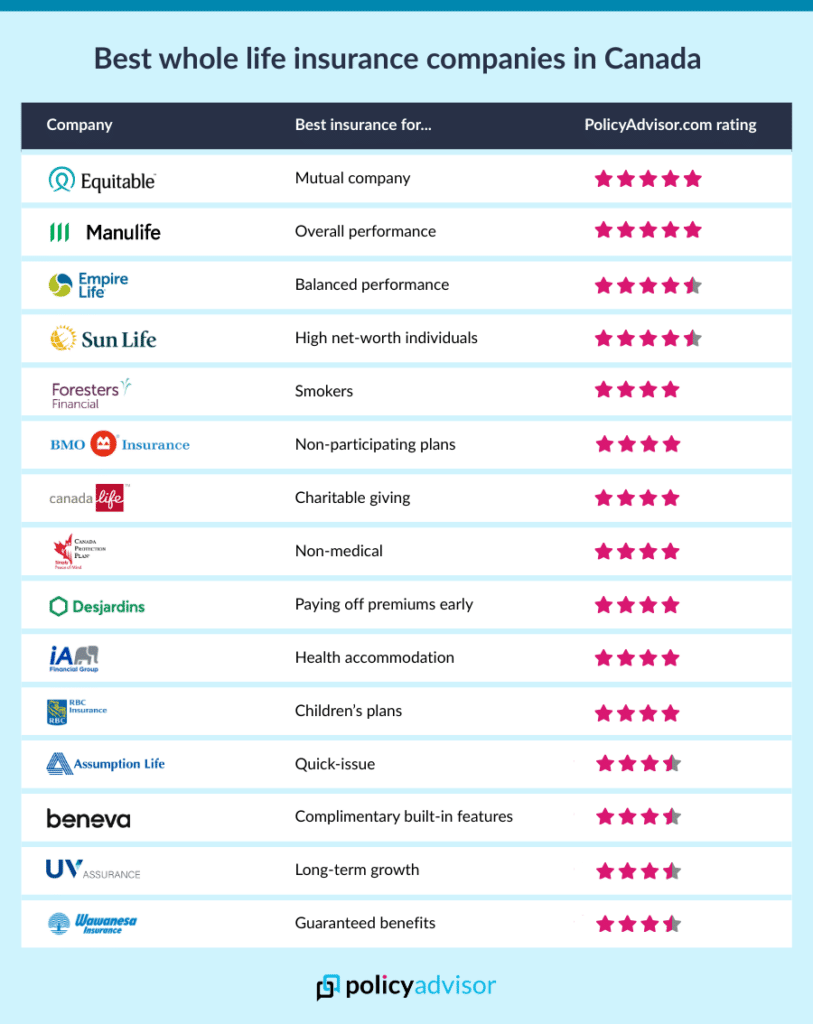
15 best whole life insurance companies in Canada

  1. Equitable Life: Mutual company
  2. Manulife: Overall performance
  3. Empire Life: Balanced performance
  4. Sun Life: High-net-worth individuals
  5. Foresters: Smokers
  6. BMO Insurance: Non-participating plans
  7. Canada Life: Charitable giving
  8. Canada Protection Plan: Non-medical
  9. Desjardins: Early and flexible pay-off
  10. iA (Industrial Alliance): Health accommodation
  11. RBC Insurance: Children’s plans
  12. Assumption Life: Quick-issue
  13. Beneva: Complimentary built-in features
  14. UV Insurance: Long-term growth
  15. Wawanesa: Guaranteed benefits

Let’s take a closer look at what makes these whole life insurance companies among the best in Canada.

Best Whole Life Insurance in Canada 2026

1. Equitable Life: Best for mutual company

Best for mutual company
☆☆☆☆☆
★★★★★
PolicyAdvisor rating
Plans offered
Equimax Estate Builder
Equimax Wealth Accumulator
Payment options
10-pay
20-pay
pay-to-100
A.M. Best financial strength rating
N/A
Dividend Scale Interest Rate (DSIR)
6.40%

PolicyAdvisor Rating

We give Equitable Life 5/5 because it stands out as one of Canada’s strongest whole life providers, particularly for Canadians who value the long-term security of a true mutual company.

The company supports its participating plans, Equimax Estate Builder and Equimax Wealth Accumulator, with a growing $2.73 billion par fund, demonstrating its financial strength and commitment to stable, long-term results. Both plans offer 10-pay, 20-pay, and pay to 100 options.

Equimax Wealth Accumulator is built for earlier cash value access, making it ideal for clients who want flexible liquidity for education, business needs, or retirement planning. Conversely, Equimax Estate Builder emphasizes long-term value and supports estate planning by helping cover taxes and fees at death.

New Equimax participating whole life policies include Equitable’s built-in KIND program. It provides compassionate and snap advances, access to policy cash value in cases of severe disability, and bereavement counselling benefits.

Equitable Life’s key financial strengths:

  • $2.73 billion participating fund
  • 6.40% dividend scale interest rate
  • Dividend rate above 6% for more than 12 years
  • 30-year average return of 7.59%
  • Exceptionally low 1.25% standard deviation over 30 years, one of the most stable in Canada
  • Par fund asset mix: 49% fixed income, 38% non-fixed income, 2% cash, 11% policy loans
  • Long-term smoothing approach that reduces market volatility and supports consistent dividend results

Why choose Equitable Life 

  • Delivers extremely stable long-term returns and minimizes volatility
  • Strengthens long-term growth through a highly diversified par-fund portfolio
  • Directs profits back to policyholders through its mutual ownership structure
  • Achieves strong investment performance through disciplined, conservative par-fund management

Unique selling point (USP): Equimax Estate Builder and Equimax Wealth Accumulator suit Canadians who want stable long-term value, reliable dividends, and accessible cash value backed by a trusted mutual insurer.

Cash Accumulation

Equimax Estate Builder: Slower early growth; strong long-term value

Equimax Wealth Accumulator: Faster early growth; accessible earlier

Dividend Options

Paid-up additions (PUA), enhanced coverage, cash, premium reduction, and deposit

2. Manulife: Best for overall performance

Best for overall performance
☆☆☆☆☆
★★★★★
PolicyAdvisor rating
Plans offered
Manulife Par
Manulife Par with Vitality Plus
Performax Gold
Payment options
10-pay
20-pay
pay-to-100
A.M. Best financial strength rating
A+
Dividend Scale Interest Rate (DSIR)
6.35%

PolicyAdvisor Rating

We give Manulife 5/5 for being the top choice for Canadians seeking whole life insurance backed by exceptional capital strength, global diversification, and advanced risk management

Manulife Par, Manulife Par with Vitality Plus, and Performax Gold plans provide lifetime coverage with 10-pay, 20-pay, and pay to 100 options. A $15.98 billion participating account backs the plans, supporting long-term guarantees, stable dividends, and reliable performance for policyholders.

Manulife Par focuses on stable long-term growth with guaranteed premiums, immediate cash value buildup, and annual dividend payouts. Manulife Par with Vitality Plus offers strong early guaranteed cash values while also providing access to the Manulife Vitality program, which rewards healthy living with perks and member benefits. Program features vary by eligibility and do not reduce premiums for participating whole life. Performax Gold provides additional flexibility for clients seeking a blend of guaranteed protection and dividend-driven long-term value. 

Manulife’s key financial strengths and performance:

  • $15.98 billion participating account
  • 6.35% dividend scale interest rate
  • 138% LICAT ratio, among the highest capital strength levels in Canada
  • Diversified global operations across Canada, the U.S., Asia, and global asset management
  • Strong balance sheet supported by investment-grade assets
  • Disciplined risk-management framework that supports long-term financial stability

Why choose Manulife

  • Maintains exceptionally strong capitalization that supports long-term dividend stability
  • Reduces performance volatility through global geographic and asset diversification
  • Generates consistent profitability through strong core earnings and disciplined risk management
  • Enhances sustainability through advanced underwriting analytics and the Vitality program

Unique selling point (USP): Manulife Par, Manulife Par with Vitality Plus, and Performax Gold are ideal for Canadians who want affordable lifetime coverage with flexible payment terms, and steady cash value. 

Cash Accumulation

Manulife Par: Cash value starts after 1 year

Manulife Par with Vitality Plus: Cash value starts after 1 year; includes Vitality benefits

Performax Gold: Cash value starts after 5 years (slower early buildup)

Dividend Options

Paid-up additions (PUA), enhanced coverage, cash, premium reduction, and deposit

3. Empire Life: Best for balanced performance

Best for balanced performance
☆☆☆☆☆
★★★★★
PolicyAdvisor rating
Plans offered
EstateMax
Optimax Wealth
Payment options
8-pay
10-pay
20-pay
pay-to-100
A.M. Best financial strength rating
A
Dividend Scale Interest Rate (DSIR)
6.25%

PolicyAdvisor Rating

We give Empire Life 4.5/5 because its whole life plans offer balanced, steady performance, making it a top choice for Canadians seeking reliable long-term value. The company backs its participating plans, EstateMax and Optimax Wealth, with a disciplined $1.21 billion par fund renowned for stability and long-term results.

EstateMax is built for conservative estate growth, offering steady dividend performance and strong long-term accumulation. In comparison, Optimax Wealth provides smoother, more predictable cash value growth over time, giving policyholders reliable access to liquidity while maintaining long-term security.  EstateMax is available with 20-pay and pay to 100 premium options. Optimax Wealth offers flexible payment structures, including 10-pay, 20-pay, and pay to 100. Empire Life also offers Solution Series, a non-participating plan with a 10-pay option.

Empire Life’s key financial strengths:

  • $1.21 billion participating fund with a stability-focused investment approach
  • 6.25% dividend rate
  • Dividend history above 6% for more than 10 years
  • 30-year average return of 6.97%
  • Par fund asset mix: 64% bonds, 29% equities, 7% cash/other
  • Long-duration bond structure with smoothing to reduce volatility

Why choose Empire Life:

  • Delivers stable long-term value growth and reduces volatility
  • Maintains reliable dividend performance that supports confident planning
  • Builds strong cash value and provides access to liquidity over time
  • Supports conservative estate planning and predictable long-term growth needs

Unique selling point (USP): EstateMax and Optimax Wealth are ideal for Canadians seeking stable cash accumulation and steady dividend performance.

Cash Accumulation

EstateMax: Steady long-term growth

Optimax Wealth: High early cash values

Dividend Options

Paid-up additions (PUA), enhanced coverage, cash, premium reduction, and deposit

4. Sun Life: Best for high-net-worth individuals

Best for high-net-worth individuals
☆☆☆☆☆
★★★★★
PolicyAdvisor rating
Plans offered
Sun Par Protector II
Sun Par Accumulator II
Sun Par Accelerator
SunSpectrum Permanent Life II
Payment options
8-pay
10-pay
15-pay
20-pay
pay-to-100
A.M. Best financial strength rating
A+
Dividend Scale Interest Rate (DSIR)
6.25%

PolicyAdvisor Rating

We give Sun Life 4.5/5 for being a leading choice for high-net-worth Canadians who want whole life insurance backed by exceptional global diversification and long-term financial strength. Sun Life backs its Par Protector II, Par Accumulator II, and Par Accelerator with a $21.2 billion par fund. This fund supports more than 400,000 active participating policies, making it one of the strongest par structures in Canada.

The Protector II and Accumulator II provide flexible payment options, including 10-pay, 15-pay, 20-pay, and pay-to-age-100, while the Sun Par Accelerator comes with a 8-pay premium option that is fully paid in just eight years. Accumulator II emphasizes early cash-value growth, allowing easier access to funds for investments, business needs, or other financial goals through policy loans or withdrawals. Meanwhile, Protector II focuses on maximizing long-term death benefits for estate and legacy planning. Accelerator builds cash value quickly, giving policyholders faster access to funds. 

For those preferring non-participating plans, SunSpectrum Permanent Life II also offers 10-pay, 20-pay, and pay to 100 payment structures.

Sun Life’s key financial strength

  • $21.2 billion participating account
  • 6.25% dividend scale interest rate
  • 154% LICAT ratio, one of the strongest among major Canadian insurers
  • Global earnings diversification across Canada, the U.S., Asia, and asset-management operations
  • Consistent profitability supported by strong insurance and wealth-management businesses

Why choose Sun Life

  • Strengthens long-term performance through global diversification and multi-market earnings stability
  • Supports long-term guarantees with exceptional capital strength and a 154% LICAT ratio
  • Offers flexibility through multiple par product designs, including estate, accumulation, and 8-pay options
  • Provides scalable planning advantages for affluent and corporate clients seeking tax-efficient wealth transfer and surplus management

Unique selling point (USP): Sun Par Protector II, Sun Par Accumulator II, and Sun Par Accelerator suit Canadians who want lifetime protection paired with strong cash-value potential and effective estate planning.

Cash Accumulation

Sun Par Protector II:  Cash value starts after 5 years

Sun Par Accumulator II: Cash value starts after 1 year

Sun Par Accumulator II:  Cash value starts after 1 year

Dividend Options

Paid-up additions (PUA), enhanced coverage, cash, premium reduction, and deposit

5. Foresters Financial: Best for smokers

Best for smokers
☆☆☆☆☆
★★★★★
PolicyAdvisor rating
Plans offered
Advantage Plus II
Non-Par Whole Life
Payment options
10-pay
20-pay
pay-to-100
A.M. Best financial strength rating
A
Dividend Scale Interest Rate (DSIR)
6.25%

PolicyAdvisor Rating

We give Foresters Financial 4/5 for being a top choice for smokers and former smokers, who need more flexible underwriting. The insurer leverages a strong Canadian capital position, including a Life Insurance Capital Adequacy Test (LICAT) ratio of 182% and $2.1 billion in surplus. This robust financial strength enables Foresters to accept higher-risk applicants while actively maintaining dependable long-term guarantees and stable dividends.

Advantage Plus II offers early cash value accessibility, dependable long-term guarantees, and dividend-driven growth, making it an attractive option for Canadians who may face stricter underwriting at larger insurers. Foresters Non-Par Whole Life offers guaranteed cash value.

Foresters’ key financial strengths:

  • $2.1 billion in surplus / net assets supporting long-term claims and guarantees
  • 182% LICAT ratio, demonstrating excellent capital adequacy
  • Member-owned structure where profits support policyholders rather than shareholders

Why choose Foresters:

  • Offers flexible underwriting for smokers and former smokers
  • Maintains strong financial resilience with a 182% LICAT ratio and $2.1 billion surplus
  • Operates a member-first fraternal model that directs value back to policyholders
  • Provides additional member benefits including wellness rewards, scholarships, community grants, and family support programs

Unique selling point (USP): Advantage Plus II is an attractive option for Canadians who may face stricter underwriting at larger insurers.

Cash Accumulation

Advantage Plus II: Cash value starts after 1 year

Foresters Non-Par Whole Life: Guaranteed cash values; slower growth


Dividend Options

Paid-up additions (PUA), enhanced coverage, cash, premium reduction, and deposit

6. BMO: Best for non-participating whole life insurance

Best for non-participating whole life insurance
☆☆☆☆☆
★★★★★
PolicyAdvisor rating
Plans offered
Estate Protector
Wealth Accelerator
Payment options
10-pay
20-pay
pay-to-100
A.M. Best financial strength rating
A
Performance bonus rate
5.75%

PolicyAdvisor Rating

We give BMO 4/5 because its non-participating whole life plans make it a reliable choice for Canadians seeking guaranteed values, predictable premiums, and no dividend-related volatility. The company offers two plan options, Estate Protector and Wealth Accelerator, both of which exclude a participating account or dividends. These plans set themselves apart with a Performance Bonus (5.75%), increasing both the death benefit and cash value without relying on traditional dividends. BMO supports its policies with a robust insurance net income of $95 million.

Estate Protector is designed for long-term estate planning, offering strong guaranteed cash value growth and a steadily increasing death benefit to help preserve wealth and offset taxes at death (e.g., deemed disposition and probate fees). Wealth Accelerator provides faster guaranteed cash value accumulation and higher early liquidity, making it an attractive option for business owners and high-income earners who want accessible long-term value. Both plans are available with 10-pay, 20-pay, and pay to 100 premium options.

BMO’s key financial strengths

  • $95 million net  insurance  income
  • 5.75% Performance Bonus Rate used to enhance non-participating whole life policy values (not a DSIR and not guaranteed)
  • Operates within BMO Wealth Management, supported by diversified earnings and enterprise-wide risk management

Why choose BMO 

  • Supports long-term financial stability by consistently growing insurance profitability
  • Strengthens guaranteed policy values through a competitive 5.75% performance bonus rate
  • Enhances stability through diversified revenue sources and favorable business performance
  • Benefits from operational scale and strong risk oversight within BMO’s wealth-management platform

Unique selling point (USP): Estate Protector and Wealth Accelerator are ideal for Canadians who want lifetime coverage with guaranteed values, predictable performance, and payment flexibility.

Cash Accumulation

Estate Protector: Strong guaranteed cash values; long-term estate growth

Wealth Accelerator: Faster liquidity; quicker cash value access


Dividend Options

Not available. BMO offers a performance bonus that is used to buy additional paid-up insurance coverage (Paid-up additions)

7. Canada Life: Best for charitable giving

Best for charitable giving
☆☆☆☆☆
★★★★★
PolicyAdvisor rating
Plans offered
Estate Select
Wealth Select
My Par Gift
Payment options
10-pay
20-pay
pay-to-100
A.M. Best financial strength rating
A+
Dividend Scale Interest Rate (DSIR)
5.75%

PolicyAdvisor Rating

We give Canada Life 4/5 because it is a leading choice for Canadians who want to use whole life insurance to support charitable giving. Its My Par Gift plan is specifically designed for charitable contributions, with a single premium and cash value starting from year 1.

Canada Life’s participating lineup, Estate Select, Wealth Select, and My Par Gift, is backed by one of the largest and most stable participating accounts in the country. It’s anchored by a $61.9 billion par fund, the largest in Canada. The company also has about 1.4 million participating life insurance policies in force.

Estate Select focuses on long-term growth, helping maximize the death benefit for estate planning. Wealth Select, on the hand, is designed for earlier cash value access, allowing for withdrawals or policy loans when needed. Both plans come with flexible payment options, including 10-pay, 20-pay, and pay to 100.

Canada Life’s key financial strengths

  • $61.9 billion participating account, the largest par fund in Canada
  • 5.75% Dividend Scale Interest Rate, supporting long-term dividend stability
  • Disciplined investment governance, guided by formal policies that address liability matching, liquidity needs, tax considerations, and interest-rate risk
  • Strong asset-liability management (ALM) using cash-flow matching to ensure long-term obligations to policyholders are met
  • Diversified asset mix with 60.0% fixed income and 30.7% non-fixed income (real estate, public equity, private equity)

Why choose Canada Life

  • Delivers exceptional long-term stability through Canada’s largest par fund ($59.2B) and deep diversification
  • Supports resilient investment performance using a balanced asset mix designed to generate stable returns across market cycles
  • Reduces volatility through disciplined ALM and cash-flow matching practices that protect DSIR sustainability
  • Preserves long-term policyholder value with strict investment parameters and governance oversight

Unique selling point (USP): My Par Gift suits Canadians who want charitable giving with single-premium simplicity.

Cash Accumulation

Estate Select: Cash value starts in year 1, with a focus on long-term growth and maximizing the death benefit for estate planning

Wealth Select: Cash value starts in year 1, with earlier cash value access through withdrawals or policy loans

My Par Gift: Cash value builds over time, with access for the charity through withdrawals or policy loans


Dividend Options

Paid-up additions (PUA), enhanced coverage, cash, premium reduction, and deposit

8. Canada Protection Plan: Best for non-medical whole life insurance

Best for non-medical whole life insurance
☆☆☆☆☆
★★★★★
PolicyAdvisor rating
Plans offered
Express Elite
Simplified Elite
Guaranteed Acceptance Life
Deferred Life
Payment options
10-pay
20-pay
pay-to-100
A.M. Best financial strength rating
N/A
Dividend Scale Interest Rate (DSIR)
N/A

PolicyAdvisor Rating

We give Canada Protection Plan (CPP) 4/5 for being a leading choice for Canadians who want whole life insurance without medical exams, offering fast approvals and guaranteed lifetime coverage. Its non-participating whole life lineup, Express Elite, Simplified Elite, Guaranteed Acceptance Life, and Deferred Life, provides predictable premiums, stable cash values, and simplified underwriting for applicants with various health profiles. As part of Foresters Financial, Canada Protection Plan is backed by a  Life Insurance Capital Adequacy Test (LICAT) ratio of 182% and consolidated surplus of $2.1 billion, giving policyholders confidence in the company’s long-term financial strength and the security of their coverage.

Canada Protection Plan’s key financial strengths:

  • Backed by Foresters Financial, benefiting from a 182% LICAT ratio and $2.1 billion in consolidated surplus that supports long-term guarantees
  • $630 million in claims paid, demonstrating strong and reliable claims fulfillment
  • Member-focused structure, reinvesting surplus into member programs, scholarships, and community support

Why choose Canada Protection Plan

  • Delivers leading access to coverage as Canada’s largest provider of no-medical life insurance
  • Approves a wide range of health profiles, serving smokers, chronic-condition applicants, and higher-risk clients
  • Provides predictable long-term costs through fully guaranteed non-participating plans with no dividend risk
  • Supports applicants who were previously declined, offering strong impaired-risk options
  • Expands accessibility with higher maximum issue ages and a Quit Smoking incentive
  • Simplifies the process with fast approvals, e-signatures, and a digital application system

Unique selling point (USP): An ideal choice for Canadians who want whole life insurance without medical exams, offering fast approvals and guaranteed lifetime coverage.

Cash Accumulation

Guaranteed Acceptance Life: Cash values begin after policy year 5

Deferred Life: Cash values begin after policy year 5

Deferred Elite Life: Cash values begin after policy year 5

Simplified Elite Life: Cash values begin after policy year 5

Preferred Life: Cash values begin after policy year 5

Preferred Elite Life: Cash values begin after policy year 5


Dividend Options

Paid-up additions (PUA), enhanced coverage, cash, premium reduction, and deposit

9. Desjardins: Best for early and flexible pay-off

Best for early and flexible pay-off
☆☆☆☆☆
★★★★★
PolicyAdvisor rating
Plans offered
5-Pay PAR
Estate Enhancer
Accelerated Growth
Payment options
5-pay
10-pay
20-pay
pay-to-100
A.M. Best financial strength rating
N/A
Dividend Scale Interest Rate (DSIR)
6.30%

PolicyAdvisor Rating

We give Desjardins 4/5 because it is a top choice for Canadians who want to pay off their whole life premiums early, combining a rare 5-pay participating option with the more standard 10-pay, 20-pay, pay to 100 structures across its par lines.

The company backs its participating lineup with one of the strongest capital positions in Canada, maintaining a Tier 1A capital ratio of 23.1%.

The flagship 5-Pay PAR plan completes premiums in just five years while still building strong early cash values. Desjardins serves around 5 million insurance policyholders across its life and health portfolio.

Its participating lineup includes three plans: 5-Pay PAR, Estate Enhancer, and Accelerated Growth. Estate Enhancer focuses on long-term estate value and strong future growth, while Accelerated Growth prioritizes earlier cash value access with long-term accumulation potential.

Desjardins’ key financial strengths and performance

  • 6.30% Dividend Scale Interest Rate (DSIR)
  • $1.115 billion in surplus earnings, demonstrating strong overall performance
  • $174 million surplus earnings from Wealth Management and Life & Health Insurance, confirming insurance profitability
  • 23.1% Tier 1A capital ratio, significantly above regulatory requirements and one of the strongest in the industry
  • Co-operative ownership model, where profits are reinvested into member value rather than shareholder returns

Why choose Desjardins

  • Offers one of the only 5-pay participating whole life plans in Canada, delivering fast paid-up coverage and strong early cash values
  • Reinvests profits to support members, improving long-term stability through a cooperative structure instead of shareholder pressure
  • Strengthens par performance durability with exceptionally strong capital ratios that safeguard dividend stability
  • Grows underlying insurance performance, supported by rising surplus earnings and expanding wealth operations
  • Provides flexible par product options, including fast-pay and long-term accumulation designs

Unique selling point (USP): Desjardins’ 5-Pay PAR plan delivers full coverage in five years while building early cash value, making it ideal for Canadians seeking fast, predictable, and long-term life insurance.

Cash Accumulation

5-Pay PAR: Steady long-term growth

Estate Enhancer: Steady long-term growth

Accelerated Growth: Fastest access to cash value during the first 10 to 15 years of the policy

Dividend Options

5-Pay PAR: Enhanced insurance 

Estate Enhancer and Accelerated Growth: Paid-up additions (PUA), premium reduction, cash dividends, deposit at interest, enhanced coverage

10. Industrial Alliance (iA): Best for health accommodation

Best for health accommodation
☆☆☆☆☆
★★★★★
PolicyAdvisor rating
Plans offered
Child Life and Health Duo
iA PAR Estate
iA PAR Wealth
Life and Serenity 65
Payment options
10-pay
20-pay
pay-to-100
A.M. Best financial strength rating
A+
Dividend Scale Interest Rate (DSIR)
6.35%

PolicyAdvisor Rating

We give Industrial Alliance (iA) 4/5 for being a leading choice for Canadians who need whole life insurance with more flexible underwriting, making it especially appealing for clients with health conditions or non-standard risk profiles.

iA offers Canadians whole life solutions for different needs: Child Life and Health Duo provides participating coverage with early protection and gradual long-term growth, while Life and Serenity 65 delivers non-participating coverage with disability and illness benefits, with cash values beginning in later policy years.

Additionally, iA PAR Estate and iA PAR Wealth are backed by a $69.36 million par account and offer flexible premium options, including 10-pay, 20-pay, and pay to 100. iA PAR Estate focuses on long-term growth of total surrender value and death benefit, while iA PAR Wealth prioritizes short-term growth by maximizing total cash surrender value in the early years, alongside long-term estate growth.

iA’s key financial strengths

  • $69.36 million par fund
  • 6.35% dividend rate
  • 13.0% return on equity (16.1% core ROE), demonstrating strong profitability and efficient capital deployment
  • 132% solvency ratio, indicating strong capitalization and long-term financial stability
  • Diversified business model, generating momentum across Individual Insurance, Group Benefits, Wealth, and U.S. operations

Why choose iA

  • Delivers strong and growing earnings, contributions broadly across Individual Insurance, Wealth, Group, and U.S. operations
  • Supports reduced volatility with a highly diversified business model and multiple profit streams beyond life insurance
  • Demonstrates robust financial strength, boasting a 132% solvency ratio and strong organic capital generation that sustains long-term par stability
  • Leads market position, ranks number one in segregated fund sales and strong momentum in Individual Insurance
  • Consistently generates profitability, reflected in a 16.1% core ROE, demonstrating durable earning power for sustaining long-term guarantees
  • Strategically expands through acquisitions, which strengthens distribution and recurring revenue sources

Unique selling point (USP): iA PAR Estate and Wealth suit Canadians with health conditions who want flexible underwriting.

Cash Accumulation

Child Life and Health Duo: Gradual long-term growth with early lifetime protection

iA PAR Estate: Long-term cash value accumulation

iA PAR Wealth: Early access to cash value

Life and Serenity 65: Cash values begin in later policy years

Dividend Options

Paid-up additions (PUA), premium reduction, cash dividends, deposit with interest available for Child Life and Health Duo, iA PAR Estate, and iA PAR Wealth

11. RBC Insurance: Best for children’s plans

Best for children’s plans
☆☆☆☆☆
★★★★★
PolicyAdvisor rating
Plans offered
RBC Growth Insurance
RBC Growth Insurance Plus
Payment options
10-pay
20-pay
pay-to-100
A.M. Best financial strength rating
A
Dividend Scale Interest Rate (DSIR)
6.30%

PolicyAdvisor Rating

We give RBC Insurance 4/5 as the top choice in Canada, for families who want whole life insurance designed specifically to protect a child’s long-term future. RBC backs its participating plans, Growth Insurance and Growth Insurance Plus, with a $9.60 million par account. Both plans feature the Juvenile Guaranteed Insurability Benefit, which lets a child buy additional coverage later without a medical exam.

Growth Insurance focuses on tax-deferred accumulation and a steadily increasing death benefit, making it ideal for long-term family legacy planning. Growth Insurance Plus accelerates cash value access, giving families greater flexibility for education, investment opportunities, or liquidity needs through policy loans or collateral. 

RBC’s key financial strengths

  • $9.60 million participating fund
  • 6.30% dividend rate
  • Stable long-term DSIR history, supported by smoothing techniques that reduce short-term volatility
  • 50/50 target asset mix between fixed income (bonds, mortgages) and non-fixed income (equities, commercial real estate)
  • Prudent investment strategy focused on disciplined risk management and long-term performance stability

Why choose RBC

  • Reduces volatility through smoothing techniques that help stabilize returns and support consistent dividends
  • Strengthens long-term stability by serving more than 5 million clients across diversified segments
  • Supports predictable returns with a balanced 50/50 asset allocation that aligns long-term growth with risk control
  • Maximizes policyholder value through disciplined risk oversight and a long-term investment approach

Unique selling point (USP): RBC Growth Insurance and Growth Insurance Plus are ideal for Canadians who want guaranteed cash values, long-term growth, and early access to policy funds when needed.

Cash Accumulation

RBC Growth Insurance: Cash values accessible after policy year 5

RBC Growth Insurance Plus: Faster early cash value accumulation vs. base plan

Dividend Options

Paid-up additions (PUA), cash dividends, premium reduction, deposit at interest, enhanced coverage

12. Assumption Life: Best for quick-issue policies

Best for quick-issue policies
☆☆☆☆☆
★★★★★
PolicyAdvisor rating
Plans offered
Golden Protection
Golden Protection Elite
FlexOptions
Payment options
10-pay
20-pay
pay-to-100
A.M. Best financial strength rating
A-
Dividend Scale Interest Rate (DSIR)
5.75%

PolicyAdvisor Rating

We give Assumption Life 3.5/5 for offering some of Canada’s strongest fast-approval whole life options, making it an excellent fit for clients who want lifetime coverage without medical exams or long underwriting queues. Backed by a 165% solvency ratio and more than 135 years as a Canadian mutual insurer, Assumption Life provides a highly stable foundation for its quick-issue non-participating whole life lineup, including Golden Protection, Golden Protection Elite, and FlexOptions. 

These plans pair simplified, primarily digital applications with streamlined underwriting and rapid decisions, and are available with flexible payment options such as pay to 100 and select limited-pay structures, giving clients guaranteed premiums, level lifetime coverage, and predictable long-term costs.

Assumption Life’s key financial strengths:

  • 5.75% dividend rate
  • $12.6 million in net earnings, reflecting strong profitability growth
  • $2.3 billion in total assets
  • $197 million in policyholder surplus, reinforcing long-term financial strength
  • 165% solvency ratio, demonstrating excellent capital adequacy
  • Mutual ownership structure, where profits support policyholders instead of external shareholders

Why choose Assumption Life:

  • Puts policyholders first, with a mutual-company model that prioritizes long-term value over shareholder returns
  • Strengthens long-term guarantees with high surplus levels and a strong solvency position
  • Improves accessibility and speed through a fully digital underwriting and application experience
  • Balances growth and risk, ensuring steady financial performance and disciplined management
  • Delivers reliable profitability, supporting long-term dividend performance and stability
  • Ideal for clients seeking simplicity, fast approvals, and dependable guaranteed coverage

Unique selling point (USP): Assumption Life excels in fast approvals and simplified underwriting for guaranteed, no-exam whole life coverage.

Cash Accumulation

Golden Protection/Elite: Guaranteed cash values with steady growth

FlexOptions: Flexible accumulation tailored to client needs

Dividend Options

Paid-up additions (PUA), enhanced coverage, cash, premium reduction, and deposit

13. Beneva: Best for complementary additional features

Best for complementary features
☆☆☆☆☆
★★★★★
PolicyAdvisor rating
Plans offered
Beneva Participating Whole Life
Beneva Non-Participating Whole Life
Simplified and Guaranteed Issue Whole Life
Payment options
10-pay
20-pay
pay-to-100
A.M. Best financial strength rating
A
Dividend Scale Interest Rate (DSIR)
not publicly disclosed

PolicyAdvisor Rating

We give Beneva 3.5/5 for being an excellent choice for Canadians who want whole life insurance backed by a strong mutual-company foundation and enhanced by valuable built-in features at no added cost. Supported by a $27.5 billion asset base and a 150% solvency ratio, Beneva’s participating whole life plan offers lifetime protection with complimentary benefits designed to enhance coverage, service, and long-term value. 

Beneva’s key financial strengths:

  • $27.5 billion in total assets
  • $589 million in consolidated net income, demonstrating strong profitability growth
  • 15.2% return on equity
  • $4.2 billion in consolidated equity
  • 150% solvency ratio, reflecting excellent capital strength

Why choose Beneva

  • Reinvests profits into member benefits through a mutual, member-first ownership model
  • Strengthens long-term financial stability with large asset scale and rising business volume
  • Builds trust and claim-paying credibility, backed by strong ratings and governance oversight
  • Enhances value through bundled benefits and competitive pricing without extra rider costs
  • Supports long-term performance stability with disciplined financial management and strong capital reserves

Unique selling point (USP): As Canada’s largest mutual insurer, Beneva reinvests its profits into member benefits and product improvements, allowing policyholders to enjoy added value without paying extra premiums. 

Cash Accumulation

Beneva Participating Whole Life: Cash value begins after policy year 1

Beneva Non-Participating Whole Life: Guaranteed cash value

Simplified and Guaranteed Issue Whole Life: Cash values available in later years

Dividend Options

Beneva Participating Whole Life: Paid-up additions (PUA), premium reduction, cash dividends, deposit at interest

14. UV Insurance: Best for long-term growth

Best for Long-Term Growth
☆☆☆☆☆
★★★★★
PolicyAdvisor rating
Plans offered
Whole Life High Values
Adaptable Whole Life
Non‑participating whole life (simplified issue)
Payment options
10-pay
20-pay
pay-to-100
A.M. Best financial strength rating
N/A
Dividend Scale Interest Rate (DSIR)
N/A

PolicyAdvisor Rating

We give UV Insurance 3.5/5 for being an excellent choice for Canadians who want long-term, reliable whole life growth backed by a mutual-style insurer with over 130 years of operations. Supported by a strong 172% solvency ratio, UV delivers the kind of financial stability that long-term whole life policyholders depend on. Its participating whole life plans focus on steady, predictable cash value accumulation with conservative investment management and policyholder-first governance. 

UV Insurance’s key financial strengths

  • 130+ years as a mutual-style insurer, operating under a policyholder-owned structure
  • $6.6 million in net income
  • 172% solvency ratio, indicating a strong capital buffer
  • $256.4 million in mutual members’ equity, reinforcing a solid policyholder-backed capital base
  • Conservative investment and disciplined long-term risk management
  • Fully digital platform using the web-based My Universe system to streamline underwriting and client experience

Why choose UV Insurance

  • Supports policyholder value directly, reinvesting profits and surplus into members rather than external shareholders
  • Protects long-term guarantees with a very high solvency ratio and disciplined capital management
  • Improves application speed and convenience with a fully digital underwriting experience
  • Strengthens community impact, allocating more than 10% of profits to health, education, and social initiatives
  • Delivers operational stability, backed by over a century of mutual-model stewardship and financial discipline

Unique selling point (USP): UV prioritizes long-term growth with high cash value potential (up to 50% of coverage by age 65 in select plans) and digital simplicity.

Cash Accumulation

Whole Life High Values: High long-term growth; cash values can reach up to 50% of the coverage amount by age 65

Adaptable Whole Life: Cash value begins in later policy years; paid-up value available from the 10th anniversary

Non‑participating whole life (simplified issue): Cash value begins from the 5th contract anniversary

Dividend Options

N/A (primarily non-participating focus)

15. Wawanesa: Best for value and guaranteed benefits

Best for value and guaranteed benefits
☆☆☆☆☆
★★★★★
PolicyAdvisor rating
Plans offered
Wawanesa Life Par
Payment options
20-pay
pay-to-100
A.M. Best financial strength rating
A
Dividend Scale Interest Rate (DSIR)
6.0%

PolicyAdvisor Rating

We give Wawanesa 3.5 for being a leading choice for Canadians who want whole life insurance with dependable guarantees, conservative investment management, and long-term affordability. The Wawanesa Life Par offers both 20-pay and pay to 100 premium options. Wawanesa backs this participating plan with a strong financial foundation, including $311 million in life division equity. The plan delivers predictable, steady cash value growth and consistent dividend performance, supported by a disciplined bond-focused investment strategy.

Wawanesa’s key financial strengths

  • 6.00% dividend scale interest rate
  • $1.9 billion life insurance asset base
  • $4.7 billion group equity / surplus supporting strong capitalization across the mutual group
  • $311 million life division equity supporting long-term participating guarantees
  • Conservative investment strategy anchored by a high-quality, low-volatility bond portfolio

Why choose Wawanesa:

  • Supports dependable dividend performance through conservative asset management and a bond-focused mix
  • Stabilizes long-term returns with a high-quality, low-volatility bond portfolio
  • Reinforces policyholder security using strong surplus reserves from a leading Canadian mutual insurer
  • Directs profits to policyholders rather than shareholders under its mutual ownership model
  • Provides competitive, affordable pricing with reliable guarantees and steady cash-value growth

Unique selling point (USP): Wawanesa Life Par delivers predictable, steady cash value growth and consistent dividend performance, supported by a disciplined bond-focused investment strategy.

Cash Accumulation

Guaranteed cash values; dividend-eligible

Dividend Options

Paid-up additions (PUA), premium reduction, cash payment, or accumulation at interest


Compare the best whole life insurance quotes in Canada.

Talk to our licensed advisors.

Methodology: How we determined the best whole life insurance companies in Canada

We selected the best whole life insurance companies in Canada by evaluating financial strength, policy design, cash value performance, and overall customer value using advisor expertise and industry data.

  1. Financial strength ratings: We prioritize insurers with strong, stable financial ratings to ensure long-term claim-paying ability and dividend reliability. Our team reviews ratings across multiple agencies to confirm consistency and stability
  2. Policy details: Each policy must match real client needs. We analyze premium payment periods, cash value schedules, guarantees, and available riders to ensure policies offer meaningful flexibility and protection
  3. Key features: Features and riders can significantly increase a policy’s value. We compare options such as accelerated benefits, waiver of premium, and guaranteed insurability to highlight policies with strong, practical enhancements
  4. Premium costs: Value matters. We review quotes across insurers to identify policies that balance affordability with robust benefits, ensuring you get strong coverage without overpaying
  5. Coverage amounts: Coverage must align with your financial goals. We assess minimum and maximum coverage options and how well they meet needs like income replacement, estate planning, and final expenses.
  6. Cash value growth potential: Cash value is a major differentiator. We examine long-term growth potential, interest crediting, and historical performance to identify policies that provide strong liquidity and retirement flexibility
  7. Dividend options: For participating policies, we review dividend history and available dividend options. Insurers with consistent dividend performance and flexible choices rank higher

Cost of whole life insurance in Canada

Whole life insurance premiums vary depending on your age, health, coverage amount, plan type, and payment term. Several factors influence the cost:

  • Age: Younger applicants lock in lower premiums
  • Health: Better health and non-smoking status reduce costs
  • Coverage amount: Higher death benefits increase premiums
  • Payment term: Shorter terms (e.g., 10-pay) cost more annually but finish sooner
  • Plan type and riders: Participating policies, optional benefits, and extra coverage add to the total premium

The table below compares annual premiums, cash value growth, and death benefits for $100,000 life-pay whole life policies for a healthy 30-year-old female non-smoker across major Canadian insurers.

Cost of $100,000 whole life insurance by insurer


Insurer Annual premium Cash value: year 20 Cash value: year 40 Death benefit: year 40
BMO $1,230 $21,482 $116,483 $246,237
Canada Life $800 $13,419 $68,267 $121,507
Empire Life $689 $14,574 $67,845 $132,540
Equitable Life $818 $21,481 $90,510 $163,023


* Illustrative values for a $100,000 life-pay participating whole life policy for a healthy 30-year-old female non-smoker. Cash values and death benefits are not guaranteed and depend on dividends, insurer performance, and policy design. Actual premiums and results vary by underwriting and product options.

Who should consider whole life insurance

Whole life insurance is suitable for people who:

  • Want permanent coverage with predictable premiums
  • Are seeking cash value growth for retirement, education, or estate planning
  • Prefer long-term financial security for dependents or business planning
  • Value mutual or financially strong insurers that return profits to policyholders

How to choose the best whole life insurance in Canada

Choosing the best whole life insurance policy comes down to comparing costs, features, flexibility, and the insurer’s financial strength. Here are the key factors to review before you decide:

  • Premiums and charges: Compare premium levels across companies and check for extra fees such as admin charges or rider costs
  • Customer support: Look for strong service ratings, easy policy management, and responsive support
  • Claims handling: Choose insurers with a reputation for fast, hassle-free claims during critical times
  • Policy flexibility: Prioritize plans that offer useful riders and customization options so you can tailor coverage to your needs
  • Underwriting requirements: Review medical exams or health questionnaires. No-exam options offer convenience but may come with higher premiums
  • Company standing: Check financial strength ratings and long-term performance to ensure the insurer is stable and reliable

What is the difference between participating, non-participating life insurance, and term life insurance?

Participating, non-participating, and term life insurance offer different levels of protection, costs, and cash value features. Participating whole life creates lifetime protection and builds cash value while giving you the chance to earn dividends. Non-participating whole life keeps lifetime coverage simple by offering guaranteed growth with no dividends. Term life focuses on affordable, temporary protection and does not build cash value.

Difference between participating, non-participating life insurance, and term life insurance


Feature Participating whole Life Non-participating whole life Term life
Coverage Duration Lifetime Lifetime 10-30 years, renewable
Premiums Higher, level Lower, fixed Lowest, may increase
Cash Value Builds tax-deferred Guaranteed growth None
Dividends/Bonuses Possible (not guaranteed) None (e.g., BMO bonus) None
Death Benefit Guaranteed + potential Guaranteed Guaranteed if active
Best For Estate planning, growth Predictable costs Temporary needs, budget

How to get the best whole life insurance quotes

Get the best whole life insurance quotes in three easy steps:

  1. Provide your basic details: Age, health status, coverage amount, and preferred payment term
  2. Compare top plans: Review premiums, riders, cash value, and insurer strength side-by-side
  3. Consult a licensed advisor: Lock in your rate and get expert guidance at no cost.

Licensed PolicyAdvisor advisors will help you compare options, answer questions, and ensure your coverage aligns with long-term goals.

Compare quotes from Canada’s top insurers.

Speak with a licensed advisor.

Frequently asked questions

What are the pros and cons of whole life insurance?

Whole life insurance provides lifelong coverage and steady, tax-advantaged cash value growth. However, it has higher premiums and less early policy liquidity compared to other types of insurance.

Pros of whole life insurance:

  • Permanent, lifetime coverage that guarantees a payout whenever you pass away
  • Premiums stay level for life with no increases
  • Guaranteed cash value accumulation over time
  • Tax-advantaged growth inside the policy
  • Optional access to funds through policy loans or withdrawals
  • Potential dividends on participating policies

Cons of whole life insurance:

  • Not cost-effective for short-term insurance needs
  • Higher premiums than term life for the same coverage amount
  • Cash value builds slowly in the first years
  • Less liquidity and fewer withdrawal options than other investment vehicles
  • Dividends are not guaranteed (if applicable)

What are the alternatives to whole life insurance?

The main alternatives to whole life insurance are term life, universal life, guaranteed universal life (GUL), variable life, and indexed universal life (IUL). Each offers different levels of cost, flexibility, and cash value potential.

Key options at a glance:

  • Term life insurance: Low-cost protection for a set period (e.g., 10–30 years). No cash value
  • Universal life insurance: Flexible premiums and adjustable coverage; cash value tied to interest performance
  • Guaranteed universal life (GUL): Lifetime coverage with guaranteed premiums and death benefit; little or no cash value
  • Variable life / Indexed universal life: Cash value linked to market or index performance; higher risk and potential returns

Choosing the right alternative depends on your budget, goals, and risk tolerance.

Can you borrow money from a whole life policy?

Yes, you can borrow money from a whole life insurance policy through policy loans. These loans typically have lower interest rates compared to traditional loans. However, unpaid loans may reduce the death benefit and cash value available to beneficiaries.

What is the best age to buy whole life insurance?

The best age to buy whole life insurance is typically younger. Purchasing at a younger age locks in lower premiums and ensures longer-term coverage. It also allows more time for the policy’s cash value to accumulate and grow.

How long does a whole life insurance policy last?

A whole life insurance policy lasts for your entire life as long as you continue to pay premiums. It provides lifelong coverage, unlike term life insurance which covers a specific period (e.g., 10, 20, or 30 years). This permanence ensures the policy remains in effect and the death benefit is paid out to beneficiaries whenever the insured passes away, regardless of age.

Are whole life insurance policies worth it?

Whole life insurance is worth it if you need permanent coverage and want guaranteed cash value growth. It’s best for long-term planning, estate protection, and tax-advantaged wealth transfer. If your goal is short-term affordability, term life is usually a better fit.

How much does whole life insurance cost in Canada?

Whole life insurance costs more than term because it provides lifetime coverage and builds cash value. Premiums depend on age, health, coverage amount, and whether the policy is participating or non-participating. Younger applicants and non-smokers receive the lowest rates.

What is the difference between participating and non-participating whole life?

Participating whole life pays dividends based on the insurer’s performance. These dividends can be used to buy additional coverage, reduce premiums, or grow cash value.
Non-participating whole life offers guaranteed values only, with no dividends but predictable long-term costs.

How do policy loans work in Canada?

 You can access cash value through loans or partial withdrawals. Loans are tax-deferred, but withdrawing or borrowing too much may reduce the death benefit and cash value. Always review your policy terms before using this feature.

Are whole life insurance dividends taxable?

Dividends from participating whole life policies are generally not taxable if used to purchase additional coverage or leave in the policy. Dividends taken in cash may have tax implications in certain situations.

Can you cancel a whole life insurance policy?

Yes, you can cancel a whole life insurance policy at any time. If you cancel after the cash value has built up, you may receive a cash surrender value. However, cancelling early may result in little to no payout, and surrender charges may apply.

Can whole life insurance be used for retirement income?

Yes. Whole life insurance can supplement retirement income by using policy loans or withdrawals from accumulated cash value. This strategy works best with well-funded participating policies and should be planned carefully to avoid reducing the death benefit too much.

/* Custom Archives Functions Go Below this line */ /* Custom Archives Functions Go Above this line */

What is a guaranteed insurability rider and how does it work?

Life insurance riders provide policyholders with additional benefits that can be customized based on individual needs. One such valuable rider is the guaranteed insurability (GI) rider, which lets policyholders increase their life insurance coverage at specific intervals without undergoing medical underwriting.

In this article, we’ll explain the purpose, functionality, benefits, and cost of a GI rider in Canada to help you determine if this option aligns with their financial and health planning goals.

Schedule a call for visitor insurance

Need insurance answers now?

Call 1-888-601-9980 to speak to our licensed advisors right away, or book some time with them below.

What is a guaranteed insurability rider?

A guaranteed insurability rider is an optional add-on to a life insurance policy that allows policyholders to purchase additional coverage at predetermined intervals without requiring a medical exam or proving insurability. This ensures that individuals can secure higher coverage despite potential changes in their health or lifestyle.

The rider is available on certain term and permanent life insurance policies and is particularly beneficial for those who anticipate increased financial responsibilities in the future, such as starting a family or purchasing a home. 

For example, if you suspect you may face future health problems through means like genetic testing or due to a history of family health issues or lifestyle choices, a GI rider might be useful to add to your life insurance policy. 

It’s also beneficial if you currently have a limited budget, but want to ensure that you’ll have the option for purchasing additional coverage later on, as your budgeting flexibility improves over time.

Learn more about life insurance riders.

How does a guaranteed insurability rider work?

A guaranteed insurability rider operates on a structured timeline, providing opportunities to increase coverage at specific milestones. Policyholders can exercise their option to purchase additional coverage every few years (typically every three to five years) on the policy anniversary date.

Additionally, certain life events can also trigger the ability to increase coverage, such as marriage, the birth/adoption of a child, or purchasing a home. However, the option to increase coverage must be exercised within a set timeframe (e.g., 30 or 90 days) following the policy anniversary or a qualifying life event. 

Lastly, the typical timeframe to exercise this rider starts five years from the original policy’s effective date.

Who needs a guaranteed insurability rider?

A guaranteed insurability rider is ideal for individuals who anticipate needing more life insurance in the future but want to avoid future medical exams that could result in higher premiums. It is especially beneficial for those with pre-existing medical conditions or a family history of health issues, as it ensures they can increase coverage regardless of any changes in their health.

How much does a guaranteed insurability rider cost?

A guaranteed insurability rider is generally an affordable addition to a life insurance policy and approximately costs between $3 and $21 for people aged 25-45 years, varying based on age.

However, it is important to note that while adding the rider itself is inexpensive, the actual cost of increasing coverage when exercising the option will depend on your age at that time. 

The later you choose to exercise the GI option, the higher the cost of the additional coverage due to increased age-related risk. The table below shows the cost of adding a GI rider to a $100,000 life insurance policy:

Age Male (Monthly Cost) Female (Monthly Cost)
25 $3.06 $2.55
30 $3.06 $2.55
35 $3.26 $3.06
40 $10.71 $8.36
45 $21.02 $14.99

Learn more about the cost of life insurance in Canada
Plan for tomorrow, insure today.

Get life insurance with a GI rider today!

When can you buy a guaranteed insurability rider?

In most cases, you must buy a GI rider at the time of applying for your life insurance policy. The decision to include a GI rider is made during the underwriting process, where the insurer assesses the financial risk of offering this option.

A GI rider cannot be added after your policy has been issued, so it’s essential to consider whether you need it at the time of application. Insurers evaluate an applicant’s health and overall risk profile during underwriting, determining whether to approve the rider and set an appropriate cost.

For instance, if an applicant has a medical history of cancer or another high-risk condition, an underwriter may deny the GI rider because the increased risk of future claims could pose a financial liability for the insurer. If approved, the insurer locks in the right to purchase additional coverage in the future, regardless of changes in health.

How many times can you use a guaranteed insurability rider?

Most guaranteed insurability riders permit policyholders to purchase additional coverage every three to five years on the policy anniversary date. This means that you can increase your coverage only at these predetermined intervals. 

Additionally, some insurers allow coverage increases during major life events, such as marriage, the birth or adoption of a child, or purchasing a home. There is also usually a maximum number of times the option can be exercised over the life of the policy. 

For example, an insurer may allow a policyholder to increase coverage up to five times throughout the duration of the policy, up to a certain age (commonly 50 or 55). Each time you choose to increase your coverage, the insurer will offer a predetermined amount based on the original policy terms.

What are the advantages and disadvantages of a guaranteed insurability rider?

A guaranteed insurability rider does not require medical exams, allows you to purchase more coverage at different intervals and is ideal for life events such as marriage, childbirth, etc. However, it comes with disadvantages like limited availability, extra premiums, and a specific window within which you can exercise this option.

  Advantages and disadvantages of a guaranteed insurability (GI) rider

Advantages Disadvantages
Policyholders can increase coverage without undergoing additional medical underwriting A GI rider comes with extra premiums, increasing the overall cost of the life insurance policy
A GI rider allows policyholders to purchase more coverage at specified intervals or life events Not all life insurance policies offer a guaranteed insurability rider, and availability varies by insurer
GI riders ensure coverage even if health declines over time The maximum additional coverage allowed is predetermined and may not always meet future needs
This is ideal for individuals expecting changes such as marriage, childbirth, or increased financial responsibilities Policyholders must act within specific windows to take advantage of the GI option
It allows those with a limited budget to secure future coverage as their financial situation improves If the policyholder remains in good health, they may find better value in purchasing a new policy rather than relying on the GI rider

At what age does guaranteed insurability end?

A guaranteed insurability rider typically expires when the policyholder reaches a certain age, which varies by insurer but is commonly between 40 and 50 years old. Once the rider expires, the option to purchase additional coverage without a medical exam is no longer available.

Most insurers set the cutoff age at 40, 45, or 50, depending on their specific policies. This age limit exists because, as individuals get older, the risk of health issues increases, making additional coverage riskier for the insurer.

Need help?

Call us at 1-888-601-9980 or book some time with our licensed experts.

Frequently asked questions

Does a GI rider increase my death benefit automatically?

No, the GI rider does not automatically increase your death benefit. Policyholders must actively choose to exercise the option during the eligible periods. If you miss the specified timeframes, you may lose the opportunity to purchase additional coverage under the guaranteed terms. Therefore, it’s essential to keep track of eligibility windows and plan for future coverage needs accordingly.

Does every life insurance policy in Canada offer a GI rider?

No, not all policies include a GI rider. While many term life and permanent life insurance plans offer this option, availability depends on the insurer and the specific policy type. Some lower-cost term policies may not include the option for future coverage increases, so it’s important to review the policy details before purchasing.

Can I use a GI rider multiple times?

Yes, most policies allow multiple uses of the GI rider, but there are limits on how often and how much coverage you can add. Typically, policyholders can increase their coverage every few years (e.g., every three or five years) or after qualifying life events. However, there may be a maximum amount of additional coverage you can purchase over time. Once you reach that limit, you may need to apply for a separate policy if you require further coverage.

Can I add a GI rider after my policy is issued?

No, most insurers require the GI rider to be added at the time of policy application. This is because the insurer assesses the financial risk upfront when underwriting the policy. Once your policy is issued, you cannot typically add this rider. However, some insurers may offer flexible options, so it’s best to speak to our insurance advisors to explore alternatives.

/* Custom Archives Functions Go Below this line */ /* Custom Archives Functions Go Above this line */

What is a life insurance rider? How do they work?

As we often say – life insurance is not a one-size-fits-all product. Canadians purchase life insurance policies for a variety of reasons: to cover a mortgage loan or debt, to provide a financial cushion to their loved ones, or to cover the costs of their children’s education – in case the insured passes away. With such diversity in use cases for life insurance, individuals choose different coverage amounts and periods to align life insurance policies with their needs.

But, life insurance can be personalized even further with a life insurance rider.

How do insurance riders work?

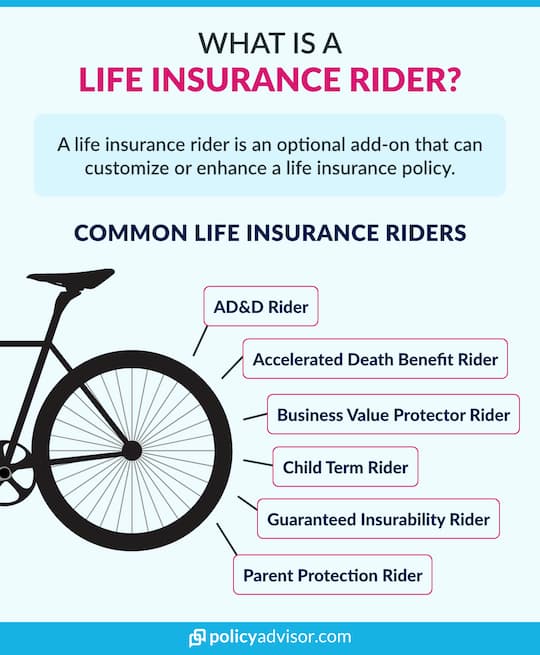
A life insurance rider is an optional feature that can be added on to a life insurance policy to enhance and customize it to better address one’s unique needs.

Schedule a call for visitor insurance

Need insurance answers now?

Call 1-888-601-9980 to speak to our licensed advisors right away, or book some time with them below.

Types of Life Insurance Riders: Quick Reference Guide

Click on any rider name to jump to the full description below.

Rider Name Description
Term Rider Additional term life insurance on top of the base policy. Can be used to offer different amount of coverages for different time periods for the life insured under the base policy, or can also cover someone else, such as children
Child Term Rider Term life insurance for life insured’s children
Guaranteed Insurability Option to purchase additional coverage without medical underwriting at future specified intervals
Business Insurability Option to purchase additional insurance coverage without medicals as business value grows
Accidental Death and Dismemberment (AD&D) Additional payout upon: death of insured in an accident, or loss of limbs or body function as a result of an accident
Accelerated Death Benefit Early access to portion of death benefit in case of terminal illness
Critical Illness Lump sum payout if the life insured contracts a covered critical illness
Child Critical Illness Critical illness insurance for life insured’s children
Return of Premiums Premiums paid are returned when term ends, if no claim
Disability Waiver of Premium Premium waiver if life insured becomes totally disabled
Parent/Payor Waiver of Premium Premium waiver upon policy owner’s death or total disability
Credit/Mortgage Disability Insurance Covers all or part of the insured’s debt or mortgage payments in the event of their disability
Extreme Disability Benefit (EDB) Early access to a portion of death benefit in case of total permanent disability
Long Term Care (LTC) Payment to meet long term care expenses at insured’s home or in a facility
Hospitalization Income Daily cash payout in case of hospitalization
Fracture Lump sum payout if insured suffers a fracture in an accident

How do you add a rider to your life insurance?

Adding a rider to your life insurance application is a simple process. Once you decide what riders you wish to add to your life insurance policy, make sure they are offered by the insurance provider you choose.

There is much variation in the numbers and types of riders offered by various insurance companies. To ensure you get the right policy and type of coverage you want, we suggest enlisting the help of a licensed insurance broker. Insurance experts, like those at PolicyAdvisor, have extensive knowledge of all the riders offered by Canada’s best insurance companies, and can make certain you choose the provider which best suits your needs.

Our experienced advisors can help make sure all the appropriate riders are added to your policy application. Or if you feel confident enough to try it out yourself, we have created an easy-to-use tool for you to compare different life insurance companies and the riders and benefits they offer.

Can you add a rider to an existing life insurance policy?

Life insurance riders are typically added to insurance policies at the time of submitting the application or during the underwriting process.

While these riders may be used to enhance the quality of coverage for the applicant, they also increase the potential risk or total amount of payout for the insurance company. The insurance company underwriters, therefore, require riders to be included at the time of the application process, so any additional risk can be evaluated and priced upfront.

If you did not add a rider at the time of initiating the coverage and were looking to add the rider after the policy coverage has begun, then you will need to seek the insurance company’s approval. In most cases, you will have to repeat medical underwriting or at least complete a health questionnaire to establish continued good health, before a new rider can be added to your policy.

In some cases, a rider may not be available to be added after the policy has been initiated. Therefore, it is essential to review the available riders with your advisor and identify what works best for your needs.

Can you drop a rider from an existing life insurance policy?

Yes, you can generally drop a rider from an existing life insurance policy. Many insurance companies allow you to remove additional riders via a straightforward process.

Typically, one fills out a form indicating which rider(s) they wish to remove and submits it to their provider. The insured’s base coverage however continues, uninterrupted.

If you are paying for the rider and have dropped the rider from your coverage, then your premium will accordingly reduce too. However, there won’t be any refund for the period that you had a rider attached to your policy.

More choice. Lower price.
PolicyAdvisor saves you time and money when comparing Canada’s top life insurance companies. Check it out!
GET STARTED

Should I get a life insurance rider?

Insurance riders are a great way to personalize your coverage to meet your specific needs. The need for riders depends on your circumstances. For some, riders may not be necessary while for others, it presents a cost-effective way to get additional or better coverage without purchasing a separate insurance policy. For example, term riders can be a valuable and affordable tool to align coverage with your future protection needs that change with age.

Similarly, riders for accidental death and disability ensure that one’s family is adequately protected for sudden unexpected circumstances. But, this isn’t to say that all life insurance riders are worth it for everyone looking for augmented coverage. For example, if you have adequate life insurance coverage, you may not wish to add a separate accidental death rider. Or if you have a standalone comprehensive disability insurance policy, you may not see the value of adding a disability rider that waives your premium payments in the event of a disability.

Ultimately, the best way to identify which riders to choose is by determining one’s insurance needs and comparing different structures that address those needs. Speak to one of our licensed insurance agents today; they can help you figure out your insurance needs, whether you need the extra benefit that riders provide, and present you with the best avenues to get covered.

Glossary: Types of Life Insurance Riders

There are various types of riders that can be added to a life insurance policy, depending on what aspect you choose to augment in the policy. We have segregated them below into riders that either augment the life insurance coverage or provide a critical illness benefit or a disability or other income benefits.

Life insurance riders

Life Insurance Coverage Riders

What is a Term rider?

A term insurance rider is an option available to provide additional temporary life insurance cover, under the insured individual’s base life insurance policy. Term life riders are essentially an individual term life insurance policy that is shorter in term length than the base policy. Multiple term riders or life policies can be stacked on top of each other, to provide different layers of coverage for different time periods.

As the term riders gradually expire over time, the coverage and life insurance premium reduce allowing the insured individual to only pay for coverage that they truly need. This approach of using term riders is called ‘laddering’ and is particularly useful for circumstances where a higher death benefit is required in the early years of a policy e.g. while mortgage debt is outstanding. The term riders have a length smaller than the base policy e.g. you can add a Term 10 or a Term 20 rider to a 30-year policy.

What is a Child Term rider?

Child Term rider provides low-cost term life coverage for the insured’s child or children. The aim is to provide a death benefit rider, albeit of a limited amount, if one or more children of the insured pass away while the policy is in force. This rider allows the grieving parents and families to cover funeral expenses and help pay for counselling or other services.

A single child rider will usually cover all children of the insured, including any future additions. Generally, these riders offer a maximum of $20,000 to $30,000 in coverage. The rider typically covers natural-born children, adopted children and stepchildren named in the application and approved for coverage.

The child or children do not have to go through medical underwriting (no medical tests are required), though companies will ask a few questions to determine their insurability. Children are usually covered up to the age of 25 and have the option of converting the coverage into a permanent life insurance policy. These policies usually have fixed prices per $1,000 of coverage.

What is a Parent Protection rider?

A Parent Protection rider lets a policyholder take life insurance coverage for their parents as a rider on their base policy. Each parent requires a separate rider. The rider’s purpose is to cover estate costs (funeral costs, settling debts, taxes) on the passing away of the parents.

What is a Guaranteed Insurability rider?

Also known simply as an Insurability rider, a Guaranteed Insurability rider allows the insured to increase the amount of their death benefit. The amount and intervals at which it is allowed vary across different providers. This is helpful for those looking to increase their cover when achieving certain milestones like marriage, starting a family, or buying a home. This rider is also a good option for those expecting their income to increase significantly in the future, but cannot afford to pay for higher coverage or do not require a larger amount of coverage at present.

What is a Business Value Protector rider?

The Business Value Protector rider is a unique optional feature offered by a few insurance companies to help with the unpredictable rate at which a business can grow and the added coverage a business owner may therefore need over the years. The Business Value Protector rider gives a business owner the option to purchase additional coverage, without medical underwriting, based on the value of the business. It can also be used to protect other stakeholders in the insured’s business(es), to fund buy/sell agreements, or to pay capital gains tax if the business owner passes away.

What is an Accidental Death & Dismemberment rider?

The Accidental Death & Dismemberment rider (AD&D) provides additional financial protection. An additional benefit payment is made if the life insured dies or suffers a loss of limbs or bodily function (such as loss of hearing, sight) due to an accident.

Due to its narrower scope of coverage, accidental death benefit riders are usually cheaper to add than increasing the overall life insurance coverage amount on your policy. Many people use accidental death riders to augment their coverage without significantly increasing the cost of coverage or to provide additional support to their families in the event of an unexpected passing away from an accident. This rider also allows for lump-sum payments in the event of a loss of limbs or other bodily injuries. There are some restrictions and exclusions with accidental death & dismemberment riders. To receive benefits related to an accident, injuries or death generally must occur within a specified duration, generally within 180 days. This time period is usually within a few months of the accident date.

The rider usually expires once the insured reaches the age of 65. Also, the benefit is paid only if the death occurs from a covered accident and injuries are a direct result of the accident. Death or losses incurred due to self-inflicted injuries, war, or the commission of a crime are generally excluded.

What is an Accelerated Death Benefit rider?

An Accelerated Death Benefit rider helps you (life insured) access a portion of your death benefit, prior to when it would ordinarily be available i.e. prior to your passing away. Payment of an accelerated death benefit is usually triggered by an extreme health situation such as the advent of a terminal illness.

A terminal illness is defined as a serious ailment expected to result in limited life expectancy or death within a fixed time span, usually 12 months. Many insurance companies build terminal illness benefit riders into their policies, in which case a policyholder is not required to pay any extra premium. The terminal illness benefit is typically restricted to a maximum amount, which may be a percentage of the original death benefit.

Companies generally impose a limit on the amount of the accelerated death benefit to 50% of the policy amount or $250,000, whichever is less. That means if you have a $1 million policy, the amount that can be paid out in the event of a terminal illness is limited to $250,000. If the accelerated death benefit is claimed and approved, it reduces the tax-free, lump-sum paid upon the death of the life insured by the amount of the death benefit advanced upfront.

Accelerated death benefit riders may also be made available in the event of a permanent disability.

Critical Illness Benefit Riders

critical illness riders

What is a Critical Illness rider?

Critical Illness rider pays out a tax-free lump sum when the life insured is diagnosed with a covered illness (subject to certain conditions). This is known as a living benefit. With some policies, you may be able to choose the number of illnesses covered as well as the amount of coverage and the term length of the rider. Critical illness riders typically have a 30 day survival period that needs to be completed, before the policy can pay out the proposed benefit of the rider.

What is a Child Critical Illness rider?

A Child Critical Illness rider provides coverage for the insured’s children if they are diagnosed with a childhood illness. The exact list and number of illnesses covered vary across insurers. This rider can help parents cover the costs associated with treating some of the more serious children’s illnesses. Similar to the child term rider, this benefit can cover multiple children without necessitating medical tests.

What is a Return of Premium on Death or Expiry rider?

A Return of Premium on Death or Expiry rider returns all or a part of the premiums one has paid over the course of their policy when the policy term ends or when the individual passes away. Such riders are typically associated with a critical illness policy or critical illness insurance riders.

Disability Income Riders

disability riders

What is a Disability Waiver of Premium rider?

There are two types of Disability Waiver of Premium riders:

Total Disability Waiver: for the insured

Under this rider, life insurance premiums are waived if the life insured suffers a permanent total disability. This rider covers disabilities due to accidents as also those suffered due to a permanent illness. To claim under this rider, the life insured must:

  • not be able to perform essential duties of their occupation,
  • not be engaged in any other occupation, and
  • be receiving medical care for the condition that has caused total disability.

Generally, disability waiver riders only pay out after the individual has been totally disabled for at least 4 or 6 consecutive months. The premiums can be waived retrospectively, including for the initial 4 or 6 months waiting period. The rider is valid till a certain age of the person to be insured, most often up to the age of 60 or 65.

Parent/Payor Disability Waiver: for the policy owner or payor

The Disability Waiver rider can also be obtained on the policy owner or the payor of the policy. A Parent/Payor Disability Waiver rider is useful in cases where the policy owner or the payor of the policy and the insured are different people. As the name suggests, Parent disability waiver riders are usually applicable in cases where the life insured is the policy owner’s child while the payor waiver covers the individual making the payments for the policy (eg spouse paying premiums for a policy).

Depending on the policy, premiums may be waived upon the policy owner’s death or if they suffer a permanent total disability. This rider requires both the policy owner and life insured to provide proof of insurability at the time of the application.

What is a Disability Income rider?

A Disability Income rider provides monthly payments to the life insured in case they become disabled and unable to work. The policyholder will need to choose the time period for which the payments are to be made and the monthly payment (which is usually capped). This rider typically has a 30 or 90 day waiting period, with retrospective payments that start after the waiting period is over.

What is a Mortgage Disability or Credit Disability Insurance rider?

A Mortgage Disability rider covers all or part of the life insured’s monthly mortgage or line of credit payments in the event of their temporary or permanent disability. The payments are made for a specified period of time such as 2 years from disability, 5 years from disability, or up to the age of 65. Credit riders typically have a waiting period of 90 days, although can be retroactive to 31 days in the event of disability from an accident. Proof of the outstanding loan is usually required at the time of the claim.

What is an EDB (Extreme Disability Benefit) rider?

An Extreme Disability Benefit rider is available exclusively from Beneva as part of their term life insurance coverage at no additional cost. In the unfortunate event of a permanent and irrecoverable disability, you may receive a portion of your life insurance benefit (up to $250,000) in advance of your death. This rider generally expires at the age of 60.

Other Riders

What is a Long Term Care rider?

A Long Term Care rider pays out a portion of your death benefit if you are unable to live independently and require assistance (either at home or in an assisted care facility). This means you are no longer able to perform two or more activities of daily living (ADLs) independently.

What is a Hospitalization Income Benefit rider?

A Hospitalization Income Benefit rider provides a steady income if the life insured is hospitalized. The rider pays out a daily fixed cash amount. Typically, there is a limit on the number of days of hospitalization covered, as well as the total amount paid out. There may or may not be a limit to the number of claims.

What is a Fracture rider?

A Fracture rider provides a benefit if the insured suffers a bone fracture or total breakage following an accident. An applicant can purchase units of fracture coverage. Generally, different amounts are paid out depending on the nature and placement of the fracture (facial bones/ribs/skull, etc).

Need help?
Call us at 1-888-601-9980 or book time with our licensed experts.
SCHEDULE A CALL
/* Custom Archives Functions Go Below this line */ /* Custom Archives Functions Go Above this line */

Does COVID-19 affect life insurance? Coronavirus FAQ

The coronavirus pandemic dramatically changed the world. In this article, we take a look at how it can impact your life insurance application or your existing policy, if at all.

On May 4, 2023, the World Health Organization (WHO) declared that COVID-19 is no longer a global health emergency.

Remember to always get COVID-19 information from verified sources, such as official government of Canada or provincial websites.

Schedule a call for visitor insurance

Need insurance answers now?

Call 1-888-601-9980 to speak to our licensed advisors right away, or book some time with them below.

What is COVID-19?

Novel Coronavirus (COVID-19) is a new strain of coronavirus that was first identified in Wuhan City, China in December 2019 and has since been detected in more than 100 countries. The virus has been named SARS-CoV-2 and the disease it causes has been named Coronavirus disease 2019 (COVID-19). Coronaviruses are a large family of viruses that are common in humans and have typically been associated with mild illnesses, similar to the common cold. The novel Coronavirus (n-COV) is a new strain that has not previously been identified in humans.

Symptoms for COVID-19 have included fever, cough, difficulty breathing, and pneumonia in the lungs, with severe pneumonia cases leading to fatalities. Generally, Coronavirus can cause severe symptoms in people with weakened immune systems, the elderly, and those with long-term health conditions like diabetes, cancer, hypertension, and chronic lung disease. On March 11, 2020, the World Health Organization (WHO) declared the global outbreak of COVID-19 as a pandemic.

Since then, over the course of the COVID-19 pandemic, multiple variants of the virus have been identified. The most prominent ones were the Alpha, Beta, Delta, and Omicron strains. The Delta variant was classified by WHO on May 11, 2021, and quickly became the dominant variant circulating globally. Delta spreads more easily than earlier strains of the virus and is responsible for more cases and deaths worldwide. The Omicron variant was reported to WHO later that year, on November 24, 2021, and was classified as a variant of concern by WHO on 26 November 2021, due to its high transmissibility compared to other variants. As of June 2023, Omicron is still the most prominent strain being spread in North America.

As of May 4, 2023, the WHO does not consider COVID-19 a global health emergency anymore. However, it is still classified as a pandemic and a serious, ongoing health issue.

Does COVID-19 affect my existing life insurance policy?

If you already have an existing, active life insurance policy, then the short answer is you will be covered for any claims associated with COVID-19.

In other words, if you were to pass away due to COVID-19 or a Coronavirus-related ailment, your beneficiary will be able to make a life insurance claim. The claim would be treated in the same manner as a death caused by any other natural disease or ailment. Life insurance policies do not treat deaths caused by Coronavirus any differently from those caused by any other flu, infectious diseases, or natural causes.

In 2020, Canadian life insurance companies paid out over $154 million in claims for Covid-19-related deaths (CLHIA). While 2021 data has yet to be released for Canadian insurers, according to US trends life insurance payouts in 2021 were the highest they have been in over 100 years, with Covid-19-related death claims topping 2020 numbers.

Covid-19 life insurance frequently asked questions

Will receiving a COVID-19 vaccine affect my life insurance policy?

Despite what some online rumours may say, receiving a COVID-19 vaccination will not affect your insurance in any way. The Canadian Life and Health Insurance Association (CLHIA) released a statement on March 8 2021 assuring Canadians that no life insurance provider in Canada will be denied coverage or benefits when using a vaccine approved by Health Canada.

From their release:

“Getting the vaccine will not affect your insurance coverage. No one should be afraid and choose to not protect themselves from COVID-19 because they are worried about it affecting their benefits. All of Canada’s life and health insurers are supportive of Canadians receiving government-approved vaccinations to protect themselves from serious illness and death.”

Blue bulb

Fast facts

If you have an existing life insurance policy, your coverage is not impacted by COVID-19.

Will COVID-19 be covered under a new life insurance policy, if I apply now?

Life insurance policies have continued to provide coverage for Coronavirus-related deaths for new life insurance applications, once those have been approved.

However, if you have been recently diagnosed with Coronavirus or are currently awaiting diagnosis or treatment of the same, insurance companies will likely defer the approval, until after such treatment or diagnosis is complete. Such a deferral will be similar to deferrals required for any other ongoing health condition or treatment.

For example, some companies may implement underwriting guidelines at the time of application that state, you must not have had Covid-19-related symptoms in the last month, that your case was only mild, or that you must wait two or three months following the resolution of all symptoms. As the situation evolves, companies may continue to amend their approval guidelines, so it’s always best to check with an insurance expert at PolicyAdvisor for the latest underwriting rules.

Does my travel history to a Coronavirus-affected region affect my life insurance application?

As part of standard life insurance applications, most life insurance companies will ask questions about your recent travels in the last year – as well as ask for information on your travel plans for the next twelve months. If you have travelled to a region that has seen a wide outbreak of COVID-19, particularly in the last 1-3 months, then you can expect the insurance company to ask you additional questions.

Similarly, any imminent plans to travel to any of COVID-affected regions invite additional questions about such travel plans. In some situations, where travel may indicate elevated risks to Coronavirus, insurance companies may choose to postpone the decision around approving a policy. Learn more about life insurance and travelling and applying for life insurance while quarantined.

Will a COVID-19 claim be paid out under Critical Illness Insurance policies?

A critical illness insurance policy is a contract whereby an insurance company agrees to pay out a one-time lump sum amount to the insured, upon the diagnosis of a specified critical illness and the completion of a survival period; usually 30 days.

COVID-19 by itself is not a covered condition as defined in Critical Illness policies currently sold. Therefore critical illness policies will not payout, purely, on a positive COVID diagnosis. The vast majority of people who contract the novel coronavirus are expected to make a full recovery within a relatively short period of time. However, if a claim is presented for a different covered critical illness (such as a major organ transplant, like a lung transplant) that is attributable to Coronavirus, then it will generally be viewed as a covered condition and insurance companies will consider such claims for approval.


Blue bulb

Fast facts

Life insurance companies – generally speaking – do not currently have any policy exclusions for coronavirus or other infectious diseases in their life, critical illness, or disability policies.

If you are unsure what your policy covers, reach out to our licensed insurance experts. We will help explain your current coverage.

More choice. Lower price.
PolicyAdvisor saves you time and money when comparing Canada’s top life insurance companies. Check it out!
GET STARTED

Am I covered for COVID-19 under my disability insurance policy?

Disability insurance products are designed to pay a monthly benefit to replace a loss of earnings if you are unable to work due to illness or injury for the length of the policy, or until you return to work. Typically, there is a waiting period before the benefit payments start. This waiting period can be between 1 to 26 weeks for short-term policies or up to 2 years for long-term disability insurance policies. Should a Coronavirus diagnosis lead to a loss of income, the insurance companies will make a payment as long as the minimum waiting period is complete. Some companies may even waive the waiting period in the case of a positive diagnosis. Learn more about Coronavirus and critical illness insurance.

Frequently Asked Questions

COVID-19 has been declared by the WHO to be a pandemic. Are there any exclusions on life insurance policies associated with pandemics that insurance providers may introduce in the future?

A pandemic is a global outbreak of disease. Pandemics happen when a new virus emerges to infect people and can spread between people sustainably. Most life insurance policies currently do not have a disease-related exclusion. The standard exclusions pertain to suicide/self-inflicted harm or criminal activity.

Currently, there are not any exclusions on coronavirus-related deaths. However, insurance companies continue to monitor the outbreak and they reserve the right to make any changes in their product or processes in the future.

Should I be buying insurance on my life or health at this time?

Regardless of this health scare, you should be buying the appropriate amount of insurance coverage to protect you and your family at the earliest time you can. Such coverage only gets more expensive with age.

COVID-19 is a reminder that life events can emerge quite quickly and it is prudent to secure coverage ahead of time. This is just as important a time as any other to protect those that depend on you for financial health. If you would like to discuss your insurance needs, our advisors are available to assist you.

Can I apply for life insurance coverage without having to meet an advisor or undergo a medical test?

When COVID-19 was still a global health emergency, many Canadians practiced social distancing to prevent the spread of Coronavirus to loved ones and community. By now, such restrictions are no longer recommended, but you may still be concerned about limiting your social interactions.

As Canada’s leading online life insurance brokers, the team at PolicyAdvisor has made finding life insurance quotes and buying life insurance an easy, quick and online process for consumers like yourself that seek the convenience of a non-face-to-face meeting to assess insurance needs. Our life insurance needs calculator can help shed light on your specific insurance requirements from your couch or kitchen table.

Our innovative algorithm parses through 100s of insurance products so you can find the best insurance policy and options for your needs. Our licensed insurance advisors are available online to answer any questions, curate your insurance choices, and help complete the application for you – all fully online.

While many life insurance products require a medical test, we have partnered with some of Canada’s leading insurance companies to arrange for life insurance coverage up to $1 million, without requiring an in-person, medical exam. We also have access to several non-medical insurance products; the coverage can be fully obtained without meeting with a medical representative.

You can easily get financial protection from the comfort of your home even if you are still practicing social distancing – like so many of us are – to protect our communities and those most vulnerable.

Need help?
Call us at 1-888-601-9980 or book time with our licensed experts.
SCHEDULE A CALL
/* Custom Archives Functions Go Below this line */ /* Custom Archives Functions Go Above this line */

State of the Nation: Canadian Life Insurance Trends 2021

PolicyAdvisor’s latest research finds that only 48% of Canadians feel their insurance coverage adequately protects their families from the financial impact of COVID-19 should they become ill or pass away from the virus.

Our State of the Nation: Life Insurance Trends 2021 report takes the temperature on Canadians’ attitude towards spending, saving, job security, and life insurance in a near post-pandemic economy. 

While the data found consumers plan to trim budgets across the board in 2022, life insurance is spared from major cuts at this point in the pandemic.

Canadians know they’ll feel some pocketbook pain in the next 12 months. Cost uncertainty of pricing for items like grocery bills and mortgage rates are top of mind and may lead to spending cuts across the board.

Schedule a call for visitor insurance

Need insurance answers now?

Call 1-888-601-9980 to speak to our licensed advisors right away, or book some time with them below.

More insights from State of the Nation: Life Insurance Trends 2021

  • Over half of Canadians surveyed (59%) are concerned about inflation’s effect on the cost of living and rising interest rates. 
  • Job security concerns worry many Canadians (14%) facing a stalled economy. 
  • Canadians plan on spending less on entertainment (51%), travel (43%), and clothing (42%). 
  • The least expendable budget item for surveyed Canadians is life and health insurance. Eighty percent (80%) will maintain their current level of insurance protection throughout the ongoing health crisis, or even purchase more.
  • Over half (52%) of Canadians feel uncertain as to whether they have adequate financial protection for themselves or their loved ones should they be stricken with a COVID-related sickness or death.
  • The perceived expense of life insurance is a primary barrier for 45% of those that haven’t purchased life insurance.
life insurance trends 2021

Stay tuned for more in-depth analysis and breakdowns of each insurance trend in 2022. Browse the report below or download the full resolution version for free.

Need help?
Call us at 1-888-601-9980 or book time with our licensed experts.
SCHEDULE A CALL

The survey was conducted via Survey Monkey’s Canadian panel in November 2021 and included 500+ qualified respondents. All graphs rounded to the nearest percentage point.

/* Custom Archives Functions Go Below this line */ /* Custom Archives Functions Go Above this line */

State of the Nation: Canadian Life Insurance Trends 2019

Canadians are underinsured.

Our first State of the Nation: Canadian Life Insurance Trends 2019 seeks to determine consumer trends and attitudes about life insurance planning across the country, and it   uncovers several stunning findings about the lack of financial protection amongst Canadians in 2019.

Unlike most life insurance surveys that poll all Canadians as respondents, our study sought feedback only from those Canadians who actually need Life Insurance. Thus the results you see below are based on answers from those Canadians that have financial dependents (i.e. family members that depend on their income for settling debts such as mortgage and credit cards, or for support in paying for education, living expenses, and more).

The results – presented below – are eye-opening, with hard numbers revealing startling truths about the state of  Canadians’ financial protection and key takeaways around the national state of life insurance ownership, needs, knowledge, and appetite for change.

Canada: An uninsured nation?

Of those who have financially dependent family members, 16% do not have any life insurance coverage. But almost as problematic is the fact that 33% of respondents have coverage solely through their employer or group. This means 49% of Canadians with dependents have never purchased life insurance themselves.

While a life insurance policy through one’s employer or group affiliation is better than none at all, it can be problematic for a couple of reasons. Firstly, in most cases employer-provided coverage is minimal: a typical group benefit life insurance policy is equivalent to only one or two years of the policyholder’s salary. The bigger issue is that if the insured leaves the particular job, group, or association through which they have the policy, they mostly lose this insurance coverage. 

They also lose time; individual coverage is less expensive in one’s earlier years when there are fewer potential complications to medical underwriting. While a group policy is a nice top-up, it should not be the primary source of one’s coverage.

How did you acquire life insurance coverage?

Life insurance ownership rates

The biggest surprise was the extent to which Canadians are underinsured: The Financial Consumer Agency of Canada suggests that life insurance should cover between seven and ten years of the holder’s annual income, which is in line with many industry practitioners’ recommendation of ten years of annual income coverage. Yet, well over half of the study’s respondents (54%) have coverage equal to only two years or less of their annual salaries. A mere 22% had between two and five years’ worth of coverage.

Only nine percent of those surveyed are solidly within the recommended range.

Overall, this means 77% of Canadians are dramatically under-insured, with policies that will only cover their obligations for at most five years, a full two years less than the minimum recommendation.

How much of your annual income would your life insurance cover?

Life insurance average years of coverage

Key life insurance ownership takeaways

  • 49% of Canadians with dependents have never purchased life insurance
  • 54% of the same group have only covered 2 years or less of their salary should they pass
  • 91% of Canadians are dramatically under-insured

Life insurance needs: Canadians not honest with themselves

Just how significant is this life insurance shortfall? When asked for hard numbers, the average shortfall among respondents was $256,000. What is even more startling is that this is a self-acknowledged shortfall that respondents know exists but they haven’t started bridging it yet. 

There are several potential reasons for a shortfall like this to exist. First, many may not realize how underinsured they really are, until they are asked the question. When asked how often they reviewed their life insurance coverage, less than a quarter (22%) of respondents indicated they did so annually (the recommended frequency). 

Twenty-eight percent said they review life insurance coverage either every two or three years, but more than a third (36%) say they have never reviewed their life insurance coverage and needs. All in, almost 80% of Canadians fail to sufficiently review their life insurance coverage.

Suggested reading

How often do you review your life insurance coverage?

Life insurance coverage checkup frequency

And, despite more than three quarters of Canadians being significantly under-insured, nearly half of respondents (43%) say they are confident that they have adequate life insurance, with 57%knowing about or unsure of the adequacy of their coverage.

How confident are you in the adequacy of your life insurance coverage?

Life insurance coverage confidence

This shows a definite disconnect between the perception and reality of the country’s financial protection. Canadians are either misinformed, or simply don’t understand what their life insurance needs are. Traditional advisors and brokers don’t make it easy to educate ones’ self in regards to the ins and outs of life insurance. 

Regardless, it’s clear Canadians require more education when it comes to making life insurance decisions – and luckily PolicyAdvisor.com is dedicated to giving them the answers they seek.

Key life insurance needs takeaways

  • The average self-acknowledged life insurance shortfall for Canadians with financial dependents is $256,000
  • Almost 80% of Canadians fail to adequately review their life insurance coverage.
  • Fifty-seven percent don’t know or acknowledge they don’t have enough life insurance coverage.

Life insurance literacy – not a thing yet

Only 35% of Canadians claim they understand how their life insurance policy works “very well,” versus the balance who only understand their coverage “somewhat” or not at all.

Do you understand how your life insurance policy works?

Life insurance knowledge confidence

In light of this knowledge deficit, Canadians offered many reasons for not obtaining additional life insurance, with almost half indicating cost and 20% the aforementioned lack-of-understanding as a barrier.

This further underscores the need for better education and transparency around life insurance. There is a clear misconception that life insurance policies are unaffordable and complicated. This is unfortunate, as there are potentially many ways Canadians can provide themselves with financial protection within their budget with straightforward terms and coverage.

Other reasons for not obtaining additional insurance included procrastination (29%) and lack of a trusted advisor (10%).

Why have you not purchased life insurance?

Life insurance reasons for not getting

Key life insurance knowledge takeaways

  • Sixty-five percent of those surveyed don’t totally understand how insurance works
  • Almost half of those surveyed think life insurance is prohibitively expensive
  • Twenty percent of those surveyed put off purchasing life insurance because they think it is too complicated

Appetite for digital disruption

Thanks to an evolving digital landscape and a tech-savvy population, Canadians are able to better educate themselves about their insurance needs. However, while they are happy to seek information online, they are slower on the uptake when it comes to purchasing life insurance digitally.

This is gradually improving. Although 29% of respondents said they prefer a traditionally fulfilled in-person process with an advisor, 60% indicated a preference for an online process with  some support to complete the transaction. The main takeaway? Over 70% of Canadians crave an online component to their life insurance buying journey. 

How would you prefer to purchase life insurance?

Appetite for digital offerings in life insurance

While globally, digital fulfillment for life insurance is quite common, this is still new territory for Canadians. Despite some hesitations, we see a definite appetite amongst Canadians to add life insurance coverage, if supported through online pathways, and PolicyAdvisor.com is here to help guide them through their life insurance buying journey. One life insurance purchase at a time.

Download the report below, or check it out and pass it along using Slide Share.

The survey was conducted via Survey Monkey’s Canadian panel in September 2019 and included 500+ qualified respondents. All graphs rounded to the nearest percentage point.

Need help?
Call us at 1-888-601-9980 or book time with our licensed experts.
SCHEDULE A CALL
/* Custom Archives Functions Go Below this line */ /* Custom Archives Functions Go Above this line */