Best life insurance for couples in Canada (2026 guide)

As a couple, managing finances means sharing major responsibilities, such as a mortgage, raising children, paying off debts, or planning for retirement. For most Canadian couples, two separate term life insurance policies are considered the best default choice because they provide two death benefits, flexible coverage amounts, and separate beneficiaries.

While separate life insurance policies are the best fit for most couples due to their flexibility, joint life insurance can be a more suitable and cost-effective option for couples who want to protect shared financial obligations, simplify policy management, or reduce policy fees.

Schedule a call for visitor insurance
Need insurance answers now?

Call 1-888-601-9980 to speak to our licensed advisors right away, or book some time with them below.

What is the best life insurance for couples in Canada?

The best life insurance for couples in Canada depends on a couple’s financial goals, family situation, and long-term plans. Policies from leading insurers such as BMO, Empire Life, RBC Insurance, and Manulife offer unique features that make them well-suited for couples seeking financial protection.

While many assume a joint policy is the best choice, separate life insurance policies can provide greater flexibility, personalized coverage, and better long-term value.

Here’s a quick overview of life insurance for couples in Canada:

Feature Details
Types of coverage
  • Individual life insurance
  • Combined (Or multi-life) life  insurance
  • Joint first-to-die life insurance
  • Joint last-to-die life insurance
Best for
  • Married couples
  • Common-law partners
  • Parents and homeowners
  • Couples with shared financial obligations
Best insurance companies
  • BMO
  • Beneva
  • Empire Life
  • RBC Insurance
  • Manulife
Can unmarried couples apply? Common-law partners can purchase life insurance individually or jointly if they meet the insurer’s eligibility requirements

Types of life insurance available for couples in Canada

In Canada, couples can choose between joint life insurance policies that cover both partners under a single plan or individual policies that provide separate coverage for each person. Based on the type you choose, the following options are available:

  • Joint first-to-die life insurance
  • Joint last-to-die (survivorship) life insurance
  • Two separate life insurance policies
  • Combined or multi-life insurance policy

Here’s a quick overview of the different policy types:

Joint first-to-die life insurance

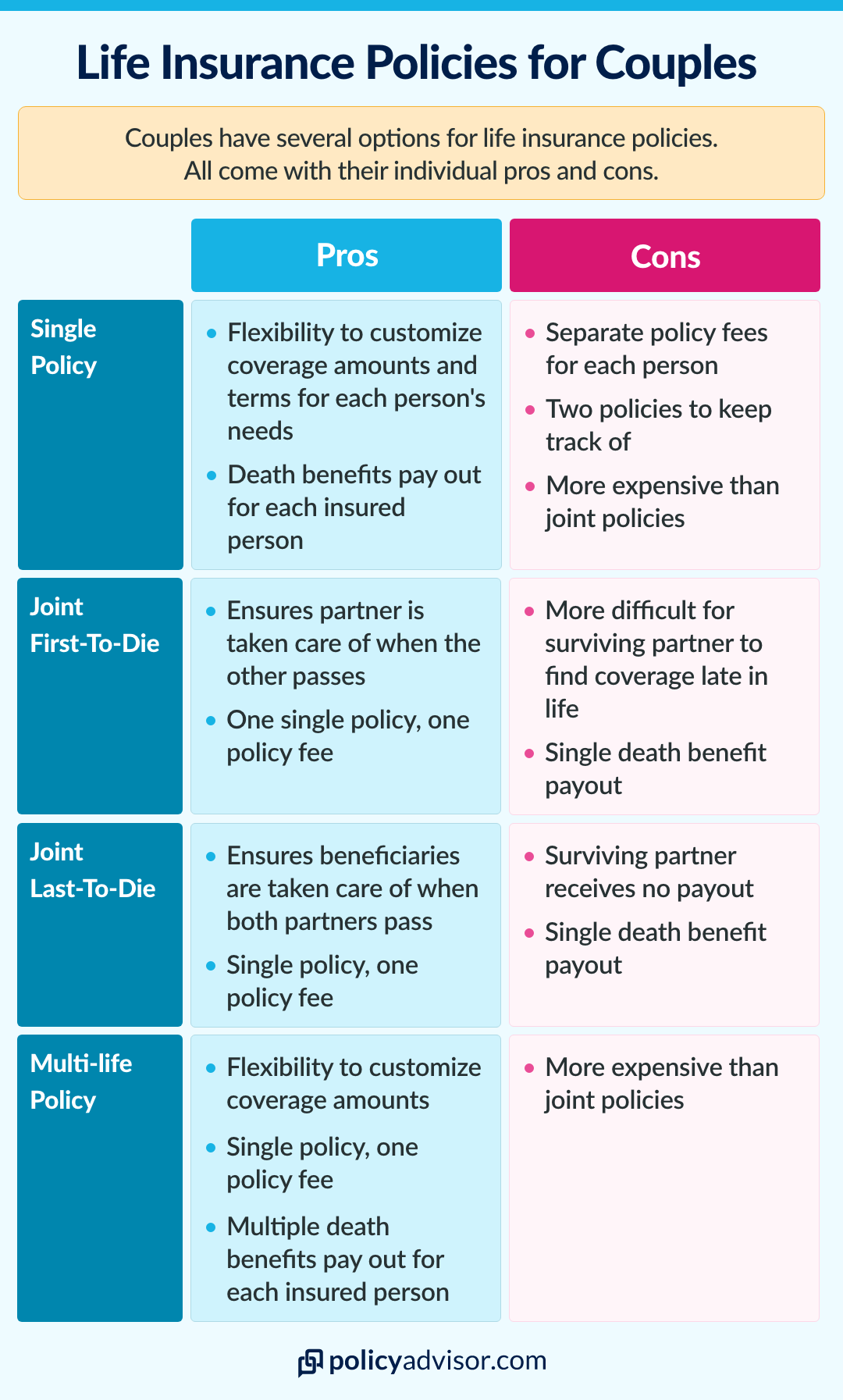
A joint first-to-die life insurance policy covers two people under a single contract and pays the death benefit after the first insured person passes away. Once the benefit is paid, the policy ends, and the surviving partner no longer has coverage.

This option is commonly chosen by couples who want to ensure the surviving spouse has financial protection for living expenses, debts, child care, or mortgage payments. While it is comparatively less expensive than two separate policies, note that joint first-to-die life insurance only provides one death benefit.

Joint last-to-die (survivorship) life insurance

A joint last-to-die policy insures two people under one contract but pays the death benefit only after both insured individuals have passed away. Since the insurer does not pay until the death of both partners, premiums are often lower than buying two separate policies.

This option is great for parents or partners who wish to protect their children and other beneficiaries from debts and to support estate planning and wealth transfer.

Two separate life insurance policies

In this case, each spouse owns an individual policy with their own coverage amount, beneficiaries, and policy features. Each policy pays its own death benefit when the insured passes away, offering beneficiaries two separate payouts over time.

This is the most flexible option, working well for couples with different incomes, debts, health conditions, or long-term financial goals. Additionally, separate policies are easier to maintain in the event of a divorce or separation. Since they are not under a joint policy, the individuals continue to be insured without any complications or reassessment. 

Combined or multi-life insurance policy

A combined or multi-life insurance policy allows two people to have two coverage within a single insurance contract. It combines features of joint policies while offering personalized and individual solutions under one policy. 

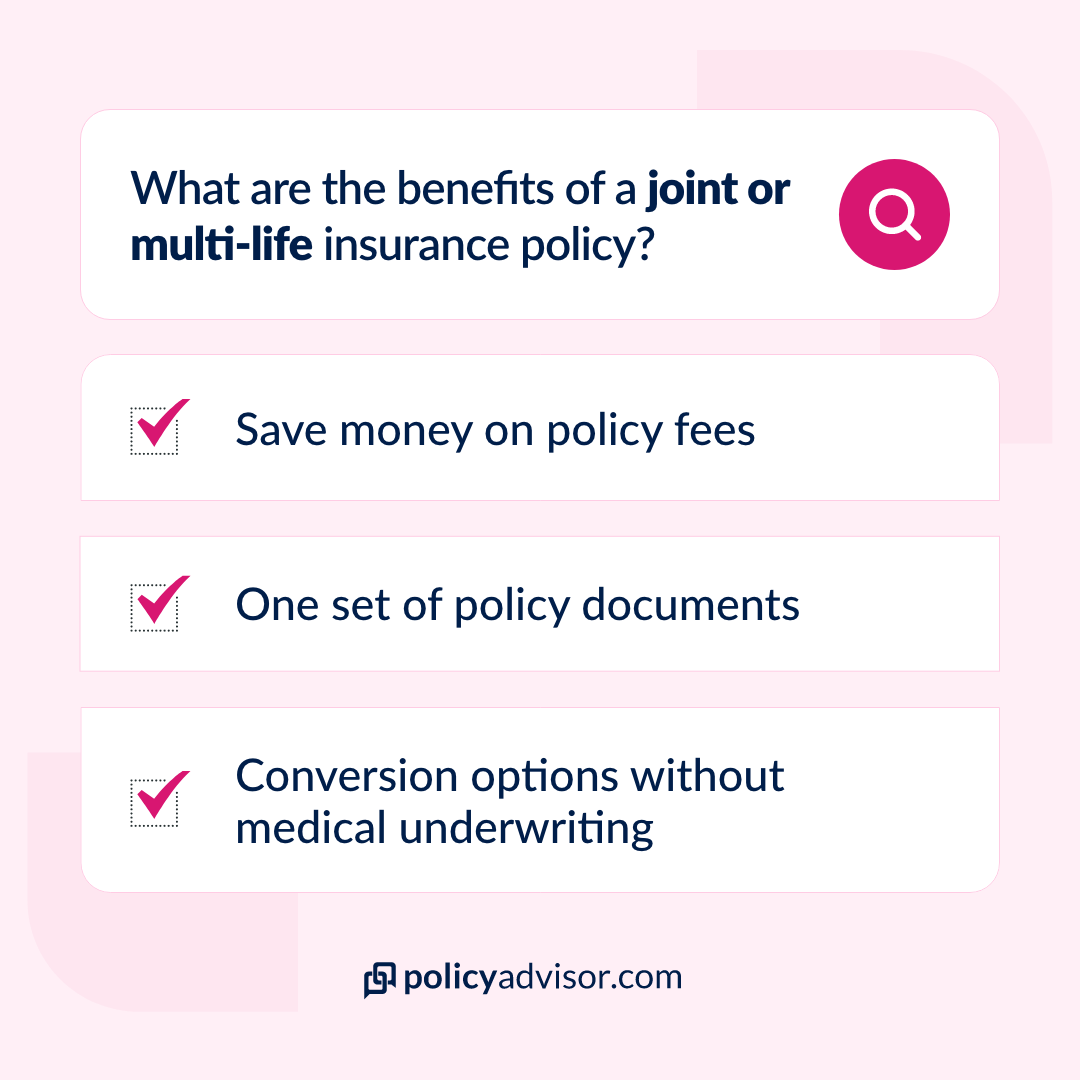
Each insured person has their own benefit, but the policy is offered under one application and one premium payment schedule. Beneficiaries receive two death benefits, one for each policyholder. Despite being combined, the death benefits are separate for each individual. Since everything is under one policy, couples can save on policy or administration fees, reducing the overall costs.

life insurance couples Canada

Comparing life insurance options for couples in Canada

Each policy type has its own series of benefits and features. Two separate term life policies are ideal for families, while joint first-to-die life insurance is ideal for individuals seeking protection for mortgages and other major expenses. Meanwhile, a joint last-to-die policy is well suited for estate planning and creating a legacy.

Here’s a comparison of the major life insurance options available for couples in Canada:

Feature Joint first-to-die life insurance Joint last-to-die (survivorship) life insurance Two separate life insurance policies Combined or multi-life insurance policy
Who is covered? Two people under one policy Two people under one policy Two people have two separate policies their own policy Two individual policies linked under one account
When is the death benefit paid? After the first insured person dies After both insured individuals have passed away When each insured person dies, according to their own policy Single payout based on the policy type
Number of payouts One One Two (one per policy) Two (one per coverage)
Policy ends when After the first claim is paid After the second insured dies and the claim is paid Each coverage ends independently according to its terms Each coverage ends independently according to its terms
Best suited for Income replacement, mortgage protection, and covering shared debts Estate planning, wealth transfer, and leaving an inheritance Couples who want flexible, personalized coverage Couples who want separate coverage with simplified administration
Coverage flexibility Low Low High High
Premiums Often lower than two comparable permanent policies Often lower than two comparable permanent policies Based on each individual’s age, health, and coverage needs Similar to separate policies, though some insurers may offer administrative discounts
If one partner dies, does the surviving partner remain insured? No, the policy ends after the payout.  Yes, but no benefit is paid until the surviving partner also passes away Yes, the surviving partner’s policy remains active Yes, the surviving partner’s policy remains active

It is also worth noting that many insurers offer a conversion or survivor privilege when couples purchase life insurance. This allows the surviving partner to purchase a new individual policy within a short window (usually 30 to 90 days) without undergoing a medical exam or answering new health questions.

How much does life insurance cost for couples in Canada?

The cost of a life insurance policy for couples ranges from $224.10 to $615.15. The premiums depend on the plans chosen and the coverage, as well as personal factors such as age, smoking status, and health. 

Here is a sample life insurance rate for two 35-year-olds for Term100 from Beneva:

Feature Individual life (Male) Individual life (Female) Combined/ Multi-life Joint First to Die Joint Last to Die
Beneva/ Monthly prem $332.1 $288.45 $615.15 $457.2 $224.1
Life covered Single Single Both Both Both
Coverage Amount 500k 500k 500k + 500k 500k 500k
Saving  –  – 1% 26% 64%

Cost of life Insurance for couples

Get instant quotes from Canada's top life insurance providers and find the perfect coverage for your family.

$500K

Should couples buy joint or separate life insurance?

For most Canadian couples, it is recommended to obtain separate life insurance policies, as this allows each partner to customize their coverage and modify riders or terms independently. However, two individual policies for couples could cost as much as $620.55, whereas a joint policy costs as little as $224.1 per month. 

Separate policies provide two death benefits and have customised features, making it easier to maintain coverage if the partners divorce or separate. On the other hand, joint policies can be a good option for couples seeking lower premiums or fewer complications.

Pros and cons of purchasing a joint policy and individual policies in Canada:

Pros and cons of purchasing a joint policy for couples

Pros:
One policy covers both partners
Easier to manage with a single premium and policy document
May cost less than two comparable permanent policies
Well suited for protecting shared financial obligations like a mortgage
Cons:
Typically pays out only once (depending on the policy type)
Less flexibility to customize coverage for each partner
May not be ideal if partners have different insurance needs
Creates additional complications if the partners divorce or separate
Equivalent Single Age (ESA) may increase costs when there is a significant age difference

Pros and cons of purchasing individual policies for couples

Pros:
Each partner chooses their own coverage amount, policy type, and term
Each policy pays its own death benefit
Surviving partner remains insured after the other partner dies
Easier to update coverage as financial needs change
Greater flexibility for beneficiaries and policy riders
Cons:
Usually costs more than a comparable joint policy, especially for permanent insurance
Two policies to manage and pay for
Separate underwriting and applications for each partner
Beneficiary updates must be made separately for each policy
Benefits of joint-life policy

Top 5 best life insurance companies for couples in Canada

Choosing the right life insurance company for couples is just as important as choosing the right type of policy. While many insurers offer great benefits, the following companies offer greater flexibility, built-in benefits, and features that make them particularly suitable for partners with shared financial goals.

Here’s an overview of the five best life insurance companies for couples in Canada:

BMO Insurance

BMO Insurance is an excellent choice for couples who want their coverage to remain stable even after a life-changing event. Even if one insured person in a joint policy passes away, the surviving insured member can continue coverage at the same premium, provided the coverage amount remains unchanged.

This feature is great for couples seeking hassle-free coverage, especially at older ages when premiums are higher. In addition, BMO also offers the Empathy service, which provides emotional and logistical support to the policyholder’s beneficiaries.

Beneva

Beneva is well suited for couples who want more than just a death benefit. The policies include valuable built-in features such as the Extreme Disability Benefit and Guaranteed Insurability Option, ensuring policyholders can increase coverage later on without additional medical underwriting (under qualifying circumstances).

Additionally, eligible policies also have the option to add valuable riders such as child coverage and accidental death benefits, allowing couples to customize their protection and help ensure the financial safety of their beneficiaries.

Empire Life

Empire Life has one of the most seamless application processes, combining a streamlined online application process with competitive policy features. Couples can benefit from policy fee savings, strong term conversion options, and the ability to choose from a wide selection of term and permanent life insurance plans.

Policyholders can also add critical illness insurance under the same policy, making it easier for them to build a comprehensive financial protection plan. Additionally, the joint first-death plan offers temporary insurance to the surviving partner for an additional 90 days. This gives the spouse time to figure out their next steps without suddenly being unprotected.

RBC Insurance

RBC Insurance stands out for its Pick-a-Term feature, which lets partners choose a customized term length rather than selecting only standard options such as 10 or 20 years. This flexibility allows them to match coverage with major financial obligations like mortgages, education, or even retirement planning.

Many eligible policies also feature a seamless conversion option, allowing couples to transition from term to whole life without additional medical underwriting. Couples can also benefit from policy fee savings when purchasing joint coverage.

Manulife

Manulife is an excellent option for couples who want to combine life insurance with wellness incentives. Through the Manulife Vitality program, policyholders can earn points and receive rewards for maintaining healthy lifestyle habits, such as exercising, participating in activities, and completing health assessments.

Additionally, Manulife life insurance offers a Waiver of Premium option for couples. If either partner becomes totally disabled due to injury or illness, the premiums for the entire joint policy are waived, ensuring coverage remains active while household income is impacted.

Quick overview of the five best insurance companies for couples in Canada:

Insurer Best for Standout feature
BMO Insurance Long-term flexibility Surviving insured can continue coverage at the same premium (subject to policy conditions)
Beneva Built-in policy benefits Extreme Disability Benefit and Guaranteed Insurability Option
Empire Life Fast digital applications Digital underwriting, policy fee savings, Critical Illness integration
RBC Insurance Custom term lengths Pick-a-Term feature and joint policy fee savings
Manulife Wellness-focused couples Manulife Vitality rewards program and Waiver of Premium

More choice. Lower price.
PolicyAdvisor saves you time and money when comparing Canada’s top life insurance companies. Check it out!
GET STARTED

How much life insurance coverage do couples need?

For many Canadian families, a rule of thumb is to purchase life insurance worth 7 to 15 times your annual income. However, this is just a baseline and should be adjusted based on your financial situation.

A great method of calculating how much coverage you need is to use the Debt, Income, Mortgage, and Education (DIME) method. It is a simple way to estimate how much life insurance you may need by considering four key financial obligations your beneficiaries could face.

Use our life insurance calculator to estimate how much coverage you need.

What mistakes do couples make when buying life insurance in Canada?

Many couples purchase life insurance to protect their loved ones, but choosing the wrong policy, waiting too long, or having insufficient coverage can leave their family financially vulnerable.

Here are some of the common mistakes you should avoid as a couple while purchasing life insurance in Canada:

  • Waiting too long: Many couples postpone buying life insurance until they have children or purchase a home. Purchasing coverage early protects you from higher premiums later on due to age and health conditions
  • Buying too little coverage: Some couples choose the lowest premium without considering how much coverage their family would actually need. Ensure the policy amount sufficiently covers debts, future income replacement, and living expenses
  • Choosing the wrong type of policy: Many couples automatically choose a joint policy because it appears simpler or less expensive. However, a term life policy or a joint last-to-die policy might offer better estate planning and coverage in certain situations
  • Forgetting the Stay-at-Home Partner: Many couples think they only need insurance on the person who earns the most money. If a stay-at-home partner passes away, the surviving partner must pay for child care, cleaning, and cooking.
  • Not reviewing coverage after major life events: Many couples forget to review their coverage amount or duration after major events like child birth, starting a business, purchasing a home, or taking on significant debt. This can leave them without sufficient coverage or term in the future.

Can you change or cancel your life insurance policy as a couple in Canada?

Yes, most life insurance policies in Canada can be changed or cancelled. However, your available options depend on the type of policy you own and the rules specific to your insurer and policy. Common changes include increasing coverage, converting term coverage to permanent coverage, or replacing a joint policy with individual policies.

Here are some of the most common changes couples make to their life insurance coverage:

Option What it means
Increase your coverage Purchase additional life insurance if your financial responsibilities grow
Replace your policy Switch to a new policy with a different insurer or coverage amount
Convert a term policy Many insurers allow you to convert eligible term life insurance into permanent coverage before a specified age or deadline
Replace a joint policy Couples who have different goals, or who divorce or separate, may replace a joint policy with individual policies
Cancel your policy Stop paying premiums and end your coverage if you no longer need life insurance

It is also worth noting that most policies include a “free-look” period to review and cancel for a refund. As a couple, you should review your life insurance coverage and goals after major life events, such as purchasing property, having children, or planning for retirement. Contact our advisors today for a comprehensive plan based on your needs.

Our advisor’s take on the best life insurance for couples

At PolicyAdvisor, we recently helped a married couple in their early thirties secure life insurance after purchasing their first home and welcoming their first child. They were seeking coverage to ensure the surviving spouse could continue paying the mortgage, replace lost income, and support their child.

Client profile

  • Ages: 32 and 34 years
  • Family: Married with one young child
  • Primary concern: Income replacement and mortgage protection
  • Existing debt: $620,000 mortgage
  • Coverage goal: $1.5 million in total life insurance
  • Approximate monthly premiums: $332.1 (Male) and $288.45 (Female), respectively

Why we recommended separate term life insurance

  • Each spouse required a different coverage amount based on their income and financial responsibilities 
  • Separate policies ensured both partners remained insured even if one policy paid a death benefit 
  • The policies included the option to convert to permanent life insurance if their long-term financial goals changed 
  • Affordable monthly premiums allowed them to get higher coverage without exceeding their budget 

How to purchase life insurance for couples in Canada?

PolicyAdvisor’s licensed life insurance advisors can help couples compare life insurance quotes from leading Canadian insurers based on their ages, budget, coverage needs, and financial goals. They can help you estimate your coverage and decide between joint and separate policies.

Whether you are newly married, raising a family, or planning your estate, PolicyAdvisor can help you compare quotes and apply online with licensed advisors. We will compare policy types, term lengths, and riders to help you choose the right protection for you and your loved ones.

Need help?
Call us at 1-888-601-9980 or book time with our licensed experts.
SCHEDULE A CALL

Frequently Asked Questions

What is the best life insurance for couples in Canada?

For most Canadian couples, two separate term life insurance policies are the best option. They offer better flexibility and allow each partner to choose their own coverage, beneficiaries, and riders with ease.

Is joint life insurance cheaper than separate policies?

Joint life insurance can sometimes have lower premiums than purchasing two comparable individual policies because both partners are insured under a single contract. However, it only pays one death benefit. Once it is paid, coverage ends.

Can common-law couples purchase life insurance together?

Yes, most Canadian insurers allow common-law partners to purchase either separate or joint life insurance policies if they meet the insurer’s eligibility requirements. Coverage options are usually the same as those available to married couples.

Can couples have different coverage amounts?

Yes, if you have separate life insurance policies. Since each policy is its own contract, you can choose to customize it based on your needs. Additionally, you can choose separate beneficiaries.

Can couples buy life insurance online?

Yes, couples can buy life insurance online. Our trusted advisors at PolicyAdvisor can help you compare quotes.

Can we name a minor child as beneficiary?

In most cases, appoint a trustee for any minor’s share so funds can be managed for the child’s benefit until they reach the age of majority in your province.

What if one of the partners has a health condition?

You can consider separate policies so one partner’s health does not influence the other’s pricing or approval. Consider exploring fully underwritten, simplified issue, or guaranteed issue options, depending on your situation.

What happens to joint life insurance after divorce or separation?

This depends on the policy terms and agreement between the policyholders. Some joint life insurance policies can be split into separate policies or transferred to one partner, while others may need to be cancelled.

/* Custom Archives Functions Go Below this line */ /* Custom Archives Functions Go Above this line */

Understanding Mortgage Insurance in Canada: A Complete Guide

Homeownership can be overwhelming, especially when it comes to understanding the various financial products involved. Among these, mortgage insurance is a critical component that can significantly impact your home-buying experience and financial security.

Whether you are a first-time homebuyer or looking to refinance your existing mortgage, understanding mortgage insurance is essential. So, this comprehensive guide to mortgage insurance in Canada will break down everything you need to know.

We will explore the types of mortgage insurance available, their benefits and drawbacks, the costs involved, and how they can affect your homeownership journey.

What is mortgage insurance?

In Canada, mortgage insurance is a financial protection product otherwise known as creditor insurance. It is typically offered by your mortgage lender. In the unfortunate event of your death, if your mortgage is still outstanding, mortgage insurance pays the debt you owe to your bank for your mortgage loan.

An example of how mortgage insurance works

Let’s say you are purchasing a house for $100,000.

  • You pay a 15% down payment ($15,000).
  • The amortization period is 25 years.
  • Leaving an $85,000 mortgage loan that you need to pay off over the next 25 years.

If you die within this 25-year period, your lender still expects to be paid back. Without this insurance, your family or your estate will need to come up with $85,000 by dipping into their savings or selling the property to settle the mortgage loan.

Mortgage insurance ensures that the mortgage loan is paid off in these circumstances. This kind of insurance is sometimes referred to as mortgage life insurance or private mortgage insurance.

Read our full review of the Best Mortgage Insurance Companies in Canada

What are the types of mortgage insurance?

There are three main types of mortgage insurance in Canada, 

  • Mortgage default insurance
  • Mortgage loan insurance
  • Optional mortgage protection insurance

Mortgage default insurance

Mortgage default insurance is mandatory coverage in Canada for homebuyers with a down payment of less than 20%. This insurance protects lenders in case the borrower defaults on their mortgage. 

For example, if you buy a house for $400,000 with a 5% down payment, mortgage default insurance reduces the lender’s risk and lets you secure a mortgage despite the smaller downpayment.

Mortgage loan insurance

Mortgage loan insurance, also known as CMHC insurance, works like mortgage default insurance, protecting lenders against the risk of borrower default. This insurance allows buyers to secure a home loan with a smaller down payment. 

For instance, if you put down 10% on a $500,000 home, mortgage loan insurance safeguards the lender, making it easier to obtain mortgage approval in the Canadian housing market.

Optional mortgage protection insurance

Optional mortgage protection insurance is an additional policy that homeowners in Canada can purchase to enhance their financial security. This insurance provides support to cover mortgage payments in case of unforeseen events such as disability, critical illness, or death.

For example, if the primary breadwinner in your family becomes critically ill, this insurance can help cover the mortgage payments, ensuring your family can maintain their home without facing financial hardship.

Benefits of mortgage insurance

Mortgage insurance has several advantages, like:

  • Financial security for lenders: Mortgage insurance, whether mandatory or optional, protects lenders. It reduces the risk of borrower default so that lenders can recover their funds even if the borrower is unable to continue making payments
  • Enables homeownership with lower down payments: Mortgage insurance makes homeownership accessible to more Canadians by allowing for smaller down payments. Without this insurance, many potential buyers would need to save for a much larger down payment, delaying their ability to purchase a home
  • Access to competitive mortgage rates: With mortgage insurance, lenders face reduced risk, which can result in lower interest rates for borrowers. This can lead to significant savings over the life of the mortgage and make homeownership more affordable
  • Stability in the housing market: Mortgage insurance contributes to the stability of the Canadian housing market by protecting lenders from widespread defaults. This stability can help prevent housing market crashes and maintain overall economic health
  • Stabilizes the housing market during economic downturns: During economic downturns, mortgage insurance plays a crucial role in stabilizing the housing market. By protecting lenders, it helps prevent a surge in foreclosures and supports market stability
  • Flexibility for borrowers: Mortgage insurance provides flexibility for borrowers to purchase a home sooner with a lower down payment. This flexibility can be crucial for first-time homebuyers or those looking to upgrade to a larger property
  • Enhanced borrower qualifications: With the protection of mortgage insurance, lenders are often more willing to approve borrowers who may not meet traditional lending criteria. This can include individuals with lower credit scores or those with less established credit histories

Drawbacks of mortgage insurance

While mortgage insurance comes with several benefits, it also has a few drawbacks:

  • High costs and added interest on premiums: Premiums can be high, and if added to your mortgage balance, you’ll pay interest on them over the life of the loan, raising the total amount paid
  • Impact on home equity: Premiums added to your loan balance can slow the rate at which you build equity in your home
  • Provincial sales tax requirements: In some Canadian provinces, mortgage insurance premiums are subject to provincial sales tax, increasing the overall cost
  • Long-term cost: While enabling homeownership sooner, the long-term cost of paying premiums over several years can be substantial

Key differences in insurance types

Mortgage Default Insurance vs. Mortgage Protection Insurance

Here’s how mortgage default insurance and mortgage protection insurance differ:

Feature Mortgage Default Insurance Mortgage Protection Insurance
Purpose Protects the lender in case the borrower defaults on the mortgage Protects the borrower by covering mortgage payments during unforeseen events like illness, disability, or death
Mandatory/optional Mandatory for down payments less than 20% Optional
Who it protects Lender Borrower and their family
When it’s required Required by lenders for high-ratio mortgages Can be purchased at any time by the homeowner
Cost Added to the mortgage and can increase monthly payments Separate premium paid by the homeowner
Coverage Covers the lender’s loss in case of default Covers mortgage payments or remaining balance upon certain conditions
Benefit payout Paid to the lender Paid to the borrower or their family
Eligibility Based on the down payment amount Based on the borrower’s health and risk factors
Tax treatment Premiums are not tax-deductible Premiums may be tax-deductible under certain conditions

To learn more about how mortgage default insurance works and how much it costs, head to our CMHC Mortgage Default Insurance Calculator.

Is mortgage loan insurance the same as mortgage protection insurance?

No, mortgage loan insurance and mortgage protection insurance are not the same. Mortgage loan insurance is mandatory for homebuyers who make a down payment of less than 20%.  Mortgage protection insurance is optional. Here are some of the key differences between the two:

Mortgage Loan Insurance

  • Often referred to as CMHC insurance, mortgage loan insurance is mandatory  for homebuyers who make a down payment of less than 20% of the home’s purchase price
  • This insurance protects the lender against the risk of borrower default. It ensures that the lender can recover their funds even if the borrower is unable to continue making mortgage payments 
  • The cost of mortgage loan insurance is typically added to the mortgage amount, which can affect monthly payments and the overall cost of homeownership

Mortgage Protection Insurance

  • It is an optional policy that homeowners can purchase to protect themselves and their families
  • This insurance provides coverage in case the homeowner experiences a critical illness, disability, or death 
  • The benefits of mortgage protection insurance are paid directly to the borrower or their family, helping to cover mortgage payments or pay off the remaining balance
  • Unlike mortgage loan insurance, mortgage protection insurance is not required by lenders and serves to offer additional peace of mind and financial security to the homeowner

Schedule a call for visitor insurance
Need insurance answers now?

Call 1-888-601-9980 to speak to our licensed advisors right away, or book some time with them below.

Do I need to buy mortgage insurance?

No, mortgage insurance is not mandatory to qualify for your mortgage. But your lender making it seem like it is. That’s because it protects them—not you.

However, it is smart to consider protecting the outstanding balance of your mortgage. A term life insurance policy that matches your mortgage term is a cost-effective way to protect your mortgage debt.

Read more about if life insurance is mandatory to qualify for a mortgage.

Mortgage insurance alternatives

Term life insurance can provide the same security as traditional mortgage insurance. This alternative is referred to as mortgage protection insurance. It is usually a more affordable option and provides more flexible coverage.

How to cover a mortgage debt with life insurance

Protecting a mortgage with life insurance works by getting term life insurance that is in force during the amortization period of your mortgage.

Your beneficiaries are entitled to a tax-free death benefit that never reduces and can be applied to whatever they choose through mortgage protection insurance.

Private mortgage insurance, as it is sometimes called, offers the same security throughout the riskiest years of your mortgage loan, with several additional benefits not offered by conventional loan insurance:

  • You can get coverage well beyond the amount of your mortgage balance
  • You get to pick your own beneficiary, instead of paying for insurance to protect the lender

Learn more about mortgage protection through term life insurance.

Mortgage insurance vs term life insurance – which is better?

While mortgage insurance pays off one’s mortgage in the event the borrower dies, other products can do a better job at protecting a mortgage debt.

A term life insurance policy can offer you better mortgage protection in a number of ways:

  • The policyholder chooses the beneficiary
  • In turn, the beneficiary can choose exactly how the benefit is used
  • The benefit can go towards paying off the mortgage and/or other uses, like servicing other debts or handling final expenses

Learn more about mortgage insurance versus life insurance.
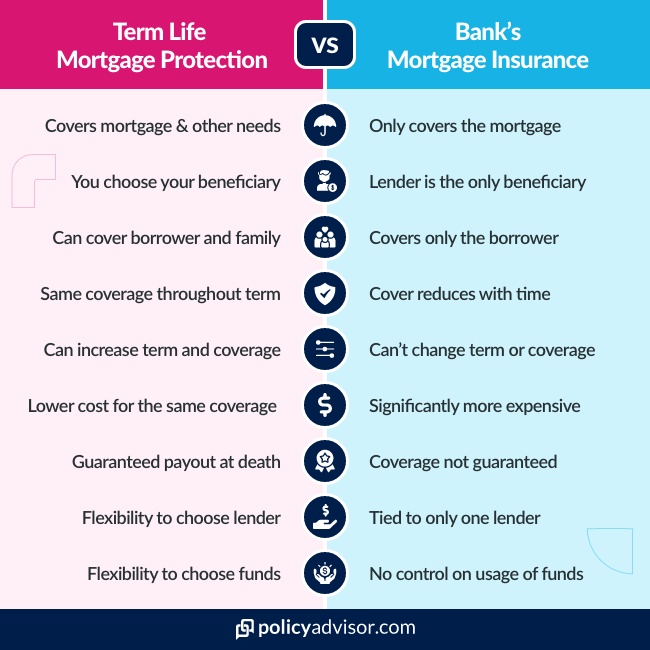
mortgage versus life insurance

How much mortgage insurance do I need?

How much mortgage coverage you need depends on the value and cost of your home and several other facts. Unfortunately, you don’t get much of a choice if you go through your lender – the coverage amount is tied to the value and term of your mortgage loan.

However, life insurance allows you to cover your mortgage loan balance and many other financial needs, including:

  • child care
  • education costs
  • your family’s future living expenses
  • funeral expenses
  • anything your beneficiaries wish

Our insurance calculator can help you find out exactly how much coverage you need.

Learn more about how much life insurance you need.

How much does mortgage insurance cost?

The cost of mortgage insurance can be 2-4 times as much as a term life insurance policy. In the below table, you can see just how affordable term insurance can be.

Coverage 10-Year Term 20-Year Term
$250,000 $11/month $14/month
$500,000 $15/month $22/month
$1,000,000 $24/month $35/month

*Premium payments for female, non-smoker, 30-years old

Why is mortgage insurance expensive?

Lender-provided mortgage insurance is expensive because there is no underwriting. Underwriting is the process an insurance company goes through to determine the appropriate fees for taking on the financial risk of your death.

Without this stringent evaluation process, they are more blindly taking on the financial risk of your policy paying out.

Read more about why mortgage insurance is so expensive.

Where do I get mortgage insurance?

You can only get mortgage insurance from the lender who provided your mortgage loan.

However, term insurance is available from several companies nationwide and the expert advisors at PolicyAdvisor have reviewed them all. We can help you find the best provider to protect your mortgage and make insurance part of your financial plan. Contact us below for advice on protecting your foray into the real estate market, or other needs like critical illness insurance or disability coverage.

Need insurance help?

Give us a call at 1-888-601-9980 or book some time with our licensed experts.

Frequently asked questions

How long does it take to get an insured mortgage?

It generally takes anywhere from a few days to a couple of weeks to get an insured mortgage in Canada. However, the duration can vary depending on several factors, such as the lender, the complexity of your financial situation, and the completeness of your application. 

Why is mortgage insurance often considered expensive?

Mortgage insurance is often considered expensive because it adds a significant cost to your mortgage payments. The premiums for mortgage loan insurance are typically added to your mortgage balance, which means you pay interest on them over the life of the loan. Additionally, if you choose to pay the premiums upfront, it can be a substantial amount that makes homeownership more expensive.

Can I cancel my mortgage insurance?

In most cases, you can cancel your mortgage loan insurance once you have paid down your mortgage to less than 80% of the home’s value, meaning your loan-to-value ratio is less than 80%. However, if you have opted for optional mortgage protection insurance, you can typically cancel it at any time, but this will depend on the terms of your policy.

How are mortgage insurance premiums calculated?

Mortgage insurance premiums are typically calculated as a percentage of your loan amount. For mortgage loan insurance, the premium rate varies based on the size of your down payment and the loan-to-value ratio. 

For example, the premium might be higher for a smaller down payment. Optional mortgage protection insurance premiums are based on factors such as your age, health, and the amount of coverage you choose.

Is mortgage insurance a one-time payment?

No, mortgage insurance, typically offered by your lender, is not a one-time payment. It is generally included in your monthly mortgage payment and can only be canceled once you reach 20% equity in your home.

Do you have to pay mortgage insurance up front?

Yes, you can pay your entire mortgage insurance premium upfront, especially if you have sufficient funds to cover the downpayment, premium expenses, and other initial costs. Paying your mortgage insurance premium upfront can help lower your monthly mortgage payments.

What age does mortgage insurance end?

In Canada, mortgage insurance, also known as mortgage life insurance or private mortgage insurance (PMI), automatically ends when you reach the age of 70.

/* Custom Archives Functions Go Below this line */ /* Custom Archives Functions Go Above this line */

Mortgage Insurance Vs Life Insurance

Have you recently purchased a home or refinanced your mortgage? If so, you have probably opened your mailbox or email inbox to find several offers for mortgage insurance. Many people confuse mortgage insurance with other products, like mortgage default insurance. Before you make a choice, look at mortgage insurance vs life insurance for your protection needs.

There are a lot of good reasons to purchase life insurance in the first place, as anyone with young children or other dependents knows. Life insurance protects your family and loved ones if anything unexpected happens to you. But it’s not the first thing on new homeowners’ minds when thinking about protecting their new purchase.

What is mortgage default insurance?

Mortgage default insurance is a mandatory insurance policy required when the down payment for your newly purchased home is above 5% but less than 20% of the value of your home. This insurance is offered to protect the lender or financial institution, in case you as the borrower are unable to make the mortgage payments for any reason. In Canada, mortgage default insurance is currently offered by two entities: Genworth and Canada Mortgage and Housing Corporation (CMHC).

On the other hand, mortgage insurance is a product that you elect to purchase for a very specific reason. What is that you ask?

Schedule a call for visitor insurance
Need insurance answers now?

Call 1-888-601-9980 to speak to our licensed advisors right away, or book some time with them below.

What is mortgage insurance?

Mortgage insurance is an insurance policy, generally offered by your lender, that pays off the mortgage should the borrower die, while the principal on the loan is still outstanding. A mortgage insurance policy (sometimes referred to as a mortgage life insurance policy) requires a fixed cost premium payment by the borrower to cover a reducing mortgage debt for the benefit of your lender until the mortgage balance is paid. With mortgage insurance, the lender is covered. However, it doesn’t fully protect you or your needs. Our experience as insurance professionals shows there are other products that do a much better job of protecting your mortgage.

Read our full review of the Best Mortgage Insurance Companies in Canada

Are there alternatives to mortgage insurance?

YES! As mentioned, mortgage life insurance entails a fixed cost payment that covers a diminishing mortgage debt for your financial institution until the mortgage is paid. The alternative to mortgage life insurance is mortgage protection through term life insurance. It can better protect your investment and the life you’re building for your loved ones.

What is mortgage protection insurance?

Mortgage protection insurance is an insurance policy offered by insurance companies that protects the borrower through a term life insurance product. It offers a lot more flexibility than traditional mortgage insurance. Term life insurance can be tailored in a way to make certain that families can pay off the mortgage balance and also provide coverage for many other needs, in case an income earner passes away. Typically, you can choose between a range of terms such as 10-, 15-, 20-, or 30-year term to closely match the length of time you have left to pay off the mortgage.

How much mortgage protection do I need?

You would generally buy at least enough mortgage protection coverage to pay the balance of your mortgage, which may be at least $160,000 (StatsCan) Mortgage protection through life insurance can make sure that a surviving spouse and children will be able to keep the family home, even if the homeowner dies unexpectedly.

Through term life insurance you have the option to consider a policy with a death benefit larger than your mortgage to cover other such obligations as your child’s education, other debts, and living expenses for survivors. Our insurance calculator can help you determine the amount of life insurance you need.

Choosing Mortgage Insurance Vs Life Insurance

Sure – there are some small advantages to mortgage insurance; we would be remiss if we didn’t mention them. As it is offered by your lender, you pay for it when you make your monthly mortgage payments – no need to worry about missing it. That said, is this small convenience worth thousands of dollars? Because that’s what you’ll be overpaying for the same amount of coverage over the life of your mortgage.

Another supposed advantage of your bank-offered mortgage life insurance – there is no underwriting when you purchase. You qualify instantly without a medical exam. The caveat here is that the mortgage insurance is not a guaranteed coverage and is only underwritten at the time of filing of a claim, so your estate might find out after your death that you weren’t covered as well as you thought or maybe not covered at all. Besides the unfortunate circumstances around an early death, having to deal with the duress of further investigation into that death is stress your loved ones do not need at that time.

 Read our full review of the Best Life Insurance Companies in Canada

mortgage versus life insurance

6 Reasons Why Term Life Insurance is Better for Mortgage Protection

1 Lower premiums

Mortgage insurance premiums offered by your bank are usually higher than term life insurance premiums. And that’s not all: lender-option premiums also increase periodically with age.

While the procedure for applying for a lender-provided policy may appear simpler, it ends up increasing your cost of insurance. Much more work goes into the diligent underwriting of life insurance, thus the insurance company knows more about the risk of covering you, and is able to give a more accurate and lower price.

2 Guaranteed coverage

When you get life insurance the insurance company guarantees your coverage, independent of any changes in your health or lifestyle choices after the policy has been approved.

Insurance offered by your bank is not guaranteed for the term of your loan. Any adverse changes in your health can cause your bank to deny you a renewal of your coverage. Worse still, the underwriting for mortgage insurance is done at the time of the claim and the bank can decline your coverage if they learn that your health was not in line with their expectations at the time of taking the policy.

More choice. Lower price.
PolicyAdvisor saves you time and money when comparing Canada’s top life insurance companies. Check it out!
GET STARTED

3 Life insurance is portable

With lender provided insurance, selling your current home and buying a new one, refinancing your home through a different lender, or even renewing your mortgage with your existing lender, requires buying new insurance policies. The mortgage dependent policy does not move or ‘port’ along with your mortgage. That’s a benefit only available with life insurance, which stays with you for the length of the term.

4 Life insurance offers a consistent payout

As you pay down your mortgage debt, the amount of the mortgage insurance payout also goes down. A lower payout must mean lower premiums, right? No, your premium stays the same, even as your coverage reduces.

On the other hand, term life insurance policy amounts and premiums remain the same over the policy term. With term life insurance, the payout would be the same whether it is year 4 or year 24 of your amortization period.

5 You choose the beneficiaries of your life insurance policy

Life insurance pays out to the beneficiaries of your choice, most likely your family. It serves to protect them when you are no longer around. Mortgage insurance isn’t really designed to protect your family. It’s designed to ensure the lender receives their money, and the fact that your family may benefit from paying off the mortgage is secondary.

6 Flexibility in using life insurance proceeds

If you should die unexpectedly, perhaps paying off the mortgage isn’t your spouse or children’s first priority. They have no choice with a lender-provided life insurance policy, but with an individually-owned life insurance policy, they can decide on the best use of the proceeds. That might mean they use the money for a college education or paying off other debts.

Want to learn even more about mortgage insurance vs life insurance? Read our Honest Guide To Mortgage Insurance or schedule a call with one of our licensed brokers to discuss your specific protection needs. Even better: get a free instant quote for mortgage protection with our online tool – you only have to answer a few basic questions to get a clear picture of how much it may cost to protect your mortgage.

Need help?
Call us at 1-888-601-9980 or book time with our licensed experts.
SCHEDULE A CALL
/* Custom Archives Functions Go Below this line */ /* Custom Archives Functions Go Above this line */

How to save money on mortgage insurance

If you are looking at houses, then you must also be looking how to save money on mortgage insurance. This is especially true when there are fees and costs, like mortgage default insurance, that are unavoidable depending on your down payment.

For instance, many potential homeowner are wondering if they qualify for the federal government’s First Time Home Buyer incentive. Through this program, they can potentially get a top up on the downpayment for their new home. Unfortunately, that new home will also have to include CMHC insurance rolled into the mortgage loan costs. Something you hope to avoid, if possible.

However, those looking to save some bucks do have options.

How to save money on mortgage insurance right now

BetterDwelling reports that big banks and lenders are already taking a disproportionate amount of your hard earned dollars. Do you want to give them even more for an insurance product when there are better and less expensive options available?

If you read our guide – like all discerning readers should – you know mortgage protection is much better served through term life insurance. Having this choice sounds great – we know – but what does it look like in real life?

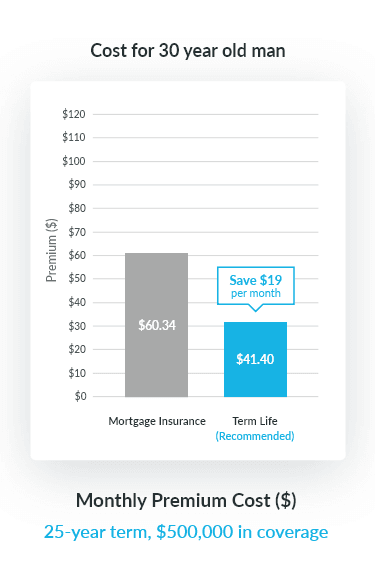
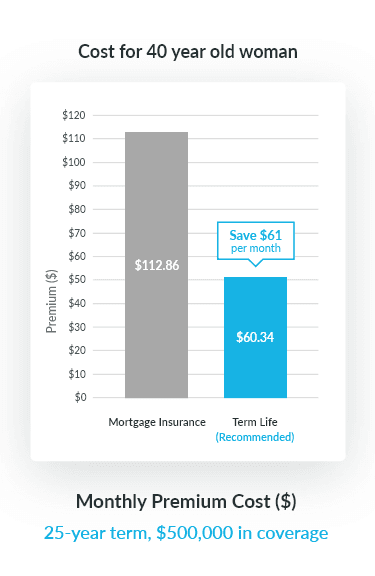
Let’s look at an example. We want to insure a mortgage in the amount of $500,000 (the principal) over a term of 25 years. The chart below shows the cost of doing so through your favourite bank’s mortgage insurance versus choosing life insurance for 30- and 40-year old applicants.

Mortgage protection through term life insurance vs lender-provided mortgage insurance*

Schedule a call for visitor insurance

Need insurance answers now?

Call 1-888-601-9980 to speak to our licensed advisors right away, or book some time with them below.

Cost for 30-year old man
Cost for 40-year old woman
More choice. Lower price.
PolicyAdvisor saves you time and money when comparing Canada’s top life insurance companies. Check it out!
GET STARTED

Wow. By shopping around instead of going with the product offered by your bank, you can save a ton of cash over 25 years, better spent on renos, furniture, and creating memories in your new home.

For the amateur mathematicians out there, if you were the 30-year old man, who decided to go for term life insurance, you would save $5,700 over the 25-year term, just in monthly cash outflow. And wait for it – if you were the 40-year old woman making the right insurance choice, you would save a whopping $18,400 by going with term life insurance over that 25-year term.

You could save tens of thousands of dollars by choosing mortgage protection through term life insurance.

Oh boy! We haven’t even factored in the cost of mortgage insurance premiums going up over time as you renew your mortgage rates. Or even still, that you could get even lower term life insurance rates if you were in good health, or that you could invest your monthly cash savings. You know where we could go with this!

Just like with mortgage rates, it pays to shop around for your mortgage insurance. Luckily we know of a place you can do that online, and within minutes. You shouldn’t need Scully and Mulder to find out the truth about mortgage protection. The lenders and banks have nowhere to hide.

*Bank mortgage premium reflects average of 4 major bank lenders with published rates.

Need help?
Call us at 1-888-601-9980 or book time with our licensed experts.
SCHEDULE A CALL
/* Custom Archives Functions Go Below this line */ /* Custom Archives Functions Go Above this line */