
Biggest life insurance companies in Canada: A complete guide (2026)

Choosing the right life insurance provider is one of the most important financial decisions you’ll make, and understanding Canada’s insurance landscape is crucial for making an informed choice.

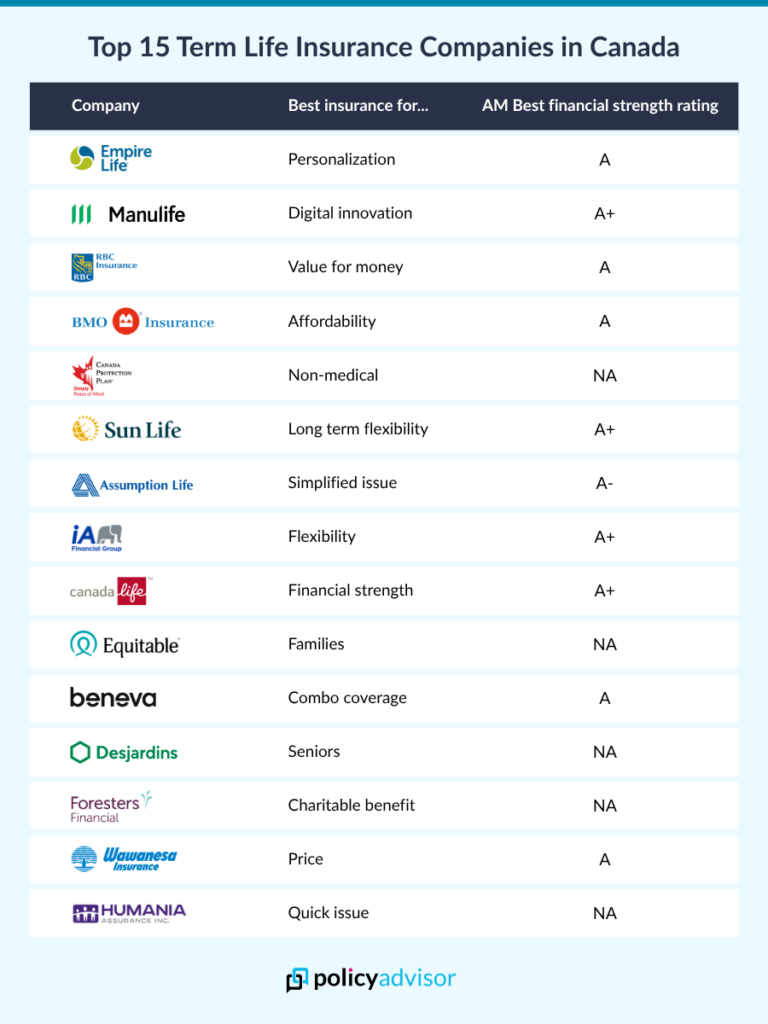
The insurance industry in Canada is dominated by several major players, each offering unique strengths in coverage options, financial stability, and customer service. 

In this guide, we review 40 of the largest life insurance companies in Canada and compare their key offerings. Understanding which insurers lead the market can help you choose the right coverage for your family’s financial security.

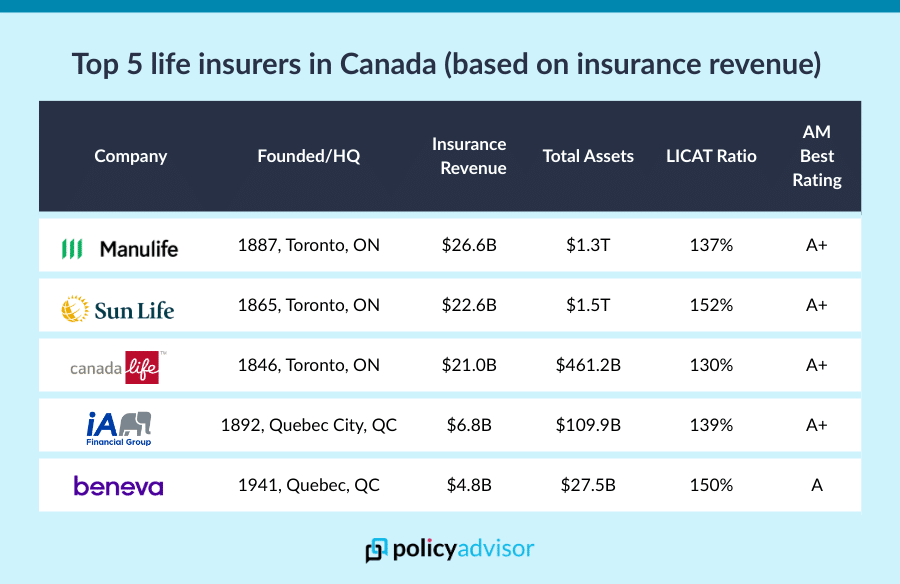
Based on our analysis of total assets, market share, and national presence, the following companies stand out as Canada’s largest life insurers. The remaining insurers are covered later in our full comparison.

Top 5 biggest life insurance companies in Canada

  1. Sun Life
  2. Manulife
  3. Desjardins
  4. Canada Life
  5. Industrial Alliance (iA)

See how much whole life insurance coverage you can get

Get instant quotes from Canada's top life insurance providers and find the perfect coverage for your family.

$500

Largest Life Insurance Companies in Canada (2026)

Explore the top 40 life insurance companies in Canada, ranked using trusted indicators of financial strength and business performance. We list all 40 insurers and further examine 28 leading companies to highlight their products, strengths, and key differentiators.

Biggest life insurance companies in Canada (2026) 


Serial Company Founded/HQ Revenue Total Assets LICAT A.M. Best
1 Sun Life 1865, Toronto, ON $21.4B $1.51T 142% A+
2 Manulife 1887, Toronto, ON $26.6B $1.3T 135% A+
3 Desjardins 1948, Lévis, QC $4.3B $470.9B 146% A
4 Canada Life 1847, Toronto, ON $21.0B $461.2B 130% A+
5 Industrial Alliance (iA) 1892, Québec City, QC $6.8B $109.9B 139% A+
6 Knights of Columbus 1882, New Haven, CT $76M $30.3B 274% A+
7 RBC Insurance 1998, Toronto, ON $2.3B $28.6B 135% A
8 Beneva 2020 (SSQ 1941/La Capitale 1940), Québec, QC $4.8B $27.5B 150% A
9 BMO 2009, Toronto, ON $1.3B $20.1B 130% A
10 Empire Life 1923, Kingston, ON $1.4B $19.7B 151% A
11 Foresters (Canada segment) 1874, Toronto, ON $910M $18.5B 182% A
12 Ivari 1927, Toronto, ON $822M $14.6B 131% A
13 Wawanesa 1896, Wawanesa, MB $300M $11.5B 165% A
14 Co-operators 1945, Guelph, ON $1.0B $10.5B 168% A
15 Equitable Life 1920, Waterloo, ON $920M $10.2B 169% N/A
16 Blumont Annuity Company 2016, Toronto, ON $383M $7.5B 147% N/A
17 Primerica 1977, Duluth, GA $359M $4.1B 191% A+
18 UV Insurance 1889, Drummondville, QC $225M $2.4B 172% N/A
19 TruStage Life 1902, Toronto, ON $120M $2.4B 165% A-
20 Blue Cross 1939, Multi-province $686M $2.3B 135% A-
21 Assumption Life 1903, Moncton, NB $147M $2.3B 165% A-
22 Metropolitan Tower (Canada branch) 1982, New York (Canada ops) $331M $2.3B 171% A+
23 Securian Canada 1955, Toronto, ON $990M $1.2B 153% A
24 Combined Insurance 1922, Chicago, IL $230M $1.1B 176% A+
25 New York Life 1845, New York, NY $42M $696M 353% A++
26 Humania 1874, Québec, QC $200M $678M 185% N/A
27 British Cayman Insurance Company Cayman Islands $77M $471M 176% N/A
28 Serenia Life 1972, Waterloo, ON $20M $371M 177% N/A
29 Chubb Life 1882, Toronto, ON $342M $345M 163% A+
30 TD Life 1855, Toronto, ON $155M $344M 200% N/A
31 Connecticut General 1957, Bloomfield, CT $4M $195M 223% A
32 CIBC Life 1961, Toronto, ON $29M $164M 494% NR
33 Cigna Life 1982, Bloomfield, CT $111M $136M 245% A
34 Aetna Life 1939, Toronto, ON $28M $98M 496% A
35 American Income Life 1951, Waco, TX $71M $64M 169% A+
36 American Health & Life 1954, Fort Worth, TX $17M $64M 576% A-
37 Allianz Partners Paris (Canada branch) $15M $38M 271% N/A
38 Reliable Life 1887, Hamilton, ON $3M $14M 310% N/A
39 Jackson National Life 1961, Lansing, MI $254K $11M 458% A
40 Teachers Life 1972, Waterloo, ON $25M N/A 234% N/A

* Methodology and sources for the above table

 We standardize “revenue” as Insurance Service Revenue under IFRS 17 and reconcile across sources. Where company-year figures differ, we use the latest audited report and note variances in footnotes.

  • Office of the Superintendent of Financial Institutions (OSFI) financial data (2024)
  • A.M. Best Financial ratings (2025)
  • Company annual reports 

Your benefits are protected: If a member life insurer fails, Assuris protects your policy up to $1,000,000 or 90% of the death benefit, whichever is higher. This safety net applies to most Canadians.

Read our detailed review of the best life insurance companies in Canada

1. Sun Life

$1.51T Assets
Overview

Sun Life Financial, Inc. is one of the largest life insurers in the world, and also one of the oldest, with a history spanning back to 1865.


Apart from Canada, they have a presence in the U.S. and in seven Asian markets, including China and India.

Insurance Products Offered
Term life insurance Permanent life insurance Mortgage protection insurance Critical illness insurance Disability insurance Health & dental insurance Travel insurance Long-term care insurance Investments and savings: retirement income plans, asset management, etc. Financial advice
Why choose Sun Life
Introduces a large number of digital projects, including Prospr by Sun Life to assist Canadians with their financial goals
Connects clients with a licensed advisor, assess their financial needs, and track their financial goals through Prospr
Provides round-the-clock access to medical and mental health professionals via the Lumino Health Virtual Care platform
Engages in community initiatives and partnerships, focusing on building healthier communities
Read our full Sun Life insurance review

2. Manulife

$1.3T Assets
Overview

Manulife Financial Corporation is one of the largest life insurers in Canada, and also one of the most globally recognized, with operations in Canada, the U.S. (through John Hancock), and multiple Asian markets. Founded in 1887, the company manages approximately  $1.3 trillion assets under management and administration globally.

Insurance Products Offered
Term life insurance Permanent life insurance (whole life, universal life) Mortgage protection insurance Critical illness insurance Disability insurance Health & dental insurance Travel insurance Group benefits and workplace plans Banking solutions through Manulife Bank
Why choose Manulife
Provides AI-powered accelerated underwriting up to $5M for ages 18-50
Rewards clients for healthy habits with premium savings and lifestyle rewards through the Manulife Vitality program
Expands access to coverage for diabetes and HIV-positive applicants
Offers strong financial stability with A+ ratings from A.M. Best and nearly $1 trillion in global assets
Read our full Manulife Term Life Insurance Review

3. Desjardins

$470.9B Assets
Overview

Desjardins is well known across Canada, offering a wide variety of financial services and insurance products.


The company mainly focuses on life, health, and home insurance, and wealth management services. They also offer business services like point-of-sale payments and cash management.

Insurance Products Offered
Term life insurance Permanent life insurance Critical illness insurance Disability insurance Health & dental insurance Travel insurance Auto & RV insurance Home insurance Pet insurance Group insurance Creditor insurance Business insurance Investments and savings: guaranteed investment accounts, wealth management, loans, etc. Mortgages
Why choose Desjardins
Operates as a cooperative financial institution owned and governed by its members, with the Melodia portfolio helping users invest in diversified assets such as stocks and bonds
Introduces the “caissassurance” model, enabling customers to obtain insurance products directly through their neighbourhood caisse populaire
Read our full Desjardins Insurance Review

4. Canada Life

$461.2B Assets
Overview

Canada Life is one of the oldest and most stable life insurers in the country. Up until recently, it came second to Manulife in the number of annual premiums, which was no surprise given that Manulife is one of the largest companies in the world.


In 2020, Great West Life merged with its sister companies, London Life and Canada Life, into the single Canada Life Assurance Company brand. That merger pushed Canada Life to the top of the charts.

Insurance Products Offered
Term life insurance Permanent life insurance Critical illness insurance Disability insurance Health & dental insurance Creditor insurance Business insurance & workplace benefits Investments & savings: segregated funds, annuities, retirement planning, etc. Mortgages
Why choose Canada Life
Holds $461 billion in assets, making it one of the largest life insurance companies in Canada
Provides accessible healthcare and affordable medication through its DrugHub mobile application
Supports corporate social responsibility initiatives, including the Health and Homelessness Fund that raised $500,000 for the homeless in London, Ontario
Read our full Canada Life Term Life Insurance Review

5. iA (Industrial Alliance)

$109.9B Assets
Overview

iA (Industrial Alliance) Financial Group is one of the largest insurance and wealth management groups in Canada. They also have operations in the United States. It was founded in 1892 and offers both individual and group benefits products.


iA  is more than an insurance company; they also work in property management and real estate. They rent out many office spaces in major cities across Canada.

Insurance Products Offered
Term life insurance Permanent life insurance Mortgage protection insurance Critical illness insurance Disability insurance Travel insurance Car & RV insurance Home insurance Investments and savings: registered savings plans, annuities, loans, etc.
Why choose iA
Maintains a strong financial foundation, serving over 4 million clients with the help of over 25,000 representatives
Provides 24/7 direct access to healthcare professionals, along with telemedicine and stress and wellness management programs through the Dialogue wellness application
Read our full iA Term Life Insurance Review

6. Knights of Columbus

$30.3B Assets
Overview

Knights of Columbus is a Catholic fraternal organization founded in 1882 as a mutual benefit society for Catholic people who moved to the US. It provides coverage for members and their families, offers insurance and financial services, and actively engages in charitable work.

Insurance Products Offered
Term life insurance Permanent life insurance Disability insurance Long-term care insurance Investments and savings: investment management, annuities, etc.
Why choose Knights of Columbus
Engages in charitable work, donating over $185 million and contributing 49 million volunteer hours in 2022 alone
Read our full iA Term Life Insurance Review

7. RBC Insurance

$28.6B Assets
Overview

The Royal Bank of Canada (RBC) is one of North America’s most well-known financial institutions. RBC Insurance is the division that provides insurance products and services to individuals and businesses across Canada.

Insurance Products Offered
Term life insurance Permanent life insurance Critical illness insurance Disability insurance Health insurance Travel insurance Auto insurance Home insurance Group insurance Creditor insurance Business insurance & reinsurance Investments and savings: guaranteed investment accounts, wealth management, loans, etc. RBC Private Insurance, a comprehensive, customizable risk protection package
Why choose RBC Insurance
Offers innovative Reinsurance Business solutions, insuring the risks of other insurance and reinsurance companies and covering life, longevity, disability, and accident
Provides specialized options for business clients, including business loan insurance and group benefits programs
Enjoys robust financial stability as part of the Royal Bank of Canada, one of the largest banks globally
Read our full RBC Term Life Insurance Review

8. Beneva

$27.5B Assets
Overview

Beneva, formed from the merger of Quebec-based SSQ Insurance and La Capitale, ranks among Canada’s top mid-tier life insurers by assets (~$27.5B) and regional presence.


SSQ Insurance was founded in 1944, while La Capitale was founded just a few years earlier, in 1940. Both companies were founded and operated on mutualist values, which have carried on with their merger into Beneva. This makes it one of the biggest mutual insurance companies in the country.

Insurance Products Offered
Term life insurance Permanent life insurance Critical illness insurance Disability insurance Health & dental insurance Auto & RV insurance Home insurance Group insurance Creditor insurance Business insurance Investments and savings: guaranteed investment accounts, wealth management, loans, etc.
Why choose Beneva
Enables customers to monitor and manage their investment portfolio through the Client Centre online platform, with 24/7 access to policies, claims submissions, and tracking
Connects users to the top three doctors in the area through the Assistance Benefit service during emergencies
Supports student-athletes and funds over 200 young sports enthusiasts
Read our full Beneva Life Insurance Review

9. BMO

$20.1B Assets
Overview

BMO Financial Group is one of the largest financial institutions in Canada, if not the world. It was founded in 1817 as the Bank of Montreal.


BMO Insurance is a part of BMO that sells insurance policies and similar services.

Insurance Products Offered
Term life insurance Permanent life insurance Critical illness insurance Travel insurance Investments and savings: income annuities, guaranteed investment funds, etc.
Why choose BMO
Invests in digital tools such as online policy management and claims submission to improve the customer experience
Leverages BMO’s strong banking network to offer integrated financial and insurance solutions
Maintains strong financial stability as part of one of Canada’s largest banking institutions
Read our full BMO Term Life Insurance Review

10. Empire Life

$19.7B Assets
Overview

Empire Life was founded in Kingston, Ontario, in 1936. The company operates services, sales, and marketing centres throughout Canada. They are most well known for their permanent participating life insurance policies.

Insurance Products Offered
Term life insurance Permanent life insurance Critical illness insurance Disability insurance Health & dental insurance Group insurance Investments & savings: RRSPs, annuities, etc.
Why choose Empire Life
Maintains strong financial stability, with a Life Insurance Capital Adequacy Test (LICAT) ratio well above minimum regulatory requirements
Provides retirement and savings support through tools like the Retirement and Savings Tool to help users track goals and plan for retirement
Read our full Empire Life Insurance Review

11. Foresters

$18.5B Assets
Overview

Foresters Financial is a company that offers financial services in Canada, the US, and the UK. It was founded over 140 years ago, in 1870. Many of Foresters’ life insurance products help charities.


Many of its life insurance products support charities through claims, grants, or special programs. Foresters underwrite the insurance policies offered by Canada Protection Plan.

Insurance Products Offered
Term life insurance Permanent life insurance Mortgage protection insurance Critical illness insurance Investments and savings: retirement income plans, annuities, etc.
Why choose Foresters
Operates as a fraternal benefit society and offers unique member benefits such as competitive academic scholarships, volunteer grants, and everyday expense discounts
Provides complimentary events for insured members and their families, including baseball games and amusement park outings
Read our full Foresters Term Life Insurance Review

12. ivari

$14.6B Assets
Overview

ivari (formerly Transamerica Life Canada) was acquired by Wilton Re in 2015. They have been operating for more than 80 years, offering a variety of insurance policies and investment products.

Insurance Products Offered
Term life insurance Permanent life insurance Critical illness insurance Investments and savings: annuities, segregated funds, guaranteed interest accounts, etc.
Why choose ivari
Engages in community support through charitable giving and partnerships, including collaboration with United Way Centraide Canada
Offers the My Insurance View interactive tool to provide clients with personalized insurance solutions based on budget and premium-paying capacity
Provides access to virtual healthcare through the Maple mobile app for eligible Critical Illness and SimplyLife policyholders and their dependents.
Read our full Ivari Term Life Insurance Review

13. Wawanesa

$11.5B Assets
Overview

Wawanesa Mutual is the parent company of Wawanesa Insurance, which sells life and other insurance products. Founded in 1896 and based in Winnipeg, Manitoba, the company also operates as Wawanesa General in the United States, primarily selling property and casualty insurance in California and Oregon.

Insurance Products Offered
Term life insurance Permanent life insurance Critical illness insurance Disability insurance Auto insurance Home & renters insurance Pet insurance Group insurance Commercial/business insurance Farm insurance Investments and savings: registered savings plans, guaranteed investment accounts, annuities, etc.
Why choose Wawanesa
Operates as a mutual company, meaning policyholders own the company and priorities align with customers’ needs
Offers individualized service and a customer-focused approach
Provides competitive rates without sacrificing coverage quality, appealing to value-conscious customers
Read our full Empire Life Insurance Review

14. Co-operators

$10.5B Assets
Overview

The Co-operators Group Limited is a leading Canadian co-operative company. They offer a wide range of insurance and financial services, mostly through a network of financial advisors and brokers.

Insurance Products Offered
Term life insurance Permanent life insurance Mortgage protection insurance Critical illness insurance Travel insurance Auto & RV insurance Home insurance Property & casualty insurance (P&C) Group insurance Business insurance Farm insurance Brokerage services
Why choose the Co-operators
Collaborates with governments, research organizations, municipalities, non-profits, and investors to build climate-resilient communities
Has set net-zero targets for operations and investments to contribute to a healthier, sustainable future

15. Equitable Life

$10.2B Assets
Overview

Equitable Life Insurance Canada is a federally regulated mutual life insurer, governed by federal rules. Like Beneva and Wawanesa, Equitable is also a mutual company that is partly owned by some of its clients.

Insurance Products Offered
Term life insurance Permanent life insurance Critical illness insurance Disability insurance Health & dental insurance Group insurance Investments and savings: retirement income protection, segregated funds, etc.
Why choose Equitable Life
Enables customers to manage policies online, including requesting policy loans, transferring investments, and changing beneficiaries, offering ease and flexibility
Offers the First Home Savings Account (FHSA) with maximum coverage amounts and attractive home insurance benefits at reduced premium costs for first-time homeowners
Emphasizes individualized service, with dedicated insurance advisors providing guidance and support throughout the insurance process
Read our full Equitable Life Insurance Review

16. Primerica

$4.1B Assets
Overview

The Primerica Canada Insurance Company was started in 1986. It is a subsidiary of Primerica Life Insurance Company, offering insurance and other financial services.

Insurance Products Offered
Term life insurance Disability insurance Auto insurance Investment management services Pre-paid legal services Financial Needs Analysis (FNA) services
Why choose Primerica
Helps families achieve financial security by offering accessible financial products tailored to individuals earning between $30,000 and $100,000 annually
Offers the Primerica Representative application to help individuals understand their financial position and create an improved financial plan within 30 minutes

17. UV Insurance

$2.4B Assets
Overview

UV Insurance, formerly known as UL Mutual, was founded in 1889 in Quebec. 

Insurance Products Offered
Term life insurance Permanent life insurance Critical illness insurance Group insurance Investments and savings: retirement products, guaranteed investments, etc.
Why choose UV Insurance
Earns recognition as the second most sustainable SME in Quebec, building on a century of accomplishments
Collaborates with ventures that share its values in sustainability and innovation
Read our full UV Life Insurance review

18. TruStage Life (Assurant Life)

$2.4B Assets
Overview

The insurance company known as Assurant Life rebranded into TruStage in 2022 after it was bought by CUNA Mutual Group.


As an insurance company, they specialized in selling insurance for end-of-life planning, like funeral insurance and executor protection insurance. They also offer services like assessing and handling final documents (wills, trusts, etc.).

Insurance Products Offered
Term life insurance Permanent life insurance Cancer, heart attack, and stroke insurance coverage Auto insurance Home insurance Business insurance Investments and savings: annuities, wealth management services, etc. Funeral pre-planning services
Why choose TruStage Life
Offers guaranteed issue and permanent final expense coverage with limits up to $300,000, including a two-year graded period for non-preferred applicants; whole life coverage is available up to $100,000.
Partners with credit unions to provide life insurance options to members who already do business with their credit union

19. Blue Cross

$2.3B Assets
Overview

There are many different Blue Cross member plans in Canada. The Canadian Association of Blue Cross Plans is the group that represents all of them nationally.


Blue Cross is best known for group insurance and travel insurance. Canadians who are Blue Cross members can save money on insurance for various services, including vision, medical, and more, through their Blue Advantage program.

Insurance Products Offered
Term life insurance Permanent life insurance Critical illness insurance Disability insurance Health & dental insurance Travel insurance Group insurance
Why choose Blue Cross
Offers the “Young Adults Benefits Package” to help young working individuals access health and dental coverage at minimal cost
Engages in wellness and preventive care programs, reflecting a commitment to healthier communities and public health

20. Assumption Life

$2.3B Assets
Overview

Assumption Life is best known for its no-medical term life plans. They were founded in 1903 in New Brunswick, Canada. But they were originally a fraternal society in Massachusetts, USA, before they decided to start selling insurance.

Insurance Products Offered
Term life insurance Permanent life insurance Critical illness insurance Group insurance Commercial mortgage insurance Investments and savings: retirement products
Why choose Assumption Life
Provides a Registered Investment Account (RIA) with low management fees and high-performing funds, designed for fee-conscious clients
Offers high-performing, pre-packaged funds that are professionally managed and tailored to each client’s risk tolerance and time horizon
Read our full Assumption Life Insurance Review

21. Securian Canada

$1.2B Assets
Overview

Most people know Securian Canada by its old name, Canadian Premier Life. It is a company that offers financial management services and several insurance products.

Insurance Products Offered
Term life insurance Permanent life insurance Mortgage protection insurance Critical illness insurance Group insurance Creditor insurance Business insurance Asset management services Customized products for financial institutions
Why choose Securian Canada
Focuses on providing insurance solutions tailored for financial institutions and affinity groups to meet their unique market needs
Adds value to memberships by offering group pricing through programs such as the CPA insurance program

22. Combined Insurance Company of America

$1.1B Assets
Overview

Combined Insurance Company of America is owned by Chubb Insurance Company in the US. It was founded in 1922 and sells insurance to people and businesses.

Insurance Products Offered
Supplemental life insurance Critical illness insurance Disability insurance Combined Insurance Worksite Solutions offers comprehensive insurance coverage to complement group insurance
Why choose Combined Insurance
Prioritizes accessible and easy-to-understand supplemental insurance while providing information and assistance to help clients evaluate their options
Earns recognition as one of the best military-friendly employers, reflecting a commitment to hiring veterans and supporting military families

23. Humania

$678M Assets
Overview

Humania Assurance was founded in Quebec in 1874 as a mutual society. They offer a lot of no medical life insurance options and are best known for how quickly they issue policies.

Insurance Products Offered
Term life insurance Mortgage insurance Critical illness insurance Disability insurance Health insurance Travel insurance
Why choose Humania
Prioritizes a human-centric strategy, ensuring customer interactions are marked by empathy and understanding to improve the overall experience
Celebrates 150 years of serving clients and building a strong network of policyholders, advisors, and trusted partners in Canada
Read our full Humania Term Life Insurance Review

24. Serenia Life

$371M Assets
Overview

Serenia Life is a U.S. fraternal benefit society that sells insurance in Canada. It was founded in 1972 and used to be called Faithlife Financial up until 2008. Their company is inspired by Christian values.

Insurance Products Offered
Term life insurance Permanent life insurance Investments and savings: investment management, annuities, etc.
Why choose Serenia
Provides one-on-one financial guidance, ensuring each member receives advice tailored to their needs
Encourages members to engage in charitable activities and community support, reflecting a belief that prosperity and generosity go hand in hand

25. Chubb Life

$345M Assets
Overview

Chubb Life Insurance Company was founded in 1882. Now, they are a trusted and reliable provider of insurance in Canada. They have offices in Ontario, Quebec, Alberta, and British Columbia.

Insurance Products Offered
Term life insurance Permanent life insurance Critical illness insurance Travel insurance Auto insurance Home insurance Property & casualty insurance Group insurance Business insurance
Why choose Chubb Life
Integrates insurance products into multiple ecosystems through the Chubb Studio platform, enabling simple and effective digital access to coverage
Offers a client benefits program that provides access to career, legal, financial, and mental health counseling

26. CIBC

$164M Assets
Overview

CIBC Insurance is a part of CIBC (the Canadian Imperial Bank of Commerce), one of Canada’s biggest banks. The bank itself was formed in 1961 after two older Canadian banks merged into one. They later started selling insurance products too.

Insurance Products Offered
Term life insurance Critical illness insurance Travel insurance Auto insurance Home insurance Creditor insurance
Why choose CIBC
Prioritizes environmental, social, and governance (ESG) principles by supporting sustainable financing initiatives and renewable energy investments
Enhances customer experience through advanced technology, including mobile banking apps and digital tools, to make insurance simpler for users

27. American Income Life

$64M Assets
Overview

American Income Life was founded in 1951. The company now sells insurance in Canada, the US, and New Zealand. They focus on helping working families and members of credit unions, labour unions, and other associations get insured.

Insurance Products Offered
Term life insurance Critical illness insurance Supplemental health insurance
Why choose American Income Life
Provides a no-cost Legacy Will Kit to help users secure their family’s future and ensure their wishes are honored
Maintains upfront and honest pricing with no hidden fees or commissions
Empowers clients through financial education, offering seminars, workshops, and resources to support informed decisions

28. Reliable Life

$14M Assets
Overview

Reliable Life has been helping Canadians with insurance since 1887. They are also part of a company called the Old Republic International Corporation, which is listed on the New York Stock Exchange. Reliable Life mostly sells travel insurance and accident insurance for students.

Insurance Products Offered
Travel insurance Accident insurance
Why choose Reliable Life
Reliable Life offers annuity products that provide a steady stream of income for life
Looking for affordable life insurance?

PolicyAdvisor gets you the lowest quotes, instantly!

What’s new in our 2026 insurance company rankings?

Rankings now weigh financial strength, product flexibility, and customer experience,so size alone doesn’t decide the winner. Here’s how we score and why it matters to you.

We measure financial strength by looking at each insurer’s total assets, LICAT ratio (a key solvency indicator), and credit ratings from A.M. Best, S&P, and Moody’s. This helps us understand how stable and reliable each company is when it comes to paying claims.

We also evaluate the range and flexibility of insurance products available, including life, health, and supplemental coverage. Insurers offering more customization, modern features, and digital tools score higher in this area.

Lastly, we consider the customer experience, from how quickly claims are paid to how easy it is to manage your policy online. We review third-party ratings, client feedback, and the overall quality of digital services.

This new ranking system makes it easier for you to compare insurance companies in Canada and find the one that fits your needs best.

IFRS 17: How it changes reported revenue in 2026 rankings

International Financial Reporting Standard 17 (IFRS 17) replaced IFRS 4 (Insurance Contracts) for Canadian life insurers beginning January 1, 2023. It requires companies to recognize revenue based on the value of insurance services provided over time rather than on gross premiums received. This change often results in lower headline revenue numbers under the new standard, reflecting a more transparent and economically relevant view of insurance operations. 

What it means for policyholders:

IFRS 17 does not change your premiums or coverage. You still receive the same benefits. However, it gives you a clearer view of how insurers manage risk and earn profits.

For investors, this standard improves transparency, reduces earnings volatility, and provides better insight into long-term financial performance.

How to choose the right insurer

When comparing the top life insurance companies in Canada, it’s important to go beyond size and brand recognition. Choosing the right provider means assessing financial strength, coverage options, premium affordability, and regional relevance.

Whether you are a young family, business owner, retiree, or high-net-worth individual, matching your needs with the right insurer can lead to better protection and long-term value.

Key selection criteria for top Canadian life insurance companies


Category What to look for
Financial strength
  • A.M. Best Superior rating (A/A+ preferred) for maximum stability
  • A- Excellent minimum for secure coverage
  • LICAT ratio >120% (150%+ ideal) 
  • Over 100 years in business
  • Strong capital reserves
Coverage needs
  • Term life (10, 20, or 30 years) 
  • Whole or universal life
  • Critical illness and disability options
Premium affordability
  • Competitive quotes from multiple providers
  • Annual vs. monthly premium choice 
  • Stable premiums over time
  • Dividend potential for permanent life
Digital and human support
  • Online comparison tools
  • Access to licensed advisors
  • Transparent educational resources

Is it better to choose a bigger insurance company?

Buying a policy from one of the biggest insurance companies in Canada may not always be the best choice. Just because a company is the biggest, it does not mean that it is the right company for your needs. Sometimes, going with a smaller company may be to your advantage.

This is why it is best to speak with our licensed advisors. They have intimate knowledge of the Canadian insurance market and can recommend the best provider for your specific needs.

largest life insurers in Canada

Comparing large vs. small insurance companies

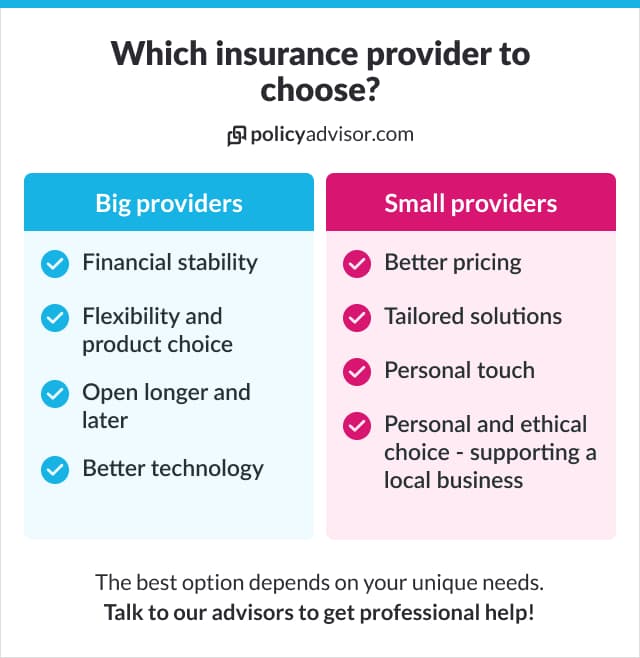
Choosing the right insurer depends on what matters most to you. Larger companies offer scale, extensive coverage options, and advanced technology, while smaller companies provide personalized service, flexible products, and local expertise. The table below highlights key differences to help you decide.

Key differences between large and small insurance companies


Feature Big insurance Small insurance
Experience Decades of industry expertise Stable, often niche-focused
Coverage Options Term & permanent, high limits Tailored products, flexible riders
Price Slightly higher, depends on scale Competitive, sometimes lower
Customer Service Fast, multiple offices & agents Personalized, flexible, responsive
Accessibility Extended hours, nationwide Limited locations/hours
Technology Advanced tools for quotes, claims, policy management Simpler tech, more customization
Values & Ethics Standard corporate practices Local, mutual, or ethically aligned

Still looking for the top insurance companies in Canada?

If you’re still not sure whether one of the largest Canadian insurance companies is right for you, our advisors are happy to help you out! Schedule a call and let our experts answer your questions about what is offered by Canadian insurance companies, big and small.

Online insurance brokers like PolicyAdvisor.com let you compare insurance quotes from 30 of the country’s best insurance companies. Schedule a call or try out our instant insurance quoting tools to see how much you can save by comparing quotes online

We make choosing the right insurer easy.

Give us a call at 1-888-601-9980 or book some time with our licensed experts.

Frequently asked questions

How often do rankings of life insurance companies change?

Rankings can change annually or even more frequently, depending on factors like financial performance, customer service ratings, innovation, and regulatory changes. A company’s solvency, claims handling, and market share can all influence its position in industry reports or consumer rankings.

What factors affect the financial stability of life insurance companies?

Financial stability is typically measured by solvency ratios, capital reserves, investment performance, and underwriting profits. Companies with diverse investment portfolios, strong risk management practices, and consistent profitability are generally more stable and reliable over the long term.

Can I buy life insurance from a company not based in Canada?

You can only purchase life insurance from international companies that are licensed to operate in Canada. These insurers must comply with Canadian regulations and are monitored by federal or provincial insurance regulators. Buying from an unlicensed foreign insurer could leave you unprotected or unable to enforce your policy.

What are the benefits of choosing a large life insurance company over a smaller one?

Large insurers often offer a wider range of products, stronger digital platforms, and greater financial stability. They may also have more streamlined claims processes and better access to additional services, such as financial planning tools or wellness programs. However, smaller insurers may provide more personalized service or competitive pricing.

How do consumer ratings affect life insurance companies?

Consumer ratings influence a company’s reputation and can guide potential customers during their decision-making process. Positive reviews can enhance trust, while repeated complaints may raise concerns. While not the sole factor, consumer feedback is a helpful indicator of service quality and client satisfaction.

What should I do if I am not satisfied with my life insurance provider?

You should begin by reviewing your policy, identifying specific concerns and contacting your insurer’s customer service to discuss your issue. If the problem persists, you can file a complaint with your provincial insurance regulator. If you are considering switching providers, ensure your new policy is active before cancelling the old one to avoid any coverage gaps.

Which are the best insurance companies in Canada for 2026?

The best insurance companies in Canada for 2026 are determined by their financial strength, customer satisfaction, product innovation, and digital capabilities. Leading providers include:

  • Sun Life, for strong client satisfaction and wellness-focused products
  • Manulife, for innovation and global reach
  • Desjardins, for cooperative structure and personalized service
  • Canada Life, for scale and comprehensive coverage options
  • Industrial Alliance, for regional expertise and competitive pricing


How do I choose between the largest insurance companies in Canada?

Choosing the right insurer involves assessing several factors such as financial strength (A.M. Best ratings and LICAT ratios), product suitability based on your needs, pricing competitiveness, quality of service and claims experience, and access to digital tools for convenience and support.

Are bigger insurance companies always better?

Larger insurance companies offer advantages such as financial stability, broad product availability, and extensive support networks. However, they may not always be the best fit. Smaller or regional insurers can provide more competitive pricing, personalized service, and flexible options tailored to specific needs.

What is the difference between the top 10 and top 20 insurance companies in Canada?

The top 10 insurers are typically national leaders with large-scale operations and diversified offerings. The top 20 includes regional and specialized insurers that may excel in niche markets or offer unique advantages in pricing, service, or policy design.

How often do rankings of the biggest insurance companies change?

Rankings among Canada’s top five life insurers tend to remain consistent year over year. However, changes can occur due to mergers, premium growth, or shifts in market strategy. Notably, Canada Life’s position strengthened following its merger with Great-West Life and London Life.

Can I trust the financial ratings of Canada’s largest insurance companies?

Yes. Canada’s major insurers are rated by independent global agencies such as A.M. Best, Moody’s, S&P Global, and DBRS Morningstar. These ratings reflect a company’s financial strength, claims-paying ability, and long-term stability, and are reviewed regularly.

Do the top Canadian life insurance companies operate nationwide?

Yes, all top life insurance companies in Canada are licensed to operate nationwide. While some have stronger regional footprints, such as Desjardins and iA in Quebec or Wawanesa in the West, they serve clients across the country either directly or through licensed advisors.

What makes the best insurance companies in Canada in 2026 different from previous years?

Top insurers in 2026 are distinguished by their investment in digital transformation, faster underwriting through AI, integrated wellness and health features, ESG investment practices, and personalized insurance solutions using data and analytics. These enhancements improve both accessibility and client experience.

/* Custom Archives Functions Go Below this line */ /* Custom Archives Functions Go Above this line */

Best whole life insurance companies in Canada (2026)

Choosing from the best whole life insurance companies in Canada feels overwhelming; there are dozens of insurers, each claiming strong performance and long-term value. 

Dozens of insurers offer participating policies, each promising strong dividends, long-term cash value growth, and flexible coverage options.

To identify the best whole life insurance companies in Canada for 2026, our team reviewed financial strength, dividend performance, cash value growth, product flexibility, and customer experience.

Based on our review, the following five companies stand out for their combination of strong performance and flexible plans, with the remaining providers covered later in our full comparison.

Top 5 whole life insurance companies in Canada (2026)

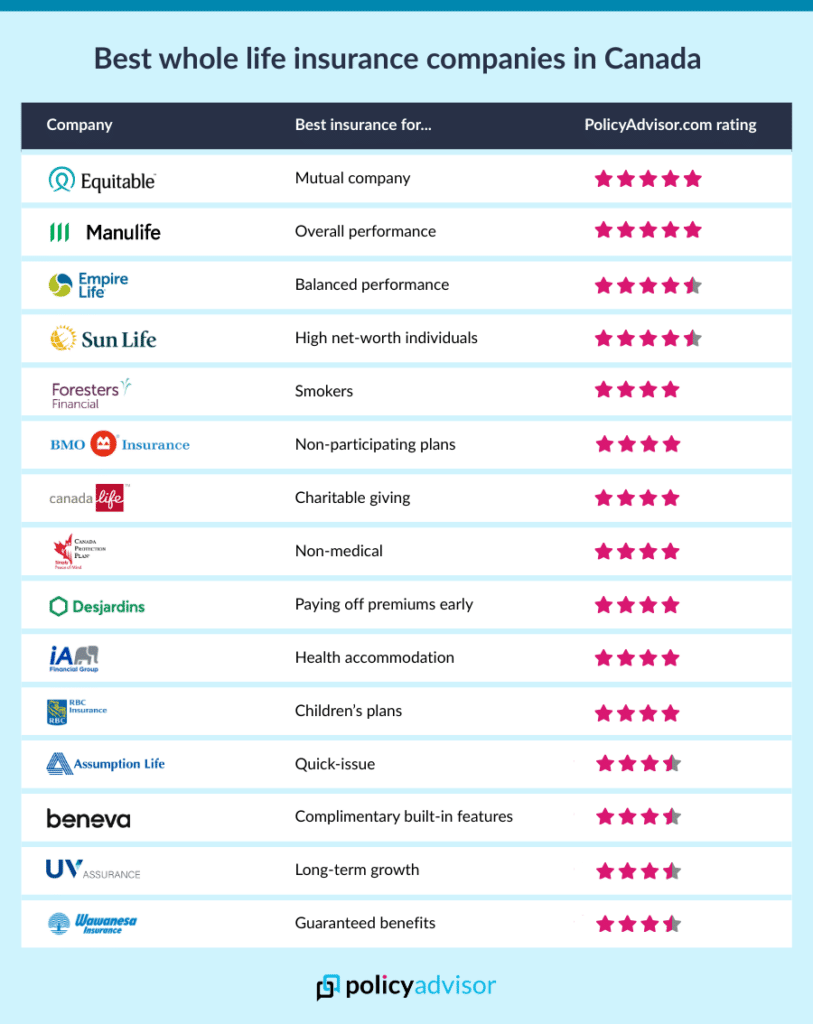
  1. Equitable Life: Best mutual insurer
  2. Manulife: Best for overall performance
  3. Empire Life: Best for balanced performance
  4. Sun Life: Best for high-net-worth individuals
  5. Foresters: Best coverage for smokers

What is whole life insurance?

A whole life insurance policy is a type of permanent life insurance that provides lifelong coverage. It offers a guaranteed, tax-free death benefit and includes a built-in investment component that grows cash value over time. With a participating whole life policy, you receive dividends, although the amount is not guaranteed.

Most people choose whole life insurance in Canada to support estate planning, cover capital gains taxes at death, and leave a tax-free inheritance, while also handling final expenses and probate fees.

Learn about whole life insurance

See how much whole life insurance coverage you can get

Get instant quotes from Canada's top life insurance providers and find the perfect coverage for your family.

$100K

How does whole life insurance work?

Whole life insurance provides coverage for life,  cash value component, optional dividends on par plans, and access to funds via loans/withdrawals. Dividends are not guaranteed and past performance doesn’t predict future results. Here’s how whole life insurance works. 

  • Lifetime coverage: You’re covered for life as long as premiums , and your beneficiaries receive a guaranteed tax-free death benefit
  • Cash value growth: Part of each premium goes into a cash value account that grows tax-deferred and becomes a long-term asset you can use for education costs, emergencies, or retirement income
  • Access to funds: You can access the accumulated cash value through policy loans or withdrawals for added financial flexibility, such as covering emergencies, education, or retirement income
  • Dividends : Some participating policies pay dividends you can use to reduce premiums, buy more coverage, or take as cash
  • Financial security: The policy provides stable long-term protection, covering final expenses and supporting your family with guaranteed benefits

The best whole life insurance companies in Canada 

Our team reviewed leading Canadian insurers based on financial strength, dividend history, cash value growth, and underwriting to determine the best whole life insurance companies across different needs and profiles.

15 best whole life insurance companies in Canada

  1. Equitable Life: Mutual company
  2. Manulife: Overall performance
  3. Empire Life: Balanced performance
  4. Sun Life: High-net-worth individuals
  5. Foresters: Smokers
  6. BMO Insurance: Non-participating plans
  7. Canada Life: Charitable giving
  8. Canada Protection Plan: Non-medical
  9. Desjardins: Early and flexible pay-off
  10. iA (Industrial Alliance): Health accommodation
  11. RBC Insurance: Children’s plans
  12. Assumption Life: Quick-issue
  13. Beneva: Complimentary built-in features
  14. UV Insurance: Long-term growth
  15. Wawanesa: Guaranteed benefits

Let’s take a closer look at what makes these whole life insurance companies among the best in Canada.

Best Whole Life Insurance in Canada 2026

1. Equitable Life: Best for mutual company

Best for mutual company
☆☆☆☆☆
★★★★★
PolicyAdvisor rating
Plans offered
Equimax Estate Builder
Equimax Wealth Accumulator
Payment options
10-pay
20-pay
pay-to-100
A.M. Best financial strength rating
N/A
Dividend Scale Interest Rate (DSIR)
6.40%

PolicyAdvisor Rating

We give Equitable Life 5/5 because it stands out as one of Canada’s strongest whole life providers, particularly for Canadians who value the long-term security of a true mutual company.

The company supports its participating plans, Equimax Estate Builder and Equimax Wealth Accumulator, with a growing $2.73 billion par fund, demonstrating its financial strength and commitment to stable, long-term results. Both plans offer 10-pay, 20-pay, and pay to 100 options.

Equimax Wealth Accumulator is built for earlier cash value access, making it ideal for clients who want flexible liquidity for education, business needs, or retirement planning. Conversely, Equimax Estate Builder emphasizes long-term value and supports estate planning by helping cover taxes and fees at death.

New Equimax participating whole life policies include Equitable’s built-in KIND program. It provides compassionate and snap advances, access to policy cash value in cases of severe disability, and bereavement counselling benefits.

Equitable Life’s key financial strengths:

  • $2.73 billion participating fund
  • 6.40% dividend scale interest rate
  • Dividend rate above 6% for more than 12 years
  • 30-year average return of 7.59%
  • Exceptionally low 1.25% standard deviation over 30 years, one of the most stable in Canada
  • Par fund asset mix: 49% fixed income, 38% non-fixed income, 2% cash, 11% policy loans
  • Long-term smoothing approach that reduces market volatility and supports consistent dividend results

Why choose Equitable Life 

  • Delivers extremely stable long-term returns and minimizes volatility
  • Strengthens long-term growth through a highly diversified par-fund portfolio
  • Directs profits back to policyholders through its mutual ownership structure
  • Achieves strong investment performance through disciplined, conservative par-fund management

Unique selling point (USP): Equimax Estate Builder and Equimax Wealth Accumulator suit Canadians who want stable long-term value, reliable dividends, and accessible cash value backed by a trusted mutual insurer.

Cash Accumulation

Equimax Estate Builder: Slower early growth; strong long-term value

Equimax Wealth Accumulator: Faster early growth; accessible earlier

Dividend Options

Paid-up additions (PUA), enhanced coverage, cash, premium reduction, and deposit

2. Manulife: Best for overall performance

Best for overall performance
☆☆☆☆☆
★★★★★
PolicyAdvisor rating
Plans offered
Manulife Par
Manulife Par with Vitality Plus
Performax Gold
Payment options
10-pay
20-pay
pay-to-100
A.M. Best financial strength rating
A+
Dividend Scale Interest Rate (DSIR)
6.35%

PolicyAdvisor Rating

We give Manulife 5/5 for being the top choice for Canadians seeking whole life insurance backed by exceptional capital strength, global diversification, and advanced risk management

Manulife Par, Manulife Par with Vitality Plus, and Performax Gold plans provide lifetime coverage with 10-pay, 20-pay, and pay to 100 options. A $15.98 billion participating account backs the plans, supporting long-term guarantees, stable dividends, and reliable performance for policyholders.

Manulife Par focuses on stable long-term growth with guaranteed premiums, immediate cash value buildup, and annual dividend payouts. Manulife Par with Vitality Plus offers strong early guaranteed cash values while also providing access to the Manulife Vitality program, which rewards healthy living with perks and member benefits. Program features vary by eligibility and do not reduce premiums for participating whole life. Performax Gold provides additional flexibility for clients seeking a blend of guaranteed protection and dividend-driven long-term value. 

Manulife’s key financial strengths and performance:

  • $15.98 billion participating account
  • 6.35% dividend scale interest rate
  • 138% LICAT ratio, among the highest capital strength levels in Canada
  • Diversified global operations across Canada, the U.S., Asia, and global asset management
  • Strong balance sheet supported by investment-grade assets
  • Disciplined risk-management framework that supports long-term financial stability

Why choose Manulife

  • Maintains exceptionally strong capitalization that supports long-term dividend stability
  • Reduces performance volatility through global geographic and asset diversification
  • Generates consistent profitability through strong core earnings and disciplined risk management
  • Enhances sustainability through advanced underwriting analytics and the Vitality program

Unique selling point (USP): Manulife Par, Manulife Par with Vitality Plus, and Performax Gold are ideal for Canadians who want affordable lifetime coverage with flexible payment terms, and steady cash value. 

Cash Accumulation

Manulife Par: Cash value starts after 1 year

Manulife Par with Vitality Plus: Cash value starts after 1 year; includes Vitality benefits

Performax Gold: Cash value starts after 5 years (slower early buildup)

Dividend Options

Paid-up additions (PUA), enhanced coverage, cash, premium reduction, and deposit

3. Empire Life: Best for balanced performance

Best for balanced performance
☆☆☆☆☆
★★★★★
PolicyAdvisor rating
Plans offered
EstateMax
Optimax Wealth
Payment options
8-pay
10-pay
20-pay
pay-to-100
A.M. Best financial strength rating
A
Dividend Scale Interest Rate (DSIR)
6.25%

PolicyAdvisor Rating

We give Empire Life 4.5/5 because its whole life plans offer balanced, steady performance, making it a top choice for Canadians seeking reliable long-term value. The company backs its participating plans, EstateMax and Optimax Wealth, with a disciplined $1.21 billion par fund renowned for stability and long-term results.

EstateMax is built for conservative estate growth, offering steady dividend performance and strong long-term accumulation. In comparison, Optimax Wealth provides smoother, more predictable cash value growth over time, giving policyholders reliable access to liquidity while maintaining long-term security.  EstateMax is available with 20-pay and pay to 100 premium options. Optimax Wealth offers flexible payment structures, including 10-pay, 20-pay, and pay to 100. Empire Life also offers Solution Series, a non-participating plan with a 10-pay option.

Empire Life’s key financial strengths:

  • $1.21 billion participating fund with a stability-focused investment approach
  • 6.25% dividend rate
  • Dividend history above 6% for more than 10 years
  • 30-year average return of 6.97%
  • Par fund asset mix: 64% bonds, 29% equities, 7% cash/other
  • Long-duration bond structure with smoothing to reduce volatility

Why choose Empire Life:

  • Delivers stable long-term value growth and reduces volatility
  • Maintains reliable dividend performance that supports confident planning
  • Builds strong cash value and provides access to liquidity over time
  • Supports conservative estate planning and predictable long-term growth needs

Unique selling point (USP): EstateMax and Optimax Wealth are ideal for Canadians seeking stable cash accumulation and steady dividend performance.

Cash Accumulation

EstateMax: Steady long-term growth

Optimax Wealth: High early cash values

Dividend Options

Paid-up additions (PUA), enhanced coverage, cash, premium reduction, and deposit

4. Sun Life: Best for high-net-worth individuals

Best for high-net-worth individuals
☆☆☆☆☆
★★★★★
PolicyAdvisor rating
Plans offered
Sun Par Protector II
Sun Par Accumulator II
Sun Par Accelerator
SunSpectrum Permanent Life II
Payment options
8-pay
10-pay
15-pay
20-pay
pay-to-100
A.M. Best financial strength rating
A+
Dividend Scale Interest Rate (DSIR)
6.25%

PolicyAdvisor Rating

We give Sun Life 4.5/5 for being a leading choice for high-net-worth Canadians who want whole life insurance backed by exceptional global diversification and long-term financial strength. Sun Life backs its Par Protector II, Par Accumulator II, and Par Accelerator with a $21.2 billion par fund. This fund supports more than 400,000 active participating policies, making it one of the strongest par structures in Canada.

The Protector II and Accumulator II provide flexible payment options, including 10-pay, 15-pay, 20-pay, and pay-to-age-100, while the Sun Par Accelerator comes with a 8-pay premium option that is fully paid in just eight years. Accumulator II emphasizes early cash-value growth, allowing easier access to funds for investments, business needs, or other financial goals through policy loans or withdrawals. Meanwhile, Protector II focuses on maximizing long-term death benefits for estate and legacy planning. Accelerator builds cash value quickly, giving policyholders faster access to funds. 

For those preferring non-participating plans, SunSpectrum Permanent Life II also offers 10-pay, 20-pay, and pay to 100 payment structures.

Sun Life’s key financial strength

  • $21.2 billion participating account
  • 6.25% dividend scale interest rate
  • 154% LICAT ratio, one of the strongest among major Canadian insurers
  • Global earnings diversification across Canada, the U.S., Asia, and asset-management operations
  • Consistent profitability supported by strong insurance and wealth-management businesses

Why choose Sun Life

  • Strengthens long-term performance through global diversification and multi-market earnings stability
  • Supports long-term guarantees with exceptional capital strength and a 154% LICAT ratio
  • Offers flexibility through multiple par product designs, including estate, accumulation, and 8-pay options
  • Provides scalable planning advantages for affluent and corporate clients seeking tax-efficient wealth transfer and surplus management

Unique selling point (USP): Sun Par Protector II, Sun Par Accumulator II, and Sun Par Accelerator suit Canadians who want lifetime protection paired with strong cash-value potential and effective estate planning.

Cash Accumulation

Sun Par Protector II:  Cash value starts after 5 years

Sun Par Accumulator II: Cash value starts after 1 year

Sun Par Accumulator II:  Cash value starts after 1 year

Dividend Options

Paid-up additions (PUA), enhanced coverage, cash, premium reduction, and deposit

5. Foresters Financial: Best for smokers

Best for smokers
☆☆☆☆☆
★★★★★
PolicyAdvisor rating
Plans offered
Advantage Plus II
Non-Par Whole Life
Payment options
10-pay
20-pay
pay-to-100
A.M. Best financial strength rating
A
Dividend Scale Interest Rate (DSIR)
6.25%

PolicyAdvisor Rating

We give Foresters Financial 4/5 for being a top choice for smokers and former smokers, who need more flexible underwriting. The insurer leverages a strong Canadian capital position, including a Life Insurance Capital Adequacy Test (LICAT) ratio of 182% and $2.1 billion in surplus. This robust financial strength enables Foresters to accept higher-risk applicants while actively maintaining dependable long-term guarantees and stable dividends.

Advantage Plus II offers early cash value accessibility, dependable long-term guarantees, and dividend-driven growth, making it an attractive option for Canadians who may face stricter underwriting at larger insurers. Foresters Non-Par Whole Life offers guaranteed cash value.

Foresters’ key financial strengths:

  • $2.1 billion in surplus / net assets supporting long-term claims and guarantees
  • 182% LICAT ratio, demonstrating excellent capital adequacy
  • Member-owned structure where profits support policyholders rather than shareholders

Why choose Foresters:

  • Offers flexible underwriting for smokers and former smokers
  • Maintains strong financial resilience with a 182% LICAT ratio and $2.1 billion surplus
  • Operates a member-first fraternal model that directs value back to policyholders
  • Provides additional member benefits including wellness rewards, scholarships, community grants, and family support programs

Unique selling point (USP): Advantage Plus II is an attractive option for Canadians who may face stricter underwriting at larger insurers.

Cash Accumulation

Advantage Plus II: Cash value starts after 1 year

Foresters Non-Par Whole Life: Guaranteed cash values; slower growth


Dividend Options

Paid-up additions (PUA), enhanced coverage, cash, premium reduction, and deposit

6. BMO: Best for non-participating whole life insurance

Best for non-participating whole life insurance
☆☆☆☆☆
★★★★★
PolicyAdvisor rating
Plans offered
Estate Protector
Wealth Accelerator
Payment options
10-pay
20-pay
pay-to-100
A.M. Best financial strength rating
A
Performance bonus rate
5.75%

PolicyAdvisor Rating

We give BMO 4/5 because its non-participating whole life plans make it a reliable choice for Canadians seeking guaranteed values, predictable premiums, and no dividend-related volatility. The company offers two plan options, Estate Protector and Wealth Accelerator, both of which exclude a participating account or dividends. These plans set themselves apart with a Performance Bonus (5.75%), increasing both the death benefit and cash value without relying on traditional dividends. BMO supports its policies with a robust insurance net income of $95 million.

Estate Protector is designed for long-term estate planning, offering strong guaranteed cash value growth and a steadily increasing death benefit to help preserve wealth and offset taxes at death (e.g., deemed disposition and probate fees). Wealth Accelerator provides faster guaranteed cash value accumulation and higher early liquidity, making it an attractive option for business owners and high-income earners who want accessible long-term value. Both plans are available with 10-pay, 20-pay, and pay to 100 premium options.

BMO’s key financial strengths

  • $95 million net  insurance  income
  • 5.75% Performance Bonus Rate used to enhance non-participating whole life policy values (not a DSIR and not guaranteed)
  • Operates within BMO Wealth Management, supported by diversified earnings and enterprise-wide risk management

Why choose BMO 

  • Supports long-term financial stability by consistently growing insurance profitability
  • Strengthens guaranteed policy values through a competitive 5.75% performance bonus rate
  • Enhances stability through diversified revenue sources and favorable business performance
  • Benefits from operational scale and strong risk oversight within BMO’s wealth-management platform

Unique selling point (USP): Estate Protector and Wealth Accelerator are ideal for Canadians who want lifetime coverage with guaranteed values, predictable performance, and payment flexibility.

Cash Accumulation

Estate Protector: Strong guaranteed cash values; long-term estate growth

Wealth Accelerator: Faster liquidity; quicker cash value access


Dividend Options

Not available. BMO offers a performance bonus that is used to buy additional paid-up insurance coverage (Paid-up additions)

7. Canada Life: Best for charitable giving

Best for charitable giving
☆☆☆☆☆
★★★★★
PolicyAdvisor rating
Plans offered
Estate Select
Wealth Select
My Par Gift
Payment options
10-pay
20-pay
pay-to-100
A.M. Best financial strength rating
A+
Dividend Scale Interest Rate (DSIR)
5.75%

PolicyAdvisor Rating

We give Canada Life 4/5 because it is a leading choice for Canadians who want to use whole life insurance to support charitable giving. Its My Par Gift plan is specifically designed for charitable contributions, with a single premium and cash value starting from year 1.

Canada Life’s participating lineup, Estate Select, Wealth Select, and My Par Gift, is backed by one of the largest and most stable participating accounts in the country. It’s anchored by a $61.9 billion par fund, the largest in Canada. The company also has about 1.4 million participating life insurance policies in force.

Estate Select focuses on long-term growth, helping maximize the death benefit for estate planning. Wealth Select, on the hand, is designed for earlier cash value access, allowing for withdrawals or policy loans when needed. Both plans come with flexible payment options, including 10-pay, 20-pay, and pay to 100.

Canada Life’s key financial strengths

  • $61.9 billion participating account, the largest par fund in Canada
  • 5.75% Dividend Scale Interest Rate, supporting long-term dividend stability
  • Disciplined investment governance, guided by formal policies that address liability matching, liquidity needs, tax considerations, and interest-rate risk
  • Strong asset-liability management (ALM) using cash-flow matching to ensure long-term obligations to policyholders are met
  • Diversified asset mix with 60.0% fixed income and 30.7% non-fixed income (real estate, public equity, private equity)

Why choose Canada Life

  • Delivers exceptional long-term stability through Canada’s largest par fund ($59.2B) and deep diversification
  • Supports resilient investment performance using a balanced asset mix designed to generate stable returns across market cycles
  • Reduces volatility through disciplined ALM and cash-flow matching practices that protect DSIR sustainability
  • Preserves long-term policyholder value with strict investment parameters and governance oversight

Unique selling point (USP): My Par Gift suits Canadians who want charitable giving with single-premium simplicity.

Cash Accumulation

Estate Select: Cash value starts in year 1, with a focus on long-term growth and maximizing the death benefit for estate planning

Wealth Select: Cash value starts in year 1, with earlier cash value access through withdrawals or policy loans

My Par Gift: Cash value builds over time, with access for the charity through withdrawals or policy loans


Dividend Options

Paid-up additions (PUA), enhanced coverage, cash, premium reduction, and deposit

8. Canada Protection Plan: Best for non-medical whole life insurance

Best for non-medical whole life insurance
☆☆☆☆☆
★★★★★
PolicyAdvisor rating
Plans offered
Express Elite
Simplified Elite
Guaranteed Acceptance Life
Deferred Life
Payment options
10-pay
20-pay
pay-to-100
A.M. Best financial strength rating
N/A
Dividend Scale Interest Rate (DSIR)
N/A

PolicyAdvisor Rating

We give Canada Protection Plan (CPP) 4/5 for being a leading choice for Canadians who want whole life insurance without medical exams, offering fast approvals and guaranteed lifetime coverage. Its non-participating whole life lineup, Express Elite, Simplified Elite, Guaranteed Acceptance Life, and Deferred Life, provides predictable premiums, stable cash values, and simplified underwriting for applicants with various health profiles. As part of Foresters Financial, Canada Protection Plan is backed by a  Life Insurance Capital Adequacy Test (LICAT) ratio of 182% and consolidated surplus of $2.1 billion, giving policyholders confidence in the company’s long-term financial strength and the security of their coverage.

Canada Protection Plan’s key financial strengths:

  • Backed by Foresters Financial, benefiting from a 182% LICAT ratio and $2.1 billion in consolidated surplus that supports long-term guarantees
  • $630 million in claims paid, demonstrating strong and reliable claims fulfillment
  • Member-focused structure, reinvesting surplus into member programs, scholarships, and community support

Why choose Canada Protection Plan

  • Delivers leading access to coverage as Canada’s largest provider of no-medical life insurance
  • Approves a wide range of health profiles, serving smokers, chronic-condition applicants, and higher-risk clients
  • Provides predictable long-term costs through fully guaranteed non-participating plans with no dividend risk
  • Supports applicants who were previously declined, offering strong impaired-risk options
  • Expands accessibility with higher maximum issue ages and a Quit Smoking incentive
  • Simplifies the process with fast approvals, e-signatures, and a digital application system

Unique selling point (USP): An ideal choice for Canadians who want whole life insurance without medical exams, offering fast approvals and guaranteed lifetime coverage.

Cash Accumulation

Guaranteed Acceptance Life: Cash values begin after policy year 5

Deferred Life: Cash values begin after policy year 5

Deferred Elite Life: Cash values begin after policy year 5

Simplified Elite Life: Cash values begin after policy year 5

Preferred Life: Cash values begin after policy year 5

Preferred Elite Life: Cash values begin after policy year 5


Dividend Options

Paid-up additions (PUA), enhanced coverage, cash, premium reduction, and deposit

9. Desjardins: Best for early and flexible pay-off

Best for early and flexible pay-off
☆☆☆☆☆
★★★★★
PolicyAdvisor rating
Plans offered
5-Pay PAR
Estate Enhancer
Accelerated Growth
Payment options
5-pay
10-pay
20-pay
pay-to-100
A.M. Best financial strength rating
N/A
Dividend Scale Interest Rate (DSIR)
6.30%

PolicyAdvisor Rating

We give Desjardins 4/5 because it is a top choice for Canadians who want to pay off their whole life premiums early, combining a rare 5-pay participating option with the more standard 10-pay, 20-pay, pay to 100 structures across its par lines.

The company backs its participating lineup with one of the strongest capital positions in Canada, maintaining a Tier 1A capital ratio of 23.1%.

The flagship 5-Pay PAR plan completes premiums in just five years while still building strong early cash values. Desjardins serves around 5 million insurance policyholders across its life and health portfolio.

Its participating lineup includes three plans: 5-Pay PAR, Estate Enhancer, and Accelerated Growth. Estate Enhancer focuses on long-term estate value and strong future growth, while Accelerated Growth prioritizes earlier cash value access with long-term accumulation potential.

Desjardins’ key financial strengths and performance

  • 6.30% Dividend Scale Interest Rate (DSIR)
  • $1.115 billion in surplus earnings, demonstrating strong overall performance
  • $174 million surplus earnings from Wealth Management and Life & Health Insurance, confirming insurance profitability
  • 23.1% Tier 1A capital ratio, significantly above regulatory requirements and one of the strongest in the industry
  • Co-operative ownership model, where profits are reinvested into member value rather than shareholder returns

Why choose Desjardins

  • Offers one of the only 5-pay participating whole life plans in Canada, delivering fast paid-up coverage and strong early cash values
  • Reinvests profits to support members, improving long-term stability through a cooperative structure instead of shareholder pressure
  • Strengthens par performance durability with exceptionally strong capital ratios that safeguard dividend stability
  • Grows underlying insurance performance, supported by rising surplus earnings and expanding wealth operations
  • Provides flexible par product options, including fast-pay and long-term accumulation designs

Unique selling point (USP): Desjardins’ 5-Pay PAR plan delivers full coverage in five years while building early cash value, making it ideal for Canadians seeking fast, predictable, and long-term life insurance.

Cash Accumulation

5-Pay PAR: Steady long-term growth

Estate Enhancer: Steady long-term growth

Accelerated Growth: Fastest access to cash value during the first 10 to 15 years of the policy

Dividend Options

5-Pay PAR: Enhanced insurance 

Estate Enhancer and Accelerated Growth: Paid-up additions (PUA), premium reduction, cash dividends, deposit at interest, enhanced coverage

10. Industrial Alliance (iA): Best for health accommodation

Best for health accommodation
☆☆☆☆☆
★★★★★
PolicyAdvisor rating
Plans offered
Child Life and Health Duo
iA PAR Estate
iA PAR Wealth
Life and Serenity 65
Payment options
10-pay
20-pay
pay-to-100
A.M. Best financial strength rating
A+
Dividend Scale Interest Rate (DSIR)
6.35%

PolicyAdvisor Rating

We give Industrial Alliance (iA) 4/5 for being a leading choice for Canadians who need whole life insurance with more flexible underwriting, making it especially appealing for clients with health conditions or non-standard risk profiles.

iA offers Canadians whole life solutions for different needs: Child Life and Health Duo provides participating coverage with early protection and gradual long-term growth, while Life and Serenity 65 delivers non-participating coverage with disability and illness benefits, with cash values beginning in later policy years.

Additionally, iA PAR Estate and iA PAR Wealth are backed by a $69.36 million par account and offer flexible premium options, including 10-pay, 20-pay, and pay to 100. iA PAR Estate focuses on long-term growth of total surrender value and death benefit, while iA PAR Wealth prioritizes short-term growth by maximizing total cash surrender value in the early years, alongside long-term estate growth.

iA’s key financial strengths

  • $69.36 million par fund
  • 6.35% dividend rate
  • 13.0% return on equity (16.1% core ROE), demonstrating strong profitability and efficient capital deployment
  • 132% solvency ratio, indicating strong capitalization and long-term financial stability
  • Diversified business model, generating momentum across Individual Insurance, Group Benefits, Wealth, and U.S. operations

Why choose iA

  • Delivers strong and growing earnings, contributions broadly across Individual Insurance, Wealth, Group, and U.S. operations
  • Supports reduced volatility with a highly diversified business model and multiple profit streams beyond life insurance
  • Demonstrates robust financial strength, boasting a 132% solvency ratio and strong organic capital generation that sustains long-term par stability
  • Leads market position, ranks number one in segregated fund sales and strong momentum in Individual Insurance
  • Consistently generates profitability, reflected in a 16.1% core ROE, demonstrating durable earning power for sustaining long-term guarantees
  • Strategically expands through acquisitions, which strengthens distribution and recurring revenue sources

Unique selling point (USP): iA PAR Estate and Wealth suit Canadians with health conditions who want flexible underwriting.

Cash Accumulation

Child Life and Health Duo: Gradual long-term growth with early lifetime protection

iA PAR Estate: Long-term cash value accumulation

iA PAR Wealth: Early access to cash value

Life and Serenity 65: Cash values begin in later policy years

Dividend Options

Paid-up additions (PUA), premium reduction, cash dividends, deposit with interest available for Child Life and Health Duo, iA PAR Estate, and iA PAR Wealth

11. RBC Insurance: Best for children’s plans

Best for children’s plans
☆☆☆☆☆
★★★★★
PolicyAdvisor rating
Plans offered
RBC Growth Insurance
RBC Growth Insurance Plus
Payment options
10-pay
20-pay
pay-to-100
A.M. Best financial strength rating
A
Dividend Scale Interest Rate (DSIR)
6.30%

PolicyAdvisor Rating

We give RBC Insurance 4/5 as the top choice in Canada, for families who want whole life insurance designed specifically to protect a child’s long-term future. RBC backs its participating plans, Growth Insurance and Growth Insurance Plus, with a $9.60 million par account. Both plans feature the Juvenile Guaranteed Insurability Benefit, which lets a child buy additional coverage later without a medical exam.

Growth Insurance focuses on tax-deferred accumulation and a steadily increasing death benefit, making it ideal for long-term family legacy planning. Growth Insurance Plus accelerates cash value access, giving families greater flexibility for education, investment opportunities, or liquidity needs through policy loans or collateral. 

RBC’s key financial strengths

  • $9.60 million participating fund
  • 6.30% dividend rate
  • Stable long-term DSIR history, supported by smoothing techniques that reduce short-term volatility
  • 50/50 target asset mix between fixed income (bonds, mortgages) and non-fixed income (equities, commercial real estate)
  • Prudent investment strategy focused on disciplined risk management and long-term performance stability

Why choose RBC

  • Reduces volatility through smoothing techniques that help stabilize returns and support consistent dividends
  • Strengthens long-term stability by serving more than 5 million clients across diversified segments
  • Supports predictable returns with a balanced 50/50 asset allocation that aligns long-term growth with risk control
  • Maximizes policyholder value through disciplined risk oversight and a long-term investment approach

Unique selling point (USP): RBC Growth Insurance and Growth Insurance Plus are ideal for Canadians who want guaranteed cash values, long-term growth, and early access to policy funds when needed.

Cash Accumulation

RBC Growth Insurance: Cash values accessible after policy year 5

RBC Growth Insurance Plus: Faster early cash value accumulation vs. base plan

Dividend Options

Paid-up additions (PUA), cash dividends, premium reduction, deposit at interest, enhanced coverage

12. Assumption Life: Best for quick-issue policies

Best for quick-issue policies
☆☆☆☆☆
★★★★★
PolicyAdvisor rating
Plans offered
Golden Protection
Golden Protection Elite
FlexOptions
Payment options
10-pay
20-pay
pay-to-100
A.M. Best financial strength rating
A-
Dividend Scale Interest Rate (DSIR)
5.75%

PolicyAdvisor Rating

We give Assumption Life 3.5/5 for offering some of Canada’s strongest fast-approval whole life options, making it an excellent fit for clients who want lifetime coverage without medical exams or long underwriting queues. Backed by a 165% solvency ratio and more than 135 years as a Canadian mutual insurer, Assumption Life provides a highly stable foundation for its quick-issue non-participating whole life lineup, including Golden Protection, Golden Protection Elite, and FlexOptions. 

These plans pair simplified, primarily digital applications with streamlined underwriting and rapid decisions, and are available with flexible payment options such as pay to 100 and select limited-pay structures, giving clients guaranteed premiums, level lifetime coverage, and predictable long-term costs.

Assumption Life’s key financial strengths:

  • 5.75% dividend rate
  • $12.6 million in net earnings, reflecting strong profitability growth
  • $2.3 billion in total assets
  • $197 million in policyholder surplus, reinforcing long-term financial strength
  • 165% solvency ratio, demonstrating excellent capital adequacy
  • Mutual ownership structure, where profits support policyholders instead of external shareholders

Why choose Assumption Life:

  • Puts policyholders first, with a mutual-company model that prioritizes long-term value over shareholder returns
  • Strengthens long-term guarantees with high surplus levels and a strong solvency position
  • Improves accessibility and speed through a fully digital underwriting and application experience
  • Balances growth and risk, ensuring steady financial performance and disciplined management
  • Delivers reliable profitability, supporting long-term dividend performance and stability
  • Ideal for clients seeking simplicity, fast approvals, and dependable guaranteed coverage

Unique selling point (USP): Assumption Life excels in fast approvals and simplified underwriting for guaranteed, no-exam whole life coverage.

Cash Accumulation

Golden Protection/Elite: Guaranteed cash values with steady growth

FlexOptions: Flexible accumulation tailored to client needs

Dividend Options

Paid-up additions (PUA), enhanced coverage, cash, premium reduction, and deposit

13. Beneva: Best for complementary additional features

Best for complementary features
☆☆☆☆☆
★★★★★
PolicyAdvisor rating
Plans offered
Beneva Participating Whole Life
Beneva Non-Participating Whole Life
Simplified and Guaranteed Issue Whole Life
Payment options
10-pay
20-pay
pay-to-100
A.M. Best financial strength rating
A
Dividend Scale Interest Rate (DSIR)
not publicly disclosed

PolicyAdvisor Rating

We give Beneva 3.5/5 for being an excellent choice for Canadians who want whole life insurance backed by a strong mutual-company foundation and enhanced by valuable built-in features at no added cost. Supported by a $27.5 billion asset base and a 150% solvency ratio, Beneva’s participating whole life plan offers lifetime protection with complimentary benefits designed to enhance coverage, service, and long-term value. 

Beneva’s key financial strengths:

  • $27.5 billion in total assets
  • $589 million in consolidated net income, demonstrating strong profitability growth
  • 15.2% return on equity
  • $4.2 billion in consolidated equity
  • 150% solvency ratio, reflecting excellent capital strength

Why choose Beneva

  • Reinvests profits into member benefits through a mutual, member-first ownership model
  • Strengthens long-term financial stability with large asset scale and rising business volume
  • Builds trust and claim-paying credibility, backed by strong ratings and governance oversight
  • Enhances value through bundled benefits and competitive pricing without extra rider costs
  • Supports long-term performance stability with disciplined financial management and strong capital reserves

Unique selling point (USP): As Canada’s largest mutual insurer, Beneva reinvests its profits into member benefits and product improvements, allowing policyholders to enjoy added value without paying extra premiums. 

Cash Accumulation

Beneva Participating Whole Life: Cash value begins after policy year 1

Beneva Non-Participating Whole Life: Guaranteed cash value

Simplified and Guaranteed Issue Whole Life: Cash values available in later years

Dividend Options

Beneva Participating Whole Life: Paid-up additions (PUA), premium reduction, cash dividends, deposit at interest

14. UV Insurance: Best for long-term growth

Best for Long-Term Growth
☆☆☆☆☆
★★★★★
PolicyAdvisor rating
Plans offered
Whole Life High Values
Adaptable Whole Life
Non‑participating whole life (simplified issue)
Payment options
10-pay
20-pay
pay-to-100
A.M. Best financial strength rating
N/A
Dividend Scale Interest Rate (DSIR)
N/A

PolicyAdvisor Rating

We give UV Insurance 3.5/5 for being an excellent choice for Canadians who want long-term, reliable whole life growth backed by a mutual-style insurer with over 130 years of operations. Supported by a strong 172% solvency ratio, UV delivers the kind of financial stability that long-term whole life policyholders depend on. Its participating whole life plans focus on steady, predictable cash value accumulation with conservative investment management and policyholder-first governance. 

UV Insurance’s key financial strengths

  • 130+ years as a mutual-style insurer, operating under a policyholder-owned structure
  • $6.6 million in net income
  • 172% solvency ratio, indicating a strong capital buffer
  • $256.4 million in mutual members’ equity, reinforcing a solid policyholder-backed capital base
  • Conservative investment and disciplined long-term risk management
  • Fully digital platform using the web-based My Universe system to streamline underwriting and client experience

Why choose UV Insurance

  • Supports policyholder value directly, reinvesting profits and surplus into members rather than external shareholders
  • Protects long-term guarantees with a very high solvency ratio and disciplined capital management
  • Improves application speed and convenience with a fully digital underwriting experience
  • Strengthens community impact, allocating more than 10% of profits to health, education, and social initiatives
  • Delivers operational stability, backed by over a century of mutual-model stewardship and financial discipline

Unique selling point (USP): UV prioritizes long-term growth with high cash value potential (up to 50% of coverage by age 65 in select plans) and digital simplicity.

Cash Accumulation

Whole Life High Values: High long-term growth; cash values can reach up to 50% of the coverage amount by age 65

Adaptable Whole Life: Cash value begins in later policy years; paid-up value available from the 10th anniversary

Non‑participating whole life (simplified issue): Cash value begins from the 5th contract anniversary

Dividend Options

N/A (primarily non-participating focus)

15. Wawanesa: Best for value and guaranteed benefits

Best for value and guaranteed benefits
☆☆☆☆☆
★★★★★
PolicyAdvisor rating
Plans offered
Wawanesa Life Par
Payment options
20-pay
pay-to-100
A.M. Best financial strength rating
A
Dividend Scale Interest Rate (DSIR)
6.0%

PolicyAdvisor Rating

We give Wawanesa 3.5 for being a leading choice for Canadians who want whole life insurance with dependable guarantees, conservative investment management, and long-term affordability. The Wawanesa Life Par offers both 20-pay and pay to 100 premium options. Wawanesa backs this participating plan with a strong financial foundation, including $311 million in life division equity. The plan delivers predictable, steady cash value growth and consistent dividend performance, supported by a disciplined bond-focused investment strategy.

Wawanesa’s key financial strengths

  • 6.00% dividend scale interest rate
  • $1.9 billion life insurance asset base
  • $4.7 billion group equity / surplus supporting strong capitalization across the mutual group
  • $311 million life division equity supporting long-term participating guarantees
  • Conservative investment strategy anchored by a high-quality, low-volatility bond portfolio

Why choose Wawanesa:

  • Supports dependable dividend performance through conservative asset management and a bond-focused mix
  • Stabilizes long-term returns with a high-quality, low-volatility bond portfolio
  • Reinforces policyholder security using strong surplus reserves from a leading Canadian mutual insurer
  • Directs profits to policyholders rather than shareholders under its mutual ownership model
  • Provides competitive, affordable pricing with reliable guarantees and steady cash-value growth

Unique selling point (USP): Wawanesa Life Par delivers predictable, steady cash value growth and consistent dividend performance, supported by a disciplined bond-focused investment strategy.

Cash Accumulation

Guaranteed cash values; dividend-eligible

Dividend Options

Paid-up additions (PUA), premium reduction, cash payment, or accumulation at interest


Compare the best whole life insurance quotes in Canada.

Talk to our licensed advisors.

Methodology: How we determined the best whole life insurance companies in Canada

We selected the best whole life insurance companies in Canada by evaluating financial strength, policy design, cash value performance, and overall customer value using advisor expertise and industry data.

  1. Financial strength ratings: We prioritize insurers with strong, stable financial ratings to ensure long-term claim-paying ability and dividend reliability. Our team reviews ratings across multiple agencies to confirm consistency and stability
  2. Policy details: Each policy must match real client needs. We analyze premium payment periods, cash value schedules, guarantees, and available riders to ensure policies offer meaningful flexibility and protection
  3. Key features: Features and riders can significantly increase a policy’s value. We compare options such as accelerated benefits, waiver of premium, and guaranteed insurability to highlight policies with strong, practical enhancements
  4. Premium costs: Value matters. We review quotes across insurers to identify policies that balance affordability with robust benefits, ensuring you get strong coverage without overpaying
  5. Coverage amounts: Coverage must align with your financial goals. We assess minimum and maximum coverage options and how well they meet needs like income replacement, estate planning, and final expenses.
  6. Cash value growth potential: Cash value is a major differentiator. We examine long-term growth potential, interest crediting, and historical performance to identify policies that provide strong liquidity and retirement flexibility
  7. Dividend options: For participating policies, we review dividend history and available dividend options. Insurers with consistent dividend performance and flexible choices rank higher

Cost of whole life insurance in Canada

Whole life insurance premiums vary depending on your age, health, coverage amount, plan type, and payment term. Several factors influence the cost:

  • Age: Younger applicants lock in lower premiums
  • Health: Better health and non-smoking status reduce costs
  • Coverage amount: Higher death benefits increase premiums
  • Payment term: Shorter terms (e.g., 10-pay) cost more annually but finish sooner
  • Plan type and riders: Participating policies, optional benefits, and extra coverage add to the total premium

The table below compares annual premiums, cash value growth, and death benefits for $100,000 life-pay whole life policies for a healthy 30-year-old female non-smoker across major Canadian insurers.

Cost of $100,000 whole life insurance by insurer


Insurer Annual premium Cash value: year 20 Cash value: year 40 Death benefit: year 40
BMO $1,230 $21,482 $116,483 $246,237
Canada Life $800 $13,419 $68,267 $121,507
Empire Life $689 $14,574 $67,845 $132,540
Equitable Life $818 $21,481 $90,510 $163,023


* Illustrative values for a $100,000 life-pay participating whole life policy for a healthy 30-year-old female non-smoker. Cash values and death benefits are not guaranteed and depend on dividends, insurer performance, and policy design. Actual premiums and results vary by underwriting and product options.

Who should consider whole life insurance

Whole life insurance is suitable for people who:

  • Want permanent coverage with predictable premiums
  • Are seeking cash value growth for retirement, education, or estate planning
  • Prefer long-term financial security for dependents or business planning
  • Value mutual or financially strong insurers that return profits to policyholders

How to choose the best whole life insurance in Canada

Choosing the best whole life insurance policy comes down to comparing costs, features, flexibility, and the insurer’s financial strength. Here are the key factors to review before you decide:

  • Premiums and charges: Compare premium levels across companies and check for extra fees such as admin charges or rider costs
  • Customer support: Look for strong service ratings, easy policy management, and responsive support
  • Claims handling: Choose insurers with a reputation for fast, hassle-free claims during critical times
  • Policy flexibility: Prioritize plans that offer useful riders and customization options so you can tailor coverage to your needs
  • Underwriting requirements: Review medical exams or health questionnaires. No-exam options offer convenience but may come with higher premiums
  • Company standing: Check financial strength ratings and long-term performance to ensure the insurer is stable and reliable

What is the difference between participating, non-participating life insurance, and term life insurance?

Participating, non-participating, and term life insurance offer different levels of protection, costs, and cash value features. Participating whole life creates lifetime protection and builds cash value while giving you the chance to earn dividends. Non-participating whole life keeps lifetime coverage simple by offering guaranteed growth with no dividends. Term life focuses on affordable, temporary protection and does not build cash value.

Difference between participating, non-participating life insurance, and term life insurance


Feature Participating whole Life Non-participating whole life Term life
Coverage Duration Lifetime Lifetime 10-30 years, renewable
Premiums Higher, level Lower, fixed Lowest, may increase
Cash Value Builds tax-deferred Guaranteed growth None
Dividends/Bonuses Possible (not guaranteed) None (e.g., BMO bonus) None
Death Benefit Guaranteed + potential Guaranteed Guaranteed if active
Best For Estate planning, growth Predictable costs Temporary needs, budget

How to get the best whole life insurance quotes

Get the best whole life insurance quotes in three easy steps:

  1. Provide your basic details: Age, health status, coverage amount, and preferred payment term
  2. Compare top plans: Review premiums, riders, cash value, and insurer strength side-by-side
  3. Consult a licensed advisor: Lock in your rate and get expert guidance at no cost.

Licensed PolicyAdvisor advisors will help you compare options, answer questions, and ensure your coverage aligns with long-term goals.

Compare quotes from Canada’s top insurers.

Speak with a licensed advisor.

Frequently asked questions

What are the pros and cons of whole life insurance?

Whole life insurance provides lifelong coverage and steady, tax-advantaged cash value growth. However, it has higher premiums and less early policy liquidity compared to other types of insurance.

Pros of whole life insurance:

  • Permanent, lifetime coverage that guarantees a payout whenever you pass away
  • Premiums stay level for life with no increases
  • Guaranteed cash value accumulation over time
  • Tax-advantaged growth inside the policy
  • Optional access to funds through policy loans or withdrawals
  • Potential dividends on participating policies

Cons of whole life insurance:

  • Not cost-effective for short-term insurance needs
  • Higher premiums than term life for the same coverage amount
  • Cash value builds slowly in the first years
  • Less liquidity and fewer withdrawal options than other investment vehicles
  • Dividends are not guaranteed (if applicable)

What are the alternatives to whole life insurance?

The main alternatives to whole life insurance are term life, universal life, guaranteed universal life (GUL), variable life, and indexed universal life (IUL). Each offers different levels of cost, flexibility, and cash value potential.

Key options at a glance:

  • Term life insurance: Low-cost protection for a set period (e.g., 10–30 years). No cash value
  • Universal life insurance: Flexible premiums and adjustable coverage; cash value tied to interest performance
  • Guaranteed universal life (GUL): Lifetime coverage with guaranteed premiums and death benefit; little or no cash value
  • Variable life / Indexed universal life: Cash value linked to market or index performance; higher risk and potential returns

Choosing the right alternative depends on your budget, goals, and risk tolerance.

Can you borrow money from a whole life policy?

Yes, you can borrow money from a whole life insurance policy through policy loans. These loans typically have lower interest rates compared to traditional loans. However, unpaid loans may reduce the death benefit and cash value available to beneficiaries.

What is the best age to buy whole life insurance?

The best age to buy whole life insurance is typically younger. Purchasing at a younger age locks in lower premiums and ensures longer-term coverage. It also allows more time for the policy’s cash value to accumulate and grow.

How long does a whole life insurance policy last?

A whole life insurance policy lasts for your entire life as long as you continue to pay premiums. It provides lifelong coverage, unlike term life insurance which covers a specific period (e.g., 10, 20, or 30 years). This permanence ensures the policy remains in effect and the death benefit is paid out to beneficiaries whenever the insured passes away, regardless of age.

Are whole life insurance policies worth it?

Whole life insurance is worth it if you need permanent coverage and want guaranteed cash value growth. It’s best for long-term planning, estate protection, and tax-advantaged wealth transfer. If your goal is short-term affordability, term life is usually a better fit.

How much does whole life insurance cost in Canada?

Whole life insurance costs more than term because it provides lifetime coverage and builds cash value. Premiums depend on age, health, coverage amount, and whether the policy is participating or non-participating. Younger applicants and non-smokers receive the lowest rates.

What is the difference between participating and non-participating whole life?

Participating whole life pays dividends based on the insurer’s performance. These dividends can be used to buy additional coverage, reduce premiums, or grow cash value.
Non-participating whole life offers guaranteed values only, with no dividends but predictable long-term costs.

How do policy loans work in Canada?

 You can access cash value through loans or partial withdrawals. Loans are tax-deferred, but withdrawing or borrowing too much may reduce the death benefit and cash value. Always review your policy terms before using this feature.

Are whole life insurance dividends taxable?

Dividends from participating whole life policies are generally not taxable if used to purchase additional coverage or leave in the policy. Dividends taken in cash may have tax implications in certain situations.

Can you cancel a whole life insurance policy?

Yes, you can cancel a whole life insurance policy at any time. If you cancel after the cash value has built up, you may receive a cash surrender value. However, cancelling early may result in little to no payout, and surrender charges may apply.

Can whole life insurance be used for retirement income?

Yes. Whole life insurance can supplement retirement income by using policy loans or withdrawals from accumulated cash value. This strategy works best with well-funded participating policies and should be planned carefully to avoid reducing the death benefit too much.

/* Custom Archives Functions Go Below this line */ /* Custom Archives Functions Go Above this line */

Best critical illness insurance companies in Canada (2026)

A serious illness can disrupt both your health and your finances. Critical illness insurance in Canada pays a tax-free lump sum after a covered diagnosis, helping cover medical costs, household expenses, and lost income without dipping into savings.

The risk is significant. About one in two Canadians will develop cancer in their lifetime. Each year, nearly 70,000 have heart attacks and more than 62,000 experience strokes.

Coverage varies by insurer. Differences in illness definitions, payouts, premiums, and policy flexibility can affect how much support you receive when you need it most. Based on our review of leading critical illness insurance companies in Canada, five providers stand out for 2026 for their strong coverage, clear payouts, competitive pricing, and flexible policy options. The remaining insurers are covered later in our full comparison.


Top 5  critical illness insurance companies in Canada (2026)

  1. Canada Life: Best for comprehensive and customizable coverage
  2. Desjardins: Best for extensive coverage
  3. iA Financial: Best for flexibility
  4. Sun Life: Best for comprehensive features
  5. Assumption Life: Best for simple coverage

What is critical illness insurance?

Critical illness insurance is designed to provide financial support if you are diagnosed with a serious illness such as cancer, heart attack, or stroke while you are still living. As a living benefit policy, it pays a one-time, tax-free lump sum directly to you after a covered diagnosis, allowing you to focus on recovery without added financial stress.

You can use the payout in any way you choose. Common uses include replacing lost income, paying for treatment or recovery costs not covered by provincial health plans, reducing debt, or managing everyday household expenses.

Critical illness insurance claims generally fall into two main categories.

  • A full claim is paid when you are diagnosed with a major covered illness, such as cancer, heart attack, or stroke, based on the definitions in your policy. Once the claim is approved, the insurer pays the full benefit amount directly to you
  • Many policies also offer partial or early-stage claims for less severe or early-detected conditions, such as early-stage cancers or certain medical procedures. These claims provide a portion of the insured amount, while keeping the remaining coverage available for future claims

What does CI insurance cover?

Critical illness insurance typically covers serious medical conditions such as:

Many policies may also include coverage for additional conditions, subject to strict medical definitions, such as:

  • Dementia and Alzheimer’s disease
  • Parkinson’s disease
  • Kidney failure
  • Major organ transplant
  • Blindness, coma, and deafness

Some policies may include limited or partial benefits for selecting early-stage or less severe conditions. Coverage for conditions such as HIV, where available, is highly restricted and definition-based, and is not included in all policies.

How much does Critical Illness Insurance cost?

Get instant quotes from Canada's top critical illness insurance providers and find the perfect coverage for your family.

$100K

What are the best critical illness insurance companies in Canada?

The best critical illness insurance companies in Canada combine broad coverage, competitive pricing, and reliable payout structures. Coverage limits, payout structures, and policy features vary significantly between insurers.

Best 14 critical illness insurance companies in Canada (2026)

  1. Canada Life: Best for comprehensive and customizable coverage
  2. Desjardins: Best for extensive coverage
  3. iA Financial: Best for flexibility
  4. Sun Life: Best for comprehensive features
  5. Assumption Life: Best for simple coverage
  6. Beneva: Best for a mutual company
  7. BMO Insurance: Most affordable enhanced coverage
  8. Empire Life: Best for couples
  9. Equitable Life: Best for multi-product discount
  10. Foresters Financial: Best for built-in benefits
  11. Humania: Best for children
  12. Ivari: Best for bundling
  13. Manulife: Best for brand recognition
  14. RBC Insurance: Best for combination long-term care conversion

Let’s take a closer look at each of these top insurers, their unique features, and what makes them stand out in 2026.

Best Critical Illness Insurance Companies in Canada

1. Canada Life: Best for comprehensive and customizable coverage

Best for comprehensive and customizable coverage
☆☆☆☆☆
★★★★★
PolicyAdvisor rating
Product name
LifeAdvance
Conditions covered
25 full conditions
8 partial conditions
A.M. Best financial strength rating
A+
Payment options
10-year term
20-year term
up to age 75

PolicyAdvisor Rating

We give Canada Life a 5/5 because its LifeAdvance critical illness insurance offers one of the most comprehensive and customizable CI product suites in Canada. LifeAdvance covers 25 full payout CI, with partial payouts available for 8 additional conditions. Coverage amounts go up to $3 million, among the highest in the market.

Policyholders can choose flexible payment options, including 10-year term, 20-year term, term to age 75, or permanent coverage with 15-pay, 20-pay, or pay-to-100 structures. Optional riders may include children’s coverage and limited second-event benefits, subject to policy terms and availability at issue. This plan works well for Canadians who want flexible, long‑term protection.

Why choose Canada Life

  • High maximum coverage supports estate planning and business protection
  • Broad rider availability allows highly customized policy design
  • Children’s coverage adds family-focused flexibility

Unique selling point (USP): Canada Life’s LifeAdvance plan delivers highly customizable critical illness protection with high limits, permanent coverage options, and advanced riders.

2. Desjardins: Best for extensive coverage

Best for extensive coverage
☆☆☆☆☆
★★★★★
PolicyAdvisor rating
Product name
Health Priorities
Conditions covered
26 full conditions
16 partial conditions
A.M. Best financial strength rating
N/A
Payment options
10-year term
20-year term
up to age 65
up to age 75

PolicyAdvisor Rating

We give Desjardins a 5/5 because its Health Priorities Critical Illness Insurance offers one of the broadest ranges of covered conditions in the Canadian market. The plan covers 26 life-threatening illnesses with full payouts and provides partial payouts for 16 additional conditions, more than most Canadian insurers. Survival periods apply and vary by condition, with longer waiting periods for certain neurological illnesses.

Coverage amounts go up to $3 million. Payment options include 10‑year term, 20‑year term, term to age 65, and term to age 75. The plan also includes children’s coverage. Partial payouts count against the total benefit. This plan is ideal for Canadians who want the broadest condition coverage.

Why choose Desjardins

  • Widest range of covered conditions in Canada
  • Digital delivery simplifies claims setup
  • Ideal for clients seeking maximum illness coverage breadth

Unique selling point (USP): Desjardins’ Health Priorities plan offers the widest range of covered critical and partial conditions in Canada, making it ideal for Canadians who want maximum illness coverage breadth.

3. iA (Industrial Alliance): Best for flexibility

Best for flexibility
☆☆☆☆☆
★★★★★
PolicyAdvisor rating
Product name
Transition
Conditions covered
25 major illnesses
5 childhood illnesses
7 partial payouts for non-life-threatening conditions
A.M. Best financial strength rating
A+
Payment options
10-year term
12-year term
25-year term
up to age 75
up to age 100

PolicyAdvisor Rating

We give iA (Industrial Alliance) a 5/5 because its Transition plan provides broad coverage with unmatched flexibility. The plan covers 25 major critical illnesses and 5 childhood illnesses. It also offers partial payouts for 7 conditions. Coverage amounts go up to $2.5 million. Payment options include 10‑year term, 12‑year term, 25‑year term, term to age 75, and term to age 100. Optional riders include guaranteed insurability and mortgage‑reducing benefits. The reducing option gradually decreases the benefit payment in the early years (down to 50%), by design, making it suitable for mortgage or short-term protection needs. This plan fits clients who want flexible and tailored coverage.

Why choose iA

  • Mortgage-reducing and guaranteed insurability riders enhance practical value
  • Multiple lives can be covered under one policy
  • Online management provides fast, convenient access

Unique selling point (USP): iA stands out for its highly flexible critical illness coverage, with the widest range of term options, customizable riders, and mortgage-reducing benefits for tailored protection.

4. Sun Life: Best for comprehensive features

Best for comprehensive features
☆☆☆☆☆
★★★★★
PolicyAdvisor rating
Product name
Critical Illness Insurance
Conditions covered
26 full conditions
8 partial conditions
A.M. Best financial strength rating
A+
Payment options
10-year term
up to age 75
permanent coverage

PolicyAdvisor Rating

We give Sun Life a 4/5 because it offers some of the most comprehensive critical illness coverage in Canada, backed by a long-established insurer with strong claims-paying ability. 

The plan covers 26 full payout conditions and partial payouts for 8 conditions. Coverage amounts go up to $2.5 million. Payment options include 10‑year term, term to age 75, and permanent coverage. The plan allows up to four partial claims, one per eligible condition, subject to policy definitions. The application process remains largely paper-based and advisor-assisted, which may be slower than fully digital competitors.

Why choose Sun Life

  • Allows multiple partial claims for increased usability
  • Long-term care conversion adds future planning flexibility
  • Children’s illnesses included for family protection

Unique selling point (USP): Sun Life stands out for its extensive condition coverage and long-term flexibility, including permanent CI and long-term care conversion options.

5. Assumption Life: Best for simple coverage

Best for simple coverage
☆☆☆☆☆
★★★★★
PolicyAdvisor rating
Product name
Critical Protection
Conditions covered
16 full conditions
A.M. Best financial strength rating
A
Payment options
10-year term
20-year term

PolicyAdvisor Rating

We give Assumption Life a 4/5 because its Critical Protection plan focuses on straightforward, essential critical illness coverage. With 16 covered conditions, it is designed for Canadians who want basic protection without the complexity or cost of more feature-rich plans.

The plan offers value through simplified underwriting, optional return-of-premium riders, and a fully digital application experience. Medical exams are not automatically required for all coverage amounts, making approval faster and more accessible for many applicants.

Why choose Assumption Life

  • Simple, straightforward coverage with fast electronic approval
  • Optional return-of-premium riders add flexibility
  • Minimal medical exam requirements for easier access

Unique selling point (USP): Assumption Life offers straightforward critical illness coverage with fast digital approval, making it ideal for Canadians seeking basic protection without complexity.

6. Beneva: Best for a mutual company

Best for mutual company
☆☆☆☆☆
★★★★★
PolicyAdvisor rating
Product name
Critical illness insurance
Conditions covered
25 full conditions
4 partial conditions
A.M. Best financial strength rating
A
Payment options
10-year term
20-year term
up to age 75
up to age 100

PolicyAdvisor Rating

We give Beneva a 4/5 because it combines comprehensive critical illness coverage with a mutual company structure. Policyholders become members of a mutualist organization, giving them a voice in how the company is run; an appealing feature for Canadians who value community involvement and corporate responsibility.

Beneva offers coverage for up to 25 critical conditions with maximum benefits of $2 million. Partial payouts are available for 4 non-life-threatening conditions, typically paid at 10% of the policy amount up to $50,000, generally payable once per policy. While partial coverage is more limited than some competitors, the plan includes children’s coverage and permanent policy options.

Why choose Beneva

  • Mutual company structure gives policyholders a voice
  • Children’s coverage is included for family protection
  • Digital delivery improves accessibility

Unique selling point (USP): Beneva stands out as a mutual insurer, offering solid critical illness coverage while allowing policyholders to participate in a member-owned organization.

7. BMO: Best for affordable enhanced coverage

Best for affordable enhanced coverage
☆☆☆☆☆
★★★★★
PolicyAdvisor rating
Product name
Benefit Critical Illness
Conditions covered
25 critical conditions
7 early-stage conditions
A.M. Best financial strength rating
A
Payment options
10-year term
20-year term
up to age 75
up to age 100

PolicyAdvisor Rating

We give BMO a 4/5 because its Living Benefit Critical Illness Insurance covers 25 life-threatening illnesses plus partial payouts for 7 early-stage conditions. Coverage ranges from $25,000 to $2 million, with flexible terms of 10 years, 20 years, or to age 75 or 100.

Unlike standard critical illness plans, BMO’s Early Discovery Benefit provides a portion of the benefit for early-stage diagnoses. This helps clients manage treatment costs right away, rather than waiting for a major claim. It’s ideal for families with mortgages, young children, or business owners who can’t afford income interruptions.

Why choose BMO

  • Early-stage payouts reduce financial stress and improve usability
  • Flexible terms accommodate different life stages
  • Affordable enhanced coverage backed by a major Canadian insurer

Unique selling point (USP): Early-stage partial payouts plus broad coverage ensure Canadians receive meaningful financial support when a serious illness strikes, not just at its most severe stage.

8. Empire Life: Best for couples

Best for couples
☆☆☆☆☆
★★★★★
PolicyAdvisor rating
Product name
Empire Life CI Protect Plus
Conditions covered
25 full conditions
6 partial conditions
A.M. Best financial strength rating
A
Payment options
10-year term
20-year term
up to age 75
up to age 100

PolicyAdvisor Rating

We give Empire Life a 4/5 because it offers a well-rounded critical illness insurance plan with strong coverage and a unique multi-life option. Coverage amounts go up to $2 million, with full payouts for 25 critical illnesses and partial payouts for 6 additional conditions, each up to $50,000.

Empire Life stands out for couples by allowing two lives to be insured under a single policy at a discounted rate. While children’s coverage and limited-pay options are not available, the plan remains a solid choice for adults seeking comprehensive protection with cost savings for partners.

Why choose Empire Life

  • Multi-life option provides discounted coverage for couples
  • Partial payouts enhance usability for less severe conditions
  • Digital policy delivery improves convenience

Unique selling point (USP): Empire Life’s multi-life critical illness policy offers couples discounted coverage under one plan, combining affordability with comprehensive protection.

9. Equitable Life: Best for multi-product discounts

Best for multi-product discounts
☆☆☆☆☆
★★★★★
PolicyAdvisor rating
Product name
Critical Illness Insurance
Conditions covered
26 full conditions
A.M. Best financial strength rating
A
Payment options
10-year term
20-year-term
payup to age 75
up to age 100

PolicyAdvisor Rating

We give Equitable Life a 4/5 because its critical illness insurance offers solid coverage paired with valuable multi-product discounts. When bundled with other Equitable policies, such as life insurance, policyholders can reduce overall premiums while maintaining comprehensive protection.

The plan covers 26 critical illnesses, includes protection for 5 childhood illnesses, and offers coverage for loss of independent existence. Coverage amounts go up to $2 million, with flexible term options including Term-to-100 and a limited-pay structure. While partial benefits are limited to a single payout, and second event coverage is not available, the discount potential makes this plan attractive for bundled insurance buyers.

Why choose Equitable Life

  • Multi-product discounts reduce overall insurance costs
  • Built-in children’s coverage adds family protection
  • Term-to-100 and limited-pay options allow flexible planning

Unique selling point (USP): Equitable Life stands out for its multi-product discounts, making it a strong choice for Canadians bundling critical illness coverage with other insurance needs.

10. Foresters Financial: Best for built-in benefits

Best for built-in benefits
☆☆☆☆☆
★★★★★
PolicyAdvisor rating
Product name
Live Well
Live Well Plus
Conditions covered
25 full conditions
8 partial conditions
A.M. Best financial strength rating
A
Payment options
10-year term
20-year term
up to age 80

PolicyAdvisor Rating

We give Foresters a 4/5 because its refreshed Live Well and Live Well Plus critical illness plans include several built-in features that add value without requiring extra riders. Return-of-premium is included as standard, and policyholders also gain access to Foresters’ community benefits.

Coverage amounts go up to $2 million for enhanced plans, with partial payouts available for 8 conditions. Partial claims typically pay 15% of the policy amount, up to $50,000, and can be claimed twice, though they reduce the final benefit. The plan also offers a unique Term-to-80 option, which is uncommon in the Canadian market.

Why choose Foresters

  • Built-in return-of-premium feature adds value without extra riders
  • Unique term-to-80 option extends coverage into later life
  • Community and member benefits included

Unique selling point (USP): Foresters stands out for its built-in benefits, combining return-of-premium features, community perks, and partial payouts in a single critical illness policy.

11. Humania: Best for children

Best for children
☆☆☆☆☆
★★★★★
PolicyAdvisor rating
Product name
Children360
Conditions covered
37 conditions
A.M. Best financial strength rating
N/A
Payment options
10-year term
15-year term
20-year term
25-year term
30-year term
up to age 75

PolicyAdvisor Rating

We give Humania a 4/5 because it offers the most comprehensive critical illness coverage for children in Canada. Its Children360 plan covers 37 conditions, including several illnesses that are specific to childhood, and includes a compassionate allowance for parents in the event of a child’s death.

For adults, Humania offers separate critical illness plans covering 25 conditions, with limited partial payouts for select non-life-threatening illnesses. While partial benefits are more restricted than many competitors, the wide range of term options and child-focused design make Humania a strong choice for families prioritizing children’s coverage.

Why choose Humania

  • Market-leading coverage for childhood conditions
  • Compassionate allowance supports parents during difficult events
  • Wide range of term options allows tailored family planning

Unique selling point (USP): Humania’s Children360 plan delivers the most comprehensive critical illness protection for children, including coverage for child-specific conditions and compassionate benefits for parents.

12. ivari: Best for bundling as a rider

Best for bundling as a rider
☆☆☆☆☆
★★★★★
PolicyAdvisor rating
Product name
Critical Illness Protection
Conditions covered
25 full conditions
4 partial conditions
A.M. Best financial strength rating
A
Payment options
10-year term
20-year term
up to age 65

PolicyAdvisor Rating

We give ivari a 4/5 because its critical illness insurance is designed to reward bundling. Policyholders can add up to $2 million in critical illness coverage as a rider to an existing ivari life insurance policy and save up to 15% on premiums.

The plan covers 25 critical illnesses with partial payouts for 4 non-life-threatening conditions (up to $50,000). Optional children’s coverage can be added for an additional cost. While coverage options are limited to term policies and lack permanent or limited-pay structures, ivari offers meaningful savings for clients consolidating insurance with one provider.

Why choose ivari

  • Bundling with life insurance reduces overall premiums
  • Optional children’s coverage for added family protection
  • Simple, streamlined policy structure with digital access

Unique selling point (USP): ivari’s critical illness insurance rewards brand loyalty by offering meaningful savings when bundled with life insurance coverage.

13. Manulife: Best for brand reliability and balanced coverage

Best for brand reliability and balanced coverage
☆☆☆☆☆
★★★★★
PolicyAdvisor rating
Product name
Lifecheque
Conditions covered
25 full conditions
6 partial conditions
A.M. Best financial strength rating
A+
Payment options
10-year term
20-year term
up to age 65
up to age 75
permanent coverage

PolicyAdvisor Rating

We give Manulife a 4/5 rating for its well-rounded critical illness insurance offering backed by one of Canada’s most trusted insurers. Lifecheque provides coverage up to $2 million, with 10- and 20-year terms, term-to-age options, and permanent coverage, making it suitable for both short- and long-term financial planning.

While the plan includes partial payouts for six non-life-threatening conditions and optional riders, return-of-premium features are expensive and second event coverage is not available. Still, Manulife remains a strong choice for Canadians prioritizing stability, flexibility, and comprehensive protection.

Why choose Manulife

  • Trusted, long-established Canadian insurer
  • Flexible term and permanent options for short- and long-term planning
  • Optional riders provide coverage for children and loss of independence

Unique selling point (USP): Manulife stands out for its combination of strong brand credibility and flexible coverage options, making it a dependable choice for Canadians seeking long-term critical illness protection.

14. RBC: Best for long-term care conversion

Best for long-term care conversion
☆☆☆☆☆
★★★★★
PolicyAdvisor rating
Product name
RBC Critical Illness Insurance
Conditions covered
25 full payout
7 partial payout
A.M. Best financial strength rating
A+
Payment options
10-year term
20-year term
up to age 65
up to age 75
permanent coverage

PolicyAdvisor Rating

We give RBC a 4/5 because it is the only major Canadian insurer offering a long-term care conversion option with its critical illness insurance. Policyholders can convert their critical illness coverage into long-term care benefits later in life without additional proof of insurability, making it a strong option for long-term planning.

RBC provides coverage for 25 critical illnesses, with partial payouts for 7 non-life-threatening conditions, typically paid once during the policy’s lifetime. While children’s critical illness coverage is limited and may require riders, RBC does not offer permanent CI policies or return-of-premium options.

Why choose RBC

  • Long-term care conversion without underwriting
  • Partial payouts provide early financial support
  • Backed by a large, established Canadian insurer

Unique selling point (USP): RBC’s critical illness insurance stands out for its long-term care conversion option, allowing Canadians to transition coverage as care needs change later in life.

Still looking for the best critical illness insurance rates?

PolicyAdvisor saves you time and money when comparing Canada’s top life insurance companies. Check it out!

Methodology: How we ranked critical illness insurance companies

We ranked critical illness insurance companies based on detailed research into the most important factors for Canadian buyers. These include:

  • Conditions covered
  • Partial conditions covered
  • Waiting periods
  • Premium rates
  • Application process
  • Online access
  • Financial strength ratings

Our team of licensed insurance advisors assessed each policy carefully. This allowed us to identify which insurer excels in which area and recommend the best critical illness insurance options for different needs.

How much does CI cost in Canada

Critical illness insurance rates in Canada depend on age, gender, smoking status, coverage amount, and province. 

The table below shows illustrative monthly premiums for healthy non-smokers, broken down by age and gender.

Non-smoker monthly CI premiums by age and gender


Age Male Female
30 years $23.94 $23.31
40 years $35.55 $37.44
50 years $77.22 $68.49


* Illustrative premiums for healthy non-smokers. Actual rates vary by insurer, coverage amount, and health profile.

The table below shows illustrative monthly premiums for smokers, broken down by age and gender.

Smoker monthly CI premiums by age and gender


Age Male Female
30 years $30.51 $25.92
40 years $62.10 $59.76
50 years $176.40 $132.48


*Illustrative monthly premiums for $100,000 of 10-year term critical illness coverage with no return of premium. Rates assume smoker status and may vary by insurer, health, and underwriting.


Note: Rates differ by province, health history, and optional riders such as return-of-premium or partial benefit coverage.

Who should consider critical illness insurance?

Critical illness insurance is designed for people whose finances could be significantly affected by a serious illness. It provides financial stability at a time when income and expenses may both be under pressure, allowing you to focus on recovery with greater peace of mind.

This coverage is especially relevant for:

  • Individuals with financial dependents, such as children or aging parents
  • Homeowners carrying mortgage obligations
  • Self-employed workers or professionals with variable income
  • People with limited savings or emergency reserves
  • Those with a family history of major illnesses
  • Anyone relying mainly on basic or limited workplace health benefits
  • For these groups, critical illness insurance can act as a financial buffer, helping protect both personal finances and long-term plans during a serious health event.

What to consider when buying critical illness insurance in Canada

If critical illness insurance still makes sense for your situation, these are the factors that matter most when choosing a policy:

  • Illnesses covered: Review the specific illnesses and medical definitions in each policy. Most plans include cancer, heart attack, and stroke. Some policies also offer partial or early-stage benefits for certain conditions, subject to strict definitions
  • Coverage amount: Choose an amount based on expected medical costs not covered by provincial health insurance, income disruption, debt obligations, and household expenses during recovery
  • Payment terms: Depending on the insurer, you may be able to choose limited-pay options (such as 10- or 20-pay) or ongoing premiums over the policy term
  • Additional benefits or riders: Optional riders, such as return-of-premium, may refund some or all premiums under specific conditions, but they increase policy cost and vary by insurer

How to get the best CI quotes in Canada

Get your best critical illness insurance quote in three simple steps:

  1. Share your age, basic health details, and coverage goals
  2. Compare critical illness plans and features side by side from leading Canadian insurers
  3. Confirm your rate with support from a licensed PolicyAdvisor advisor at no cost

To begin, you only need your age, general health history, desired coverage amount, and an estimate of how much financial protection you want if a serious illness occurs.

After you choose a plan, PolicyAdvisor’s licensed insurance experts continue to support you by explaining your coverage clearly and helping you make informed decisions with confidence.

Need insurance help?

Give us a call at 1-888-601-9980 or book some time with our licensed experts.

Frequently asked questions

Is critical illness insurance worth it in Canada?

Critical illness (CI) insurance is worth considering if a serious diagnosis would disrupt your income or create out‑of‑pocket costs. CI pays a tax‑free lump sum you can use for anything. If you have dependants, debt, or limited savings, talk to an advisor about a right‑sized amount and term for your budget.

Which three illnesses are covered under most critical illness policies?

Cancer, heart attack, and stroke are covered under most critical illness policies in Canada.

What is a good amount for critical illness insurance?

The right amount of critical illness insurance in Canada depends on your lifestyle, family needs, savings, medical expenses not covered by provincial health care, and the income required to support you and your family during your illness. 

What is the difference between critical illness insurance and regular health insurance?

Critical illness insurance provides a one-time, tax-free lump sum payment upon diagnosis of specific conditions, such as cancer, heart attack, and stroke. Regular health insurance, in contrast, covers a broad range of conditions and reimburses you for the actual treatment costs after you submit bills and related documentation.

/* Custom Archives Functions Go Below this line */ /* Custom Archives Functions Go Above this line */

Best visitors insurance companies in Canada (2026)

Canada is an exciting destination, but medical care for visitors can be extremely expensive. A single emergency room visit, hospital stay, or prescription can cost thousands of dollars without insurance.

Visitors insurance protects you against these unexpected medical and hospital expenses. It can cover emergency treatment, ambulance services, hospital stays, and in some plans, follow-up care and prescriptions. Claims are common, and payouts often involve high-cost medical bills, making coverage essential for both short and long stays.

Visitors to Canada can choose from many reputable insurers. Based on our review of leading visitors insurance companies in Canada, five providers stand out for 2026 for their strong coverage, competitive pricing, and reliable claims support. The remaining insurers are covered later in our full comparison.

Top 5 visitors insurance providers in Canada

  1. Allianz: Best for international students 
  2. Manulife: Best for comprehensive coverage 
  3. TuGo: Best for pre-existing medical conditions 
  4. Secure Travel: Best for customizable deductibles
  5. 21st Century: Best for companion discounts 

How much does Visitor Insurance cost?

Get instant quotes from Canada's top travel insurance providers and find the perfect coverage for your trip.

$100K
$0 Deductible
--
$250 Deductible
--
$500 Deductible
--

What is visitors insurance in Canada?

Visitors insurance covers unexpected medical emergencies and travel-related expenses during your stay in Canada. Most travellers buy visitors health or travel medical plans to cover hospital and doctor costs.

What does visitors insurance cover?

Visitors insurance in Canada primarily covers emergency medical expenses if you become sick or injured during your stay. This includes costs such as hospital care, surgery, doctor visits, and prescription medication.

Most plans also include emergency services such as ambulance transportation, medical evacuation, and repatriation if you must return to your home country for medical reasons.

Some Visitors to Canada (VTC) plans offer optional add-ons, including accidental death and dismemberment (AD&D) coverage, coverage for adventure activities, or other travel-related benefits, depending on the insurer.

Visitor insurance benefits generally fall into three main categories: medical coverage, emergency services, and optional add-ons. The most common benefits are outlined below.

  1. Emergency medical expenses: Covers hospitalization, surgery, doctor consultations, and prescription medications if you become sick or injured during your trip
  2. Emergency evacuation and repatriation: Pays for transportation to the nearest appropriate medical facility or return to your home country in case of serious illness or injury.
  3. Accidental death and dismemberment (AD&D): Offers financial protection in the event of serious injury or accidental death during the trip
  4. Adventure sports coverage: May be available as an optional add-on for activities such as skiing, hiking, or other higher-risk sports, depending on the insurer
Travel with confidence!

Get affordable visitor insurance quotes instantly.

Top visitors insurance companies in Canada (2026)

Choosing the right visitor insurance plan depends on your travel length, health needs, and budget. Whether you are visiting for a short stay, need coverage for pre-existing conditions, or want an affordable option, the right policy can protect you from costly medical and travel emergencies. Some insurers focus on comprehensive protection, while others offer lower premiums, flexible payment options, or added travel benefits.

Below are our top-rated visitors insurance providers in Canada (2026).

  1. Allianz: Best for international students 
  2. Manulife: Best for comprehensive coverage 
  3. TuGo: Best for pre-existing medical conditions 
  4. Secure Travel: Best for customizable deductibles
  5. 21st Century: Best for companion discounts 
  6.  Destination Canada: Best for convenience 
  7. GMS: Best for super visa insurance
  8. MSH International: Best for side trips 
  9. Travelance: Best for monthly payment plans

1. Allianz: Best for international students

Best for international students
☆☆☆☆☆
★★★★★
PolicyAdvisor rating
Product name
Visitors to Canada Plan
International Students to Canada Travel Insurance
Types of coverage
Emergency medical
Super Visa
A.M. Best financial strength rating
A+
Pre-existing conditions covered
Limited; up to age 59 only, if stable

PolicyAdvisor rating

We rate Allianz 5/5 because it provides high medical coverage and comprehensive travel protection for international students in Canada. The plan includes emergency medical transportation and 24/7 emergency assistance, ensuring students get timely support during unexpected events. Its strong claims coordination and high coverage limits make it ideal for students needing protection beyond school or provincial health plans.

Why choose Allianz

  • Emergency medical and travel accident protection included
  • High coverage limits for medical emergencies
  • Reliable claims coordination and support for students

Unique selling point (USP): Allianz combines high medical limits, travel protection, and global emergency support in a single policy, making it ideal for international students visiting Canada.

Pros:
Medical coverage up to $2,000,000 for international students
Includes emergency transportation
Trusted international insurer with strong financial backing
10-day free look period
Cons:
Pre-existing condition coverage limited (up to age 59, if stable)
No adventure sports coverage
No family plans

2. Manulife: Best for comprehensive coverage

Best for comprehensive coverage
☆☆☆☆☆
★★★★★
PolicyAdvisor rating
Product name
“Visitors to Canada” emergency medical insurance
Types of coverage
Emergency medical
Super Visa
optional trip interruption
A.M. Best financial strength rating
A+
Pre-existing conditions covered
Yes, if stable

PolicyAdvisor rating

We rate Manulife 5/5 because it provides broad medical and travel protection for visitors to Canada. The plan covers stable pre-existing conditions, travel accidents, and side trips, and allows automatic plan extensions in emergencies. Its strong financial backing and flexible trip coverage make it ideal for families or visitors seeking a reliable, comprehensive policy.

Why choose Manulife

  • Covers emergency medical expenses, including stable pre-existing conditions
  • Travel accident protection with benefits up to $50,000 for accidental death or serious injury
  • Supports side trips up to 30 days and allows trip breaks with coverage suspension outside Canada
  • Automatic plan extension for emergencies beyond the scheduled return date
  • 24/7 emergency assistance provided by the insurer

Unique selling point (USP): Manulife combines comprehensive medical coverage, travel accident protection, and flexible trip features with strong financial backing, making it a top choice for visitors needing complete protection.

Pros:
Covers stable pre-existing conditions
Includes side trips, and automatic emergency extensions
Family plans available
Refund options available before policy start
Cons:
Adventure or extreme sports are not included unless a rider is included

3. TuGo: Best for pre-existing conditions

Best for pre-existing conditions
☆☆☆☆☆
★★★★★
PolicyAdvisor rating
Product name
Visitors to Canada Emergency Medical Insurance
Trip Cancellation and Trip Interruption Insurance
Types of coverage
Emergency medical
Super Visa
optional trip interruption
A.M. Best financial strength rating
A+
Pre-existing conditions covered
Yes, optional coverage for unstable conditions (plan-specific)

PolicyAdvisor rating

We rate TuGo 5/5 because it offers one of the most flexible and comprehensive visitor insurance plans for Canadians with pre-existing conditions. The plan covers stable and unstable conditions, and side trips. Features like automatic plan extensions, MyFlyt service, and digital wallet access make TuGo a convenient choice for travellers needing extra protection.

Why choose TuGo

  • Covers stable and unstable pre-existing conditions
  • Automatic plan extension in case of emergencies or travel delays
  • Optional sports and adventure activity coverage
  • Digital wallet and e-claims for easy policy access and claims management
  • MyFlyt service provides instant lounge access or cash payout for flight delays

Unique selling point (USP): TuGo offers rare coverage for unstable pre-existing conditions alongside travel accidents, trip interruption, and digital tools, making it ideal for visitors to Canada with medical histories.

Pros:
Optional coverage for unstable pre-existing conditions
Broad medical and non-medical coverage
Supports trip breaks and emergency plan extensions
Family plans available
Digital wallet and online claims platform
Cons:
Additional cost may apply for travel accident coverage
Premiums are higher for unstable pre-existing condition coverage

4. Secure Travel: Best for customizable deductibles

Best for customizable deductibles
☆☆☆☆☆
★★★★★
PolicyAdvisor rating
Product name
Visitors to Canada Insurance (Standard or Enhanced)
Super Visa Insurance
International Student Insurance (Standard, Enhanced, or Premium)
Types of coverage
Emergency medical
Super Visa
A.M. Best financial strength rating
N/A
Pre-existing conditions covered
Yes, if stable

PolicyAdvisor rating

We rate Secure Travel 4.5/5 because it offers flexible deductible options that help visitors lower premium costs while maintaining solid emergency medical coverage. The plan also includes coverage for stable pre-existing conditions, side trips, and emergency dental care, making it suitable for cost-conscious travellers who want control over upfront expenses.

Why choose Secure Travel

  • Wide range of deductible options to adjust premium costs
  • Covers stable pre-existing conditions
  • Includes side trips and trip breaks
  • Emergency dental coverage included
  • 24/7 emergency claims support

Unique selling point (USP): Secure Travel offers customizable deductibles with high coverage limits, allowing visitors to balance affordability and protection.

Pros:
Deductibles range from $0 to $3,000
Coverage up to $1,000,000
Covers stable pre-existing conditions
Includes emergency dental care
Automatic coverage extension up to 72 hours
Family plans available
10-day free look period
Cons:
Limited refund flexibility
Limited non-medical coverage options
Does not cover adventure or extreme sports

5. 21st Century: Best for long stays

Best for long stays
☆☆☆☆☆
★★★★★
PolicyAdvisor rating
Product name
Visitors to Canada Insurance Basic Plan
Standard Plan
Enhanced Plan
Types of coverage
Emergency medical
Super Visa
A.M. Best financial strength rating
N/A
Pre-existing conditions covered
Yes, if stable (Enhanced Plan only)

PolicyAdvisor rating

We rate 21st Century 4/5 because it offers flexible options for visitors staying in Canada long-term. The plan covers stable pre-existing conditions (Enhanced Plan), side trips, travel accidents, and trip breaks. Unique features such as two-year plan upgrades and monthly payment options make it ideal for super visa holders or long-term visitors seeking predictable costs.

Why choose 21st Century

  • Covers stable pre-existing conditions (Enhanced Plan)
  • Side trips and trip breaks included
  • Travel accident coverage provided
  • Round-the-clock emergency assistance
  • Monthly payment options available
  • Two-year upgrade option keeps premiums consistent

Unique selling point (USP): 21st Century allows visitors to extend coverage up to two years while keeping the same price, with monthly payment options and support for long-term stays in Canada.

Pros:
Long-term coverage with two-year upgrade
Monthly premium payment options
Family plans available
Cons:
Partial refunds only
Limited non-medical coverage options
No dedicated coverage for international students
Adventure or extreme sports are not included

6. Destination Canada: Best for convenience

Best for convenience
☆☆☆☆☆
★★★★★
PolicyAdvisor rating
Product name
Visitors to Canada Plan
International Student Insurance
Types of coverage
Emergency medical
Super Visa
A.M. Best financial strength rating
N/A
Pre-existing conditions covered
Limited; up to age 79 only, if stable

PolicyAdvisor rating

We rate Destination Canada 4/5 because it provides easy-to-use coverage for visitors seeking essential protection. The plan covers emergency medical care, stable pre-existing conditions, super visa insurance, and offers automatic extensions in emergencies. Its simple application process and support for side trips make it convenient for travellers who want straightforward coverage without complex forms.

Why choose Destination Canada

  • Covers stable pre-existing conditions
  • Side trip and trip coverage included
  • Travel accident protection for injuries during travel
  • Automatic emergency plan extensions
  • Simple application process with no medical questionnaire

Unique selling point (USP): Destination Canada offers convenient, easy-to-apply coverage for essential medical and travel protection, ideal for visitors who prioritize simplicity and flexibility.

Pros:
Covers stable pre-existing medical conditions
Includes side-trip and trip coverage benefits
Provides travel accident protection
Automatic emergency coverage extensions
Easy application with no medical questionnaire
Cons:
Limited deductible options
Pre-existing condition coverage only for stable conditions
Fewer non-medical benefits compared to other providers
Adventure or extreme sports are not covered

7. Group Medical Services (GMS): Best for super visa

Best for super visa
☆☆☆☆☆
★★★★★
PolicyAdvisor rating
Product name
Immigrants and Visitors to Canada Insurance
Types of coverage
Emergency medical
Super Visa
A.M. Best financial strength rating
N/A
Pre-existing conditions covered
Limited; up to age 79 only, if stable

PolicyAdvisor rating

We rate GMS 4/5 because it provides reliable super visa insurance for visitors to Canada, especially seniors. The plan covers stable pre-existing conditions, side trips up to 30 days, and automatically extends coverage in emergencies. With no medical questions for visitors under 55 and round-the-clock multilingual support, it’s a convenient choice for families seeking Immigration, Refugees and Citizenship Canada (IRCC)-compliant coverage.

Why choose GMS

  • Covers stable pre-existing conditions
  • Side-trip coverage outside Canada for up to 30 days
  • Automatic coverage extension up to 48 hours
  • No medical questions for visitors under 55
  • 24/7 multilingual support

Unique selling point (USP): GMS combines IRCC-compliant Super Visa coverage with automatic extensions and easy access support, making it ideal for seniors and long-stay visitors.

Pros:
Covers stable pre-existing conditions
Includes side-trip and emergency coverage extensions
No medical questions for visitors under 55
24/7 multilingual support
Suitable for seniors and families
Cons:
Limited travel accident and non-medical benefits
No dedicated coverage for international students
Adventure or extreme sports are not included
Limited availability in some provinces

8. MSH: Best for side trips

Best for side trips
☆☆☆☆☆
★★★★★
PolicyAdvisor rating
Product name
Discover Canada Insurance
Patriot Travel Plan
Types of coverage
Emergency medical
Super Visa
A.M. Best financial strength rating
N/A
Pre-existing conditions covered
Yes, if stable

PolicyAdvisor rating

We rate MSH 4/5 because it offers unmatched flexibility for side trips outside Canada. Unlike most insurers that limit coverage to short trips abroad, MSH allows extended worldwide travel without strict time caps. This makes it ideal for frequent flyers and visitors who plan to spend significant time outside Canada during their stay.

Why choose MSH

  • Covers worldwide side trips without strict duration limits
  • Includes coverage for trip breaks
  • Emergency transportation with economy airfare included
  • Flexible deductible options
  • Suitable for frequent international travellers

Unique selling point (USP): MSH offers extended worldwide side-trip coverage without the usual 30-day restriction, making it ideal for visitors who travel frequently outside Canada.

Pros:
Covers extended side trips worldwide
Coverage available up to $1,000,000
Includes emergency transportation
Offers trip break coverage
Wide deductible range up to $25,000
Family plans available
Cons:
Limited coverage for pre-existing conditions
No non-medical coverage, like baggage loss or trip cancellation
No dedicated plans for international students
Professional sports not covered

9. Travelance: Best for monthly payment plans

Best for monthly payment plans
☆☆☆☆☆
★★★★★
PolicyAdvisor rating
Product name
Visitors to Canada Emergency Medical Insurance (VTC) Essential or Premier Plan
International Student Travel Insurance (ISP) Smart
Smart-Plus Plan
Types of coverage
Emergency medical
Super Visa
A.M. Best financial strength rating
N/A
Pre-existing conditions covered
Limited; up to age 69 and only with premium plans, if stable

PolicyAdvisor rating

We rate Travelance 4/5 because it provides flexibility with monthly payment options while still offering strong emergency medical coverage. The plan also covers side trips, automatic plan extensions during travel delays, and special coverage for international students, making it a convenient choice for visitors who want manageable premiums over longer trips.

Why choose Travelance

  • Coverage includes side trips outside Canada
  • Option to pay premiums monthly
  • Automatic plan extension in case of travel delays
  • Special coverage for international students
  • Extensive emergency medical protection

Unique selling point (USP): Travelance allows monthly premium payments without compromising emergency medical coverage, making it ideal for visitors who prefer flexible payment options.

Pros:
Flexible monthly payment option
Strong emergency medical coverage
Family plans available
10-day free look period
Cons:
Limited coverage for pre-existing conditions
Limited non-medical coverage options
Adventure and extreme sports are not covered
Need help?

Compare affordable visitors insurance quotes in Canada.

Methodology: How we ranked the best visitors insurance companies in Canada

We ranked each visitor insurance company using a structured review process led by licensed advisors. Emergency medical limits, pre-existing condition coverage, and travel benefits were compared first. Plan flexibility was reviewed next, including side trips, extensions, and deductibles. Pricing and overall value were analyzed across age groups. Claims support and customer experience were also assessed. Suitability for seniors, students, super visa applicants, families, and long-stay visitors influenced final placement. Ratings reflect protection quality, reliability, and real-world usability.

Below, we break down each of the top visitors’ insurance providers, their key features, and why they stand out in 2026.

How much does visitors health insurance cost?

Visitors health insurance premiums in Canada vary significantly based on age, health status, coverage amount, deductible and the duration of the trip, so a single fixed range can be misleading.

Here is an example of a cost breakdown of different age groups with and without pre-existing health conditions:

Monthly premiums for $100,000 visitor insurance (30-day trip)


Visitor’s age Premiums without pre-existing condition coverage  Premiums with pre-existing condition coverage 
25 years $73.20 $92.70
35 years $87.60 $100.20.
45 years $101.70 $115.50
55 years $107.40 $129.60
65 years $116.10 $168.60
75 years $240.00 $328.80
85 years $412.65 $453.92


*Cost of $100,000 in coverage for a visitor travelling to Canada for a 30-day period

What affects travel insurance costs?

Several factors influence travel insurance costs:

  • Age: Older travellers typically pay higher premiums due to increased health risks
  • Trip duration: Longer trips generally incur higher costs
  • Coverage amount: Policies with higher coverage amount for medical expenses 
  • Health condition: Pre-existing medical conditions may increase premiums or limit coverage
  • Activities: Engaging in high-risk activities like skiing or scuba diving may raise premiums
  • Policy type: Comprehensive policies covering more aspects of travel tend to be more expensive
Read about the cheapest travel insurance for visitors to Canada

How to choose the right Visitors to Canada insurance plan

Choosing the right Visitors to Canada insurance plan is about balancing coverage, reliability, and cost, not just price.

Look for policies that adequately cover emergency medical care, stable pre-existing conditions, and potential trip interruptions. Comparing insurers based on coverage limits, claim processes, and customer experience helps you avoid gaps when you need support most.

Always review policy exclusions, deductibles, and coverage limits carefully. Understanding these details ensures you choose visitor insurance that provides dependable protection throughout your stay in Canada.

Who should buy visitors to Canada insurance?

Visitors to Canada insurance is essential for several groups of people to ensure they have adequate coverage for medical emergencies and other unforeseen events while in Canada. 

Here are the primary groups who should consider purchasing VTC insurance:

  • Tourists and vacationers: To cover medical emergencies, trip cancellations, and other travel-related issues
  • International students: To cover healthcare costs not included in their school’s insurance plan
  • Parents and grandparents: Especially those under the super visa program, which requires proof of medical insurance
  • Business travellers: To cover any medical emergencies during their stay
  • New immigrants: To cover the interim period before provincial health coverage takes effect
  • Returning Canadians: If not immediately eligible for provincial health coverage
  • Temporary foreign workers: To cover medical expenses and protect against high healthcare costs
  • Event attendees: To cover medical emergencies while attending conferences, sports tournaments, or cultural festivals

Common exclusions in Visitors to Canada insurance policies

Visitors to Canada insurance provides essential emergency medical protection, but it does not cover everything. Understanding common exclusions helps you avoid denied claims and unexpected expenses.

  1. Non-emergency care: Planned or elective procedures, routine check-ups, alternative treatments, and preventive care are not covered
  2. Charges above UC&R limits: Insurers reimburse only costs considered Usual, Customary, and Reasonable (UC&R). Any amount above this limit is excluded
  3. Pregnancy and maternity care: Routine maternity services and childbirth are generally not covered under visitor insurance plans
  4. High-risk or extreme activities: Activities such as skydiving, scuba diving, or mountaineering may be excluded unless additional coverage is purchased
  5. Intentional or illegal acts: Injuries resulting from criminal activity, self-harm, or illegal acts are not covered
  6. Travelling against medical advice: Medical expenses may be excluded if you travel despite a doctor advising against it
  7. Experimental treatments: Procedures not recognized as standard medical care are generally excluded

Always review policy exclusions carefully to ensure your coverage matches your needs.

Read more about exclusions to visitor to Canada insurance plans

How to choose the best Visitors to Canada insurance policy

Choosing the right Visitors to Canada insurance plan can feel overwhelming, but focusing on your coverage needs makes the decision easier:

  1. Assess your travel plans: Consider the length of your stay, planned activities, and the province you’ll visit. For provinces with higher healthcare costs, select a policy with sufficient emergency medical coverage
  2. Consider your health history: If you have pre-existing conditions, choose a plan that explicitly covers them, such as those offered by TuGo or Manulife
  3. Compare coverage limits: Review emergency medical, hospital, and outpatient benefits to ensure adequate protection
  4. Read the fine print: Check exclusions, deductibles, and limitations, especially for high-risk activities or medical conditions
  5. Consult a licensed advisor: PolicyAdvisor experts can help compare VTC policies and select a plan tailored to your visit

When preparing for a visit to Canada, securing medical insurance for visitors is a crucial step to protect yourself from the high costs of healthcare. It not only serves as a financial safety net against inflated medical bills but also guarantees access to necessary medical care when needed, offering peace of mind throughout your trip.

PolicyAdvisor licensed experts can help you explore budget-friendly plans tailored to your needs, so you can enjoy your trip to Canada stress-free and focus on creating memorable experiences.

Need help?

Let our experts help with choosing the best options for your needs.

Frequently asked questions

Is travel insurance essential for visitors to Canada?

Yes, travel insurance is essential for visitors to Canada as it covers potential medical emergencies, trip cancellations, and unforeseen events, ensuring financial protection during your stay.

When does travel medical insurance coverage begin and end?

If you purchase travel insurance before arriving in Canada, coverage begins immediately upon arrival. When purchased after arrival, most visitor insurance plans include a waiting period of 48–72 hours, which may extend up to 7–8 days in certain cases. Coverage ends on the earliest of policy expiry, return to your home country, eligibility for government health insurance, or other policy-defined termination conditions. 

Can you extend your visitors to Canada insurance coverage?

Yes, most insurers allow you to extend coverage if the request is made before the original policy expires, often subject to certain conditions.

What is a waiting period?

A waiting period is the initial time after the policy start date during which certain medical conditions or treatments are not covered.

Can a tourist see a doctor in Canada?

Yes, tourists can see a doctor in Canada. However, without visitor insurance, medical costs can add up quickly. Community clinic visits often range from about $100–$300 or higher, while hospital outpatient clinics frequently charge several hundred dollars or more. Emergency room visits are even more expensive and can reach $1,000–$2,000 or higher, depending on the treatment required.

How do you submit a travel insurance claim?

To submit a claim, contact your insurer, complete the claim form, and provide all necessary documentation, such as medical reports and receipts.

Can I travel to Canada without travel insurance?

Yes, you can enter Canada without travel insurance, but it’s not recommended. Canadian healthcare is expensive for visitors, who are not covered by the public health system, and the cost of any medical emergency, whether it’s a doctor’s visit or a stay in the hospital, can be substantial.

How do you apply for travel insurance to visit Canada?

You can apply online through an insurer’s website or via an insurance broker by providing your personal details, travel information, and payment.

Which company offers the best medical insurance for travel to Canada?

Manulife, TuGo, Destination Canada, and RBC offer comprehensive and affordable medical insurance for travel to Canada. However, we advise speaking with our advisors to choose the best visitor’s travel insurance policy for you.

/* Custom Archives Functions Go Below this line */ /* Custom Archives Functions Go Above this line */

Best disability insurance companies in Canada (2026)

A sudden illness or injury can interrupt your income without warning. Disability insurance in Canada replaces part of your earnings when a medical condition prevents you from working, helping you cover essential expenses.

Over 8 million Canadians aged 15 and older live with at least one disability, according to Statistics Canada, showing how common and unpredictable income loss can be. This guide explains how coverage works, compares leading providers, and shares tips to help you choose affordable, reliable protection.

Based on our review of leading disability insurance providers in Canada, the following five companies stand out for 2026 for their strong coverage and flexible options, with the remaining providers covered later in our full comparison.

Top 5 disability insurance companies in Canada (2026)

  1. Canada Life: Best for comprehensive riders
  2. RBC Insurance: Best for working professionals
  3. Manulife: Best for combo plans
  4. Desjardins: Best for top-up coverage
  5. Edge Benefits: Best for simplified underwriting
Compare disability insurance quotes from top insurers in Canada.

Receive personalized rates.

What is disability insurance in Canada?

Disability insurance is designed to protect your income if a physical or mental health condition, such as an illness or injury, prevents you from performing your job. When you cannot work, this coverage replaces a portion of your after-tax income, helping you maintain financial stability while focusing on recovery. You can use the benefits to cover essential expenses such as rent or mortgage payments, groceries, medical bills, and loan obligations.

Types of disability insurance in Canada

Disability insurance in Canada generally falls into two main categories: short-term and long-term coverage.

1. Short-term disability (STD) replaces part of your income for a limited time, typically from a few weeks up to six months, if an illness or injury prevents you from working
2. Long-term disability (LTD) covers more serious or extended conditions and usually replaces 60% to 80% of your income for several years or until age 65, depending on the policy

Coverage applies to both physical and mental health conditions, including illnesses, injuries, and psychiatric disorders such as anxiety or depression. Insurers require medical confirmation and ongoing documentation to approve and continue benefits.

Learn more about disability insurance in Canada

Best disability insurance companies in Canada (2026)

Finding the right disability insurance provider is essential for protecting income in case of illness or injury. Coverage, flexibility, and affordability vary across insurers, so choosing a trusted company can make a significant difference.

Our ranking identifies providers that offer strong coverage, competitive pricing, and policy options that suit different occupations and lifestyles.

Top disability insurance providers in Canada (2026)

  1. Canada Life: Best for comprehensive riders
  2. RBC Insurance: Best for working professionals
  3. Manulife: Best for combo plans
  4. Desjardins: Best for top-up coverage
  5. Edge Benefits: Best for simplified underwriting
  6. Humania: Best for non-medical plans

Let’s take a closer look at each of these top insurers, their unique features, and what makes them stand out in 2026.

Best disability insurance

1. Canada Life: Best for comprehensive riders

Best for comprehensive riders
☆☆☆☆☆
★★★★★
PolicyAdvisor rating
Product
Canada Life Disability Insurance
Coverage for
“Own occupation” for job class categories 3A and 4A
Payment options
2 years
5 years
up to age 65
A.M. Best financial strength rating
A+

PolicyAdvisor rating

We give Canada Life a 5/5 because its disability insurance offers one of the most customizable options in Canada. Policyholders can choose from a wide range of riders and add-ons, including accidental death & dismemberment, return of premium, and catch-up rider. This flexibility allows coverage to be tailored to unique financial and lifestyle needs. Canada Life is ideal for white-collar and light manual workers seeking competitive pricing. Healthcare workers also benefit from exclusive discounts.

Why choose Canada Life

  • Flexible structure supports personalized disability coverage
  • Competitive pricing for desk-based or light manual occupations
  • Optional riders enhance protection for specific needs
  • Strong reputation for long-term financial protection

Unique selling point (USP): Customizable coverage with flexible riders, multiple benefit periods, and healthcare worker discounts. Ideal for Canadians seeking tailored income protection.

Pros:
Wide range of rider options for customization
“Own occupation” coverage for specific job classes
Discounts available for healthcare professionals
Multiple benefit period options (2 years, 5 years, up to age 65)
Cons:
Premiums may be slightly higher for high-rated job classes
COLA (Cost of Living Adjustment) and Future Income Option (FIO) benefits are more limited than those of competitors
Adding riders increases overall policy cost

2. RBC Insurance: Best for working professionals

Best for working professionals
☆☆☆☆☆
★★★★★
PolicyAdvisor rating
Product
RBC Disability Insurance
Coverage for
Professionals
self-employed
farmers
small business owners
Payment options
2 years
5 years
up to age 65
A.M. Best financial strength rating
A+

PolicyAdvisor rating

We give RBC Insurance a 5/5 because it offers flexible disability coverage tailored to working professionals and self-employed Canadians. The plan includes essential riders at the base price, the family compassionate care benefit, and COLA (Cost of Living Adjustment) / FIO (Future Income Option) riders for enhanced protection. It is backed by Canada’s largest bank, ensuring long-term reliability.

Why choose RBC Insurance

  • Flexible coverage tailored to occupation and income type
  • Robust built-in riders for comprehensive protection
  • Family compassionate care benefit for support during family illness
  • Backed by Canada’s largest bank for long-term policy reliability

Unique selling point (USP): RBC Insurance delivers professional-focused disability coverage with built-in riders, flexible options, and reliable backing from a top-tier Canadian bank.

Pros:
Customized coverage for professionals, self-employed, farmers, and small business owners
Includes essential disability insurance riders at the base price
COLA and FIO riders offer enhanced benefit flexibility
Cons:
“Own occupation” rider only available for select high-income occupations
Premiums may be higher for lower job classes or manual occupations
No premium refund rider available
Less cost-effective for those needing basic or short-term disability insurance

3. Manulife: Best for combo plans

Best for combo plans
☆☆☆☆☆
★★★★★
PolicyAdvisor rating
Product
Manulife Synergy Disability Insurance
Coverage for
Self-employed Canadians or those without group benefits
Payment options
Conversion to permanent insurance up to age 65
A.M. Best financial strength rating
A+

PolicyAdvisor rating

We give Manulife a 4/5 because its Synergy policy combines disability, life, and critical illness insurance in one bundled plan. This all-in-one solution is ideal for self-employed Canadians or those without group benefits. Optional term life riders and early benefit access provide additional flexibility and protection.

Why choose Manulife

  • Combines three types of insurance in a single plan for simplicity
  • Ideal for self-employed Canadians and small business owners
  • Streamlined application and policy structure
  • Multi-risk protection through one policy

Unique selling point (USP): Manulife Synergy delivers all-in-one protection with flexible access to benefits, making it suitable for Canadians seeking simplified financial security.

Pros:
Bundled coverage for disability, life, and critical illness
Optional term life riders and child coverage
Early benefit access before the waiting period ends
Simplified management with a single policy
Cons:
Disability claim payout is only 0.5% of total coverage amount
Fixed coverage amounts limit customization
90-day waiting period before claims begin
Not suitable for those wanting standalone high-limit disability insurance

4. Desjardins: Best for top-up coverage

Best for top-up coverage
☆☆☆☆☆
★★★★★
PolicyAdvisor rating
Product
Desjardins SOLO Disability Insurance
Coverage for
Canadians with partial employer or group coverage
Benefit periods
36 months, up to age 65 (depending on eligibility)
A.M. Best financial strength rating
N/A

PolicyAdvisor rating

We give Desjardins a 4/5 because it offers flexible top-up disability coverage for Canadians who already have partial coverage. The plan provides non-integrated benefits up to $1,200 per month for 36 months, includes a death benefit, and guarantees renewability as long as premiums are paid. It is cost-effective and ideal for those needing additional security without a full standalone policy.

Why choose Desjardins

  • Works perfectly as a supplement to employer or group plans
  • Reduces the need for add-ons with built-in benefits
  • Supports newcomers and work-permit holders who meet eligibility requirements

Unique selling point (USP): Desjardins ensures supplemental income protection with cost-effective, guaranteed features. Ideal for Canadians needing additional security without a full standalone policy.

Pros:
Guaranteed renewability as long as premiums are paid
Includes a death benefit
Affordable initial premiums with no waiting period charges
Cons:
Non-guaranteed premiums for Term 10 (T10) and Term 65 (T65) plans
More exclusions and limitations compared to full standalone disability plans
Coordination of benefits may reduce payouts
Not sufficient as primary, comprehensive disability insurance

5. Edge Benefits: Best for simplified underwriting

Best for simplified underwriting
☆☆☆☆☆
★★★★★
PolicyAdvisor rating
Product
Edge Benefits Disability Insurance
Coverage for
Individuals seeking simplified underwriting, including self-employed and blue-collar workers
Benefit periods
Monthly benefits payable up to age 70, depending on the selected plan
A.M. Best financial strength rating
N/A

PolicyAdvisor rating

We rate Edge Benefits 3/5 for its fast, simplified application, guaranteed injury coverage, optional zero-day waiting periods, and monthly benefits of up to $5,000–$6,000 depending on occupation class. Applicants with minor health concerns can often qualify without full medical underwriting. It works well for self-employed and blue-collar Canadians who need quick, accessible disability coverage.

Why choose Edge Benefits

  • Quick and simplified application process
  • Reliable injury-only coverage
  • Optional zero-day waiting period for short-term use
  • Coverage available up to age 70

Unique selling point (USP): Edge Benefits offers fast, simplified access to disability insurance with guaranteed injury protection and extended coverage options.

Pros:
Simplified underwriting with limited medical questions
Injury coverage is guaranteed even if illness coverage is declined
Cons:
May deny illness coverage based on health history
No comprehensive long-term disability options
Lower maximum benefits than major insurers
Not suitable as a standalone long-term protection plan

6. Humania: Best for non-medical plans

Best for non-medical plans
☆☆☆☆☆
★★★★★
PolicyAdvisor rating
Product
Humania Insurance Without Medical Exam (IWME) Disability Insurance
Coverage for
Self-employed, part-time, seasonal, gig workers, and those with health conditions
Benefit periods
Coverage lasts 10 or 20 years (Term 10 or Term 20)
A.M. Best financial strength rating
N/A

PolicyAdvisor rating

We give Humania a 3/5 because it provides Insurance Without Medical Exam (IWME) coverage, offering essential protection for those unable to work due to illness or injury. The plan includes partial disability coverage up to $1,000/month for part-time and seasonal workers and a monthly benefit cap of $6,000, depending on eligibility. It allows bundling with life and critical illness insurance and guarantees premiums for the first five years.

Why choose Humania

  • Accessible coverage without a medical exam
  • Partial disability protection for non-traditional workers
  • Fast approval and simplified application
  • Can bundle with life and critical illness insurance

Unique selling point (USP): Humania provides no-medical disability coverage with partial protection for seasonal or part-time workers.

Pros:
No medical exam required
Partial disability coverage for part-time and seasonal workers
Premiums guaranteed for the first 5 years
Cons:
Coverage amounts are limited
No option to cover up to age 65
Monthly benefit caps may not suit higher-income earners
Partial disability coverage is often limited to 6 months, depending on the policy
Premiums can increase after 5 years
Get the best disability insurance quotes in Canada!

Find the coverage that fits your needs.

Methodology: How we ranked the best disability insurance in Canada

Our expert team of licensed insurance advisors at PolicyAdvisor ranked the top disability insurance providers in Canada based on key factors:

  • Term lengths: Flexibility of short-term and long-term coverage options
  • Waiting periods: How quickly policyholders can access benefits after a claim
  • Premium rates: Monthly costs compared to coverage value and affordability
  • Application process: Ease of underwriting, including no-medical exam options
  • Online accessibility: Ability to get quotes, apply, and manage policies digitally
  • Financial strength ratings: Third-party ratings (e.g., AM Best) for stability and claims-paying ability
  • Plan features and customization: Availability of riders, conversion options, and built-in benefits for tailored protection
Explore the cost of disability insurance in Canada to see which plan fits your needs

How much does disability insurance cost in Canada?

Several factors influence how much you’ll pay for disability insurance. Understanding these helps you choose coverage that protects your income without overpaying:

  • Age: Younger applicants generally pay lower premiums
  • Occupation: High-risk jobs cost more; low-risk office roles pay less
  • Waiting period: Shorter waiting periods increase premiums; longer waits reduce them but delay benefit payments
  • Benefit period: Longer coverage periods (e.g., to age 65) cost more but protect long-term earning power
  • Coverage amount: Higher monthly benefits increase premiums
  • Health: Healthier applicants and non-smokers qualify for lower rates
  • Policy type: Short-term disability is cheaper; long-term provides more comprehensive protection

On average, individual disability insurance costs around 1–3% of your annual income, which may be about $40–$125 per month for low-risk, younger applicants earning approximately $50,000 per year. Premiums can be higher for more comprehensive plans or higher-risk professions. For example, long-term plans with broader coverage or riders can cost a larger percentage of income.

Cost for disability insurance premiums by occupation class

Before looking at the table, it’s important to note that occupation risk is one of the biggest determinants of premiums. Low-risk office roles have lower monthly costs, while higher-risk manual jobs carry higher premiums.

Monthly premiums by occupation class


Class Occupation example Monthly premium 
4A Software professional, doctor, lawyer, accountant $103.78
3A Office administrator $128.12
2A Nurse $55.12
A Dental hygienist $128.12
B Truck driver, manual labour $128.12

*Illustrative cost for a 35-year-old male, non-smoker, in good health, with a $5,000 monthly benefit, 90-day waiting period, and coverage to age 65.

Cost for disability insurance premiums by age
Premiums increase with age because older applicants are statistically more likely to claim. The table below shows how age affects monthly costs for $5,000 and $10,000 benefits with a standard 90-day waiting period.

Monthly premiums for $5,000 and $10,000 benefits by age (90-day waiting period)


Age $5,000 monthly benefit (90-day waiting period) $10,000 monthly benefit (90-day waiting period)
25 $62.00 $125.00
35 $83.00 $166.04
45 $131.00 $262.00
55 $223.00 $445.69

* Illustrative cost for a male, non-smoker, in good health, with coverage to age 65 and a 90-day waiting period.

Cost for disability insurance premiums by waiting period
The waiting period determines how soon benefits start after a disability. Shorter waiting periods increase premiums because the insurer begins paying sooner, while longer waits reduce monthly costs.

Monthly premiums for $5,000 benefit by waiting period


Age 60-day waiting period 90-day waiting period
25 $73.75 $62.00
35 $100.94 $83.00
45 $154.39 $131.00
55 $248.99 $223.00

* Illustrative cost for a 35-year-old male, non-smoker, in good health, with a $5,000 monthly benefit and coverage to age 65.

Find out about the cost of disability insurance in Canada

Who should consider disability insurance?

If losing your ability to work, even temporarily, would impact your income or financial stability, disability insurance can help protect your livelihood. It’s especially important for individuals who depend on their income to cover day-to-day expenses.

  • Employees who rely on a steady paycheque
  • Self-employed professionals or those with variable income
  • Homeowners with rent or mortgage obligations
  • Individuals with dependents who rely on their income
  • People without sufficient savings to cover months of expenses
    Workers with limited or no employer-provided disability benefits

Key factors to consider when applying for disability insurance

When choosing a disability insurance policy in Canada, it’s best to look beyond the price. Several technical features, such as how your insurer defines disability, the waiting period, and the coverage amount, will determine how much protection you receive.

  1. Definition of disability: Insurers define “disability” in three main ways:
  • Own occupation pays benefits if you can’t perform your specific job or specialized profession
  • Regular occupation covers you if you can’t work in your field, but ends benefits if you take another job
  • Any occupation offers the least protection. If you can work in any role, even one unrelated to your training, you won’t qualify for benefits
  1. Waiting period: This is the time you must wait after becoming disabled before benefits begin. Longer waiting periods lower premiums but require you to cover all expenses until payments start. If your condition resolves during this time, you receive no payout
  2. Coverage amount: Short-term disability insurance often covers 70% to 100% of your income. Long-term disability typically replaces 50% to 70%, which may not be enough for most Canadians. Consider topping up your coverage with an individual plan to ensure long-term financial stability

How to get the best disability insurance quotes in Canada

Get the best disability insurance quotes in three easy steps:
1) Tell us your occupation and income
2) Compare top-matched plans and riders side-by-side
3) Lock in your rate with a licensed advisor from PolicyAdvisor, at no cost. You’ll need: job title, income estimate, and an idea of your emergency fund (for waiting period choice).

Once you choose a plan, licensed PolicyAdvisor experts provide free guidance and ongoing support to help you understand your coverage and make informed decisions.

Compare disability insurance quotes today.

Protect your income with confidence.

Frequently asked questions

Is disability insurance worth it in Canada?

Yes. For most Canadians, disability insurance is valuable as it can cover living expenses, debts, and other financial obligations during periods of short- or long-term disability, effectively replacing a portion of their income.

How much do most people pay for disability insurance?

If your short-term disability insurance is part of your employer benefits, you pay little to no premiums. However, if you opt for a private policy, your premium is determined by your salary and occupation (among other factors), with basic injury-only coverage starting at $10 per month.

Long-term disability insurance typically costs between 1% and 3% of your annual income. For a 30-year-old in an office job earning $40,000, premiums for $2,500/month benefits can range from $28 to $50 per month, depending on occupation and health. A 2-year benefit period is on the lower end, while coverage to age 65 costs more.

What percentage of my income is covered by disability insurance?

Short-term disability insurance typically covers 60–90% of your income, while long-term disability insurance usually replaces 60–70% of your gross income, depending on the policy. The exact percentage for both depends on your specific policy and insurer.

Can you work on long-term disability in Canada?

Yes, some policies allow you to work while receiving long-term disability benefits. However, they usually limit the income you can earn and the work you can do. Violating these terms could result in the termination of your benefits.

What happens if I miss a premium payment on my disability insurance plan?

Most Canadian insurers offer a 30-day grace period during which your coverage remains active. If payment isn’t made within this period, the insurer may terminate your policy. Some policies can be reinstated by paying missed premiums and providing updated medical information. To avoid interruption, set up automatic payments or contact your insurer for temporary solutions.

What is the difference between disability insurance and critical illness insurance?

Disability insurance replaces a portion of your income if you are unable to work due to illness or injury. Critical illness insurance pays a one-time lump sum after diagnosis of a covered serious illness.

Are disability benefits taxable in Canada?

Generally, individual policy benefits are tax-free when you pay the premiums personally. If your employer pays the premiums, benefits may be taxable; plan your coverage amount accordingly.

How does disability insurance interact with Employment Insurance (EI) sickness benefits?

Employment Insurance (EI) sickness benefits can provide temporary income support for up to 26 weeks if you’re unable to work due to illness or injury. Private DI can supplement EI benefits, but some group policies may offset EI payments, reducing your private insurance payout. Individual DI policies are often non-integrated, so benefits may stack with EI.

What is typically not covered by disability insurance?

Disability insurance usually does not cover:

  • Pre-existing conditions during the exclusion period
  • Disabilities resulting from non-covered activities (e.g., extreme sports if excluded)
  • Periods that do not meet the policy’s waiting period before benefits begin

Why do exclusion periods exist?

Exclusion periods protect insurers from covering known health conditions at the time of application. This ensures premiums remain fair for all policyholders.

/* Custom Archives Functions Go Below this line */ /* Custom Archives Functions Go Above this line */

What is the cost of disability insurance in Canada?

Living with a disability can change a person’s life overnight, and the financial impact can be just as overwhelming. According to a 2022 survey, more than one in four Canadians live with one or several disabilities, highlighting the importance of financial protection. That’s where disability insurance in Canada steps in, offering income replacement when illness or injury prevents you from working. 

However, despite the figures, most people in Canada worry about the cost of disability insurance. In this blog, we’ll break down typical premium ranges, factors that affect pricing, and how costs vary across provinces so you can make an informed decision about your coverage.

Schedule a call for visitor insurance

Need insurance answers now?

Call 1-888-601-9980 to speak to our licensed advisors right away, or book some time with them below.

What is disability insurance in Canada?

Disability insurance in Canada is a type of insurance that replaces part of your income if you’re unable to work due to an illness, injury, or disability. Its purpose is to protect your financial stability by covering everyday expenses, such as rent or mortgage, bills, and groceries, when you are unable to earn your regular salary.

Unlike health insurance (which pays for medical costs), disability insurance pays you a monthly benefit to replace a portion of your lost income, usually between 60–70% of your pre-tax earnings.

There are two main types of disability insurance in Canada:

Read more about how disability insurance works

How much does disability insurance cost in Canada?

Disability insurance premiums in Canada vary depending on your income, age, occupation, health, and the type of coverage you choose. For example, if you earn $50,000 per year, your premiums would typically fall between $500 and $1,500 annually, or about $41 to $125 per month.

However, costs can be higher for more comprehensive coverage or riskier professions. In fact, some estimates suggest that long-term disability insurance can cost as much as 9% of your salary, in case you have a high-risk job. This is especially true if you opt for:

  • A higher monthly benefit amount,
  • Longer benefit duration (e.g., coverage up to age 65), or
  • Riders and add-ons like cost-of-living adjustments or “own-occupation” coverage

To illustrate how disability insurance premiums are calculated, let’s consider the example of a 30-year-old, non-smoker individual looking for disability insurance coverage in Canada:

  • Benefit amount: $3,000 per month
  • Occupation class: Accountant (4A, low-risk professional category)
  • Age: 30
  • Status: Non-smoker
  • Waiting period: 90 days

Average monthly premium for disability insurance in Canada

Coverage length Monthly premium – Male Monthly premium – Female
2 Years $29/month $53/month
Up to Age 65 $51/month $95/month

* Illustrating the cost of disability insurance for  a 30-year-old, non-smoker individual, seeking $3,000 per month in coverage

Affordable disability insurance for your financial needs!

Get the best disability insurance plans to stay protected against medical emergencies!

What factors impact the cost of disability insurance in Canada?

The cost of disability insurance in Canada isn’t one-size-fits-all. Premiums depend on several factors such as the age of an individual, their occupation, income and benefit amount, lifestyle, as well as additional riders included within the plan. Understanding these helps you predict your costs and choose coverage that fits your budget.

Age and gender

Age is one of the strongest predictors of disability insurance cost. Younger applicants usually pay less because they are seen as lower risk, while premiums rise as you get older, particularly after age 40. Gender can also influence pricing, and in some cases, women may pay slightly more than men due to longer claim durations.

Occupation and risk class

Your line of work has a direct impact on your disability insurance premiums. Office-based professionals are usually charged lower rates. However, physically demanding or high-risk jobs, such as trades, healthcare, or manual labour, tend to pay higher premiums because insurers see them as more likely to file a claim.

Income and benefit amount

The amount of income you choose to insure also shapes the cost. Disability insurance typically covers 60 to 70 percent of your pre-tax income. This means higher-income earners, or anyone opting for a larger monthly benefit, will face steeper premiums compared to those insuring a modest amount.

Benefit period

The benefit period refers to how long your policy will pay out if you become disabled. A shorter period, such as two to five years, results in lower premiums. However, a policy that pays until age 65 provides stronger protection but comes at a significantly higher cost.

Elimination period

Also known as the waiting period, this is the time between when you become disabled and when benefits start. Shorter elimination periods, like 30 days, increase premiums, while longer ones, such as 90 or 120 days, reduce them because you are taking on more initial financial risk.

Health and lifestyle

Your personal health history and lifestyle habits heavily influence premiums. Smokers, individuals with chronic illnesses, or those engaging in high-risk hobbies such as rock climbing usually pay more. Applicants with a clean medical record and healthy habits are rewarded with lower premiums.

Riders and add-ons

Optional features known as riders can make your policy more robust but also raise costs. Popular add-ons include cost-of-living adjustments, own-occupation coverage, and future purchase options. While these improve protection, they also increase monthly premiums.

Individual vs. group coverage

The type of plan you choose also matters. Employer-provided group coverage is often more affordable and may even be subsidized by your company. In contrast, individual policies give you more flexibility and customization but generally come with higher premiums.

Learn more about the best disability insurance companies in Canada in 2025
Get the best disability insurance quotes in Canada!

Our AI-powered calculator gets you the most affordable quotes and the lowest rates.

How much disability insurance coverage do you need in Canada?

When deciding how much disability insurance coverage you need in Canada, the general rule of thumb is to replace 60 to 70% of your pre-tax income. This level of coverage ensures you can continue paying for essential expenses such as housing, groceries, utilities, and loan payments if you are unable to work due to illness or injury. 

Since disability benefits are often tax-free when you pay premiums personally, this percentage is usually enough to maintain your standard of living without over-insuring. The exact amount you need will depend on your lifestyle, financial obligations, and whether you have other sources of income, such as a spouse’s earnings, employer benefits, or savings. 

If your expenses are high or you’re self-employed without group coverage, you may want to aim toward the higher end of the range. 

How does the cost of disability insurance differ in various Canadian provinces?

While the base cost of disability insurance in Canada stays fairly consistent, actual premiums can vary slightly depending on the insurer and province. On average, Canadians can expect to pay 1% to 3% of their annual income for coverage, though this may rise for higher-risk jobs or more comprehensive plans.

For example, if you earn $50,000 annually as a low-risk, younger applicant:

  • In Alberta, typical disability insurance premiums range from $40 to $120 per month
  • In British Columbia, disability insurance costs are similar, averaging $45 to $125 per month
  • In Manitoba, the cost of disability insurance is slightly higher, usually $50 to $130 per month

Overall, premiums do not differ drastically between provinces, but local market factors and provider pricing can create small variations.

Read more about the difference between disability insurance vs disability riders in Canada

Does age affect disability insurance premiums in Canada?

Yes, age has a direct impact on disability insurance premiums in Canada. Insurers view younger applicants as lower risk because they are generally healthier and less likely to file a claim. As a result, someone in their late 20s or early 30s will usually pay much lower premiums compared to someone in their 40s or 50s for the same coverage.

Premiums typically rise as you get older, especially after age 40, since the chances of developing a disability increase with age. For example, a healthy 30-year-old professional might pay around $50 to $80 per month for a moderate long-term disability plan, while a 45-year-old in the same occupation could pay $120 or more for similar protection.

Applying earlier not only locks in lower premiums but also makes approval easier, since health issues that come with age can further increase costs or limit coverage options.

How can you save on disability insurance premiums in Canada?

Disability insurance can feel expensive, but there are several ways to keep costs manageable without sacrificing essential protection. Here are some proven strategies:

  • Choosing longer elimination periods: The elimination period is the waiting time before your benefits begin. A policy with a 90-day or 120-day elimination period will cost less than one with a 30-day period. If you have savings or an emergency fund to cover short-term expenses, opting for a longer elimination period can reduce your premiums significantly
  • Riders and add-ons: Riders like cost-of-living adjustments (COLA), own-occupation coverage, or future purchase options enhance protection but also increase costs. Before adding them, consider whether the extra security justifies the higher premiums
  • Comparing quotes from different providers: Premiums can vary widely across insurers, even for applicants with similar profiles. Comparing quotes from multiple providers helps you find the most competitive rate. Working with an insurance broker (such as our experts at PolicyAdvisor) can simplify the process and uncover discounts you might miss on your own
  • Applying at a younger age: Premiums increase with age, so applying in your 20s or 30s can lock in lower rates and ensure coverage before health issues develop
  • Tailoring benefit amounts: While it’s tempting to ensure the maximum benefit possible, you may not need it. Choosing coverage that replaces 60–70% of your income keeps premiums affordable while still offering strong protection

How to get the best disability insurance quotes in Canada?

If you want the best disability insurance quotes in Canada, the first step is to compare options from different providers to find coverage that fits your financial needs.

PolicyAdvisor makes this simple by partnering with Canada’s leading disability insurance companies, giving you access to a wide selection of competitive plans all in one place.

With just a few quick questions online, you can get personalized disability insurance quotes in Canada. Once you’ve found the right plan, our licensed experts provide proper advice and ongoing support, so you fully understand your policy and remain protected over the long term.

Schedule a call with us today to safeguard your income against life’s uncertainties!

Looking to buy disability insurance?

Give us a call at 1-888-601-9980 or book some time with our licensed experts.

Frequently asked questions

Does disability insurance cover mental health conditions?

Yes, many disability insurance policies in Canada cover mental health conditions such as depression, anxiety, or stress-related disorders, as long as they prevent you from working. However, coverage depends on the policy terms and medical documentation provided. 

Some insurers may impose waiting periods, exclusions, or stricter eligibility rules for pre-existing mental health conditions. Since mental health is a leading cause of disability claims in Canada, it’s important to review your policy carefully and ensure you have adequate protection.

What happens if I stop paying premiums?

If you stop paying your disability insurance premiums, your coverage will lapse, and you will no longer be protected. This means you won’t receive benefits if you become disabled in the future. In most cases, insurers allow a short grace period for missed payments, but if you don’t resume payments in time, the policy is cancelled. 

Reapplying later may require medical underwriting and could result in higher premiums or exclusions, especially if your health has changed since your original application.

Can I get disability insurance after a health issue diagnosis?

Yes, it’s still possible to get disability insurance after being diagnosed with a health issue, but your options may be limited. Insurers may charge higher premiums, exclude coverage for your specific condition, or offer reduced benefit amounts. 

The outcome depends on the type and severity of the diagnosis, your treatment history, and overall health. If traditional policies aren’t available, simplified or guaranteed issue disability insurance may be an option, though they often come with higher costs and limited coverage.

Is disability insurance tax-deductible in Canada?

In most cases, disability insurance premiums are not tax-deductible in Canada if you pay them personally. The benefit is that any income you receive from a personally paid policy is usually tax-free. However, if your employer pays the premiums for group disability insurance, the benefits you receive are considered taxable income. 

This makes it important to understand how your policy is funded. Paying your own premiums generally provides better after-tax protection, since you won’t have to share your disability benefits with the CRA.

/* Custom Archives Functions Go Below this line */ /* Custom Archives Functions Go Above this line */

Disability Insurance for Remote Workers in Canada: The Complete Guide

Since the pandemic, remote work in Canada has remained significantly above pre-2020 levels. While peak levels approached 40% in April  2020, by November 2023 the proportion of Canadians working most of their hours from home had settled at about 20%, and by May 2024 approximately 13.2% worked exclusively from home with 10.3% in hybrid arrangements.

With such a high share of Canadians now working remotely at least part‑time, and remote-capable jobs accounting for nearly 23.5% of all Canadian jobs, disability insurance for remote workers in Canada has become more critical than ever. 

Home‑based workers often lack traditional employer-based coverage, making individual policies essential. This guide offers a comprehensive look at coverage options, costs, and benefits tailored to remote workers in Canada.

Schedule a call for visitor insurance

Need insurance answers now?

Call 1-888-601-9980 to speak to our licensed advisors right away, or book some time with them below.

What is disability insurance for remote workers in Canada?

Disability insurance in Canada replaces income if you become unable to work due to illness or injury. For remote workers, especially freelancers, contractors or hybrid employees, it fills coverage gaps left by employer‑sponsored plans. Typical income replacement ranges from 60% to 85%.

The remote work boom post‑2020 saw home‑based work rise from just 7% in 2016 to nearly 40% during the pandemic, before settling around 23.5% in late 2023. Despite the decline, remote-capable jobs remain widespread, especially in sectors like finance, insurance and professional services (with up to 85% of roles eligible for remote work).

Read more about how disability insurance works

Why remote workers need disability insurance more than ever in Canada

Remote work has become a permanent part of Canada’s labour market. While it offers flexibility, it also leaves many workers without the financial safety nets that traditional employees often take for granted.

Remote workers, including freelancers and self-employed Canadians, are typically not covered by employer-sponsored group disability plans and may not qualify for Workers’ Compensation. 

Government programs like CPP Disability have strict eligibility rules and pay modest benefits that often fall short of covering basic living expenses. Without private disability insurance, remote workers face significant income loss if they become ill or injured.

Unique disability risks in remote work

Remote work hasn’t eliminated disability risks, it has simply changed them. Home office setups frequently lack proper ergonomic design, increasing the risk of repetitive strain injuries and musculoskeletal disorders. These conditions often develop gradually, making them harder to detect and treat early.

Mental health challenges are also more prevalent among remote employees. The blurred line between home and work, social isolation, and constant digital connectivity contribute to higher rates of anxiety, depression, and burnout. Mental health conditions now account for more than 30% of disability claims in Canada, with a higher incidence among remote workers.

Freelancers, gig workers, and independent contractors make up a growing share of the remote workforce, yet they often lack access to group disability benefits, leaving them financially vulnerable. 

In addition, digital eye strain and overuse injuries are on the rise. Remote employees typically log an extra 2.5 hours of screen time per day compared to office counterparts, often without proper equipment or support, which increases the risk of long-term health problems.

Remote workers vs. traditional employees

Factor Remote workers Traditional employees
Group disability coverage Rare Common
Workers’ Comp access Often ineligible Usually covered
Income stability Highly vulnerable More protected

Gaps in traditional coverage

Most group disability insurance plans were designed for office-based roles. Some still limit coverage to incidents “at the workplace,” potentially excluding remote claims. Others require costly riders to extend protection to remote settings.

Public disability programs like CPP Disability offer limited support, averaging around $1,538/month (2024), with a 2025 maximum of $1,638. These programs require a strict definition of disability that may not reflect the realities of remote work. Self-employed workers often face additional eligibility hurdles.

Workplace-linked protections like workers’ comp, extended health benefits, and return-to-work supports may not apply to contractors or home-based employees, leaving a major coverage gap.

Affordable disability insurance for your financial needs!

Get the best disability insurance plans to stay protected against medical emergencies!

Types of disability insurance for Canadian remote workers

With more Canadians working remotely, protecting your income has become more important than ever. If you work from home, whether as an employee, freelancer, or contractor, here’s what you need to know about your options.

Short-term disability insurance in Canada

Short-term disability covers temporary illnesses or injuries that prevent you from working. It typically lasts between 15 and 26 weeks.

  • Waiting periods: Typically 0 to 120 days
  • Premiums: Range from $20 to $60 per month, depending on your age, occupation, and waiting period
  • Best for: Covering brief recovery periods without relying on personal savings

Long-term disability insurance in Canada

Long-term disability insurance provides income if you can’t work for an extended period, often until age 65.

  • Coverage types: “Own-occupation” protects your current role while “Any-occupation” requires total inability to work in any job
  • Waiting periods: Range from 30 to 730 days, with coordination options for EI or short-term disability
  • Tax treatment: Benefits from personal policies are usually tax-free if you pay the premiums yourself

How much disability insurance do remote workers need?

Determining the right amount of disability insurance is one of the most important steps in protecting your income. As a remote worker, you may not have access to employer-sponsored coverage, so it’s essential to calculate your needs carefully.

Most remote workers should aim to replace 60-85% of their net income. This ensures that you can cover essential expenses without depleting your savings. Keep in mind:

  • Tax implications: If you pay premiums personally for an individual policy, your benefits are usually tax-free. Group plans or employer-paid premiums may result in taxable benefits
  • Cost-of-living adjustments: Consider adding inflation protection to ensure your benefit keeps pace with rising expenses
  • Offsets: Some policies reduce your benefit if you receive payments from CPP Disability or provincial programs, which usually offer limited support
Get the best disability insurance quotes in Canada!

Our AI-powered calculator gets you the most affordable quotes and the lowest rates.

Best disability insurance companies for remote workers in Canada

Not all insurance providers understand the unique needs of Canada’s growing remote workforce. However, top insurers, such as Manulife, Canada Life, RBC, and Desjardins, offer true own-occupation coverage, flexible underwriting for self-employed and contract workers, and policy features that support long-term income protection.

Top disability insurance providers for remote workers

Canada Life

Canada Life offers the Lifestyle Protection Plan, StartRight, and Upgrader Plus. These plans include non-cancellable contracts, true own-occupation coverage, and optional riders that allow policyholders to customize their protection. Canada Life is best for young professionals, new graduates, and business owners who are starting their careers.

RBC Insurance

RBC Insurance provides the Professional Series and Foundation Series. These plans feature own-occupation protection, partial disability benefits, and guaranteed renewability to ensure coverage remains secure over time. RBC Insurance is best for professionals and high-income earners who want strong and reliable long-term protection.

Desjardins

Desjardins offers the Solo Disability Income plan, which includes 24/7 medical assistance, family access, and flexible definitions of disability. These features make the plan adaptable to different work situations, including remote and self-employed roles. Desjardins is best for self-employed individuals and remote workers who need comprehensive coverage and additional support services.

Manulife

Manulife provides the Proguard and Venture Series. These plans offer own-occupation coverage, return-to-work assistance, and business overhead protection options for incorporated professionals and entrepreneurs.

Manulife is best for entrepreneurs and incorporated professionals who want both personal income protection and support for their business operations.

Read more about the best disability insurance companies in Canada

What to look for in a disability policy for remote workers

When evaluating disability insurance, Canadian remote workers should look for policy features that reflect their unique income sources, work environment, and long-term financial needs. The following features are the most important:

  • True own-occupation means the policy pays full benefits if the insured cannot perform the main duties of their original occupation, even if they are able to work in another job. For remote workers, this ensures they do not lose benefits simply because they switch to a less demanding role
  • Benefit period to age 65 provides long-term income replacement in the event of a permanent disability. This feature ensures that benefits continue until retirement age, protecting the insured’s financial stability throughout their working years
  • Cost-of-living adjustment (COLA) increases disability benefits over time to keep pace with inflation. This prevents the insured from losing purchasing power during a long-term disability claim
  • Partial or residual disability benefits provide income support when the insured can still work but has reduced capacity or earnings due to illness or injury. This is particularly valuable for remote workers who may return on a part-time or limited basis
  • Waiver of premium means the insured does not have to pay policy premiums while they are receiving disability benefits. This ensures that coverage remains in force without creating extra financial pressure during a disability
  • Rehabilitation and return-to-work support includes services such as vocational training, therapy, or workplace reintegration programs. These features help claimants gradually transition back into employment when possible
  • Home-based work accommodation ensures that disability definitions and benefits recognize the realities of remote work. Policies with this feature account for flexible job settings and protect income even if the insured works primarily from home

What is the cost of disability insurance for remote workers?

Disability insurance should cost you between 1 to 3% of your annual income. So, if you make a salary of $50,000, you can expect to pay a premium of $500 to $1,500 each year. Remote work can lower premiums if classified as low-risk, but coverage features and income level significantly impact the final cost.

Disability insurance comparison for remote workers in Canada

Factor Low-Risk Remote (4A) Moderate-Risk Remote (2A)
Annual income $80,000 $80,000
Monthly benefit $4,000 $4,000
Estimated monthly premium $80–$120 $140–$200
Return of premium rider Adds 20–30% Adds 20–30%
Own occupation definition Typically included Often optional, adds cost

Factors affecting premium costs for remote workers

Several key factors influence premium calculations, and remote workers often benefit from favourable rating:

  • Occupation class: Most remote knowledge workers fall into preferred occupation classes (Class 1 or 2), receiving the lowest premium rates due to lower physical risk exposure. A remote software developer pays significantly less than an on-site construction manager with similar income
  • Age and gender: Premiums increase with age, with significant jumps typically occurring at ages 40, 50, and 60. Women generally pay higher premiums due to higher claim frequency for certain conditions, though the gap has narrowed in recent years
  • Health status: Medical underwriting can significantly impact premiums. Remote workers with good health profiles benefit from standard rates, while pre-existing conditions may result in exclusions or rated premiums
  • Coverage features: True own-occupation coverage adds approximately 15-25% to base premiums but provides crucial protection for specialized remote workers. Cost-of-living adjustments add another 10-15%, while partial/residual benefits typically increase premiums by 5-10%

Strategies to lower disability insurance premiums

Remote workers can employ several strategies to manage premium costs without sacrificing essential coverage:

  • Annual vs. monthly premiums: Paying annually typically saves 8-12% compared to monthly payments
  • Longer elimination periods: Extending the waiting period from 90 to 180 days can reduce premiums by 15-20%, suitable for remote workers with emergency funds
  • Graded benefit periods: Some insurers offer policies with benefits that increase over time, reducing initial premiums while maintaining long-term protection

How to apply for disability insurance as a remote worker

Remote workers in Canada face a few unique steps when applying for disability insurance. Insurers require proof of stable income, medical history, and confirmation of remote work arrangements. Preparing the right documents in advance can help streamline the process.

Steps to apply for disability insurance as a remote professional

  • Provide documentation of remote work: Applicants should submit contracts, invoices, or employer letters to confirm their remote employment status. Freelancers and contractors may also need to outline the nature of their work and client relationships
  • Undergo medical underwriting: Most insurers require a health questionnaire. For higher coverage amounts, a medical exam or lab tests may also be necessary
  • Verify income: For self-employed and contract workers, insurers typically request recent tax returns, T4A slips, or financial statements. Some may average income over the past 2–3 years to account for fluctuations
  • Wait for underwriting approval: The full underwriting process usually takes several weeks. Applications involving variable income or complex medical histories may take longer
Looking to buy disability insurance?

Give us a call at 1-888-601-9980 or book some time with our licensed experts.

Frequently asked questions

Does an employer’s group disability plan cover remote work?

Not always. Many group plans were designed before remote work became widespread. Some include exclusions or limitations for injuries or illnesses that occur outside of a traditional workplace. Remote employees should review their plan documents carefully and confirm with their HR department whether coverage applies when working from home. In some cases, coverage may require an additional rider or approval.

Can a remote worker get coverage as an international worker?

It depends on the insurer. Most Canadian disability insurance providers require the policyholder to reside in Canada for a set number of months per year—often at least six. Coverage may be denied or limited for individuals who work primarily abroad or live outside of Canada long-term. Remote workers who travel frequently or work internationally should confirm residency requirements before applying.

What happens if someone switches between remote and in-office work?

Switching work locations does not automatically void coverage, but it’s important to choose a policy with an own-occupation definition and individual portability. These policies continue to protect the insured regardless of location or employer, as long as the occupation remains the same. This flexibility is key for hybrid employees or contractors who may work in multiple environments.

How much does individual disability insurance cost?

Premiums for long-term disability insurance typically range from 1% to 3% of annual income. The exact cost depends on factors such as age, occupation, health status, waiting period, benefit amount, and benefit duration. Policies with additional features, such as cost-of-living adjustments, will cost more but offer stronger long-term protection.

Can someone get coverage with pre-existing conditions?

Yes, insurers may accept applicants with pre-existing medical conditions but often apply exclusions related to those conditions or charge higher premiums. For example, someone with a history of back pain may be covered for most disabilities but excluded from claims related to spinal or musculoskeletal issues. Full disclosure during underwriting is essential to avoid denied claims later.

How long does the disability insurance underwriting process take?

Underwriting typically takes three to six weeks. More complex cases, such as self-employed applicants, those with variable income, or individuals with medical histories may require additional documentation and time. The process includes a medical questionnaire, possible exams or lab tests, and financial verification.

/* Custom Archives Functions Go Below this line */ /* Custom Archives Functions Go Above this line */

Best Life Insurance Companies in Canada (Sep 2025): Reviews, Ratings & Buyer’s Guide

Choosing the best life insurance company in Canada depends on your financial goals and insurance needs. Whether you want to leave a legacy for your family, cover outstanding debts, or protect your business, having the right life insurance plan is crucial. However, with the number of players offering life insurance products, making the right choice can be hard. Each company has their own benefits and features that can suit different needs.

That’s why our licensed life insurance experts have reviewed and rated top Canadian providers to bring you our list of the 16 best rated life insurance companies in Canada. In this article, you will find honest insights on different life insurance providers and how they can meet your needs.

Schedule a call for visitor insurance
Need insurance answers now?

Call 1-888-601-9980 to speak to our licensed advisors right away, or book some time with them below.

Which are the best life insurance companies in Canada?

Some of the best life insurance companies in Canada include Manulife, Canada Life, Desjardins, Empire Life, BMO, RBC, and more. However, depending on your needs, choosing the right one is important. 

Our advisors have created a list of the best life insurance companies in Canada. Combining years of expertise and the unique benefits that each company offers, we have curated a list of the top 16 life insurance providers.

Top life insurance companies in Canada

The best life insurance company for you depends on your unique needs. But, if you’re looking for term life insurance coverage, our team recommends:

Top 16 life insurance companies in Canada: Ratings
Company Best for… AM best financial strength rating PolicyAdvisor rating
Assumption Life Simplified issue A- 5
Beneva Combo coverage A 4
BMO Affordability A 5
Canada Life Financial strength A+ 4
Canada Protection Plan Non-medical NA 5
Desjardins  Stability NA 4
Empire Life Personalization A 5
Equitable Life Families NA 4
Foresters Giving back NA 4
Humania Quick issue NA 4
Industrial Alliance Flexibility A+ 5
Ivari Layering A+ 3
Manulife Digital innovation A+ 5
RBC Value for money A 5
Sun Life Buying in-person A+ 5
Wawanesa Price A 4

Protect what matters most!

Speak to our licensed experts and get a free quote from Canada’s top life insurance companies. 

Choosing the right insurance company

While choosing a life insurance company, some of the factors that you should keep in mind are the underwriting, claims process, riders and optimizations, policy costs, and customer service. You should also look at added benefits for certain demographics such as business owners, doctors, and parents. If you are someone who has a pre-existing condition, you should consider companies that offer no-medical life insurance plans. 

A good indicator of any company is the claims settlement ratio. This is where you look at the ratio of claims received versus settled. A higher ratio is always a good indicator. 

Detailed ratings and reviews of the top life insurance companies in Canada

Read our ratings and reviews below to discover the best Canada life insurance companies.

Best for Simplified Issue: Assumption Life

PolicyAdvisor Rating

Best for Simplified Issue

AM Best Rating A-

GET QUOTES

Our Assumption Life rating and review:

We’ve given Assumption Life Insurance Company 5 stars and rated them as the best life insurance provider for Simplified Issue policies. These policies do not ask you to do a medical exam, but may have some simple medical questions on the application.

Assumption Life offers 4 different types of non-medical policies, making them a great option for people who may have health issues. You can also get bigger amounts of coverage if you opt for full underwriting.

Unique selling point (USP): Wide range of non-medical policies designed for those looking to qualify without medical underwriting

Types of life insurance offered: Term life, whole life, guaranteed life

Pros: 

– Multiple term coverage options

– Simplified, non-medical issue options available

– Quick, easy electronic process

– Decreasing option available for mortgage coverage

Cons:

– Wide range of options can be confusing

– High policy and rider fees on non-medical policies

Read our full Assumption Life Insurance review

Best for Combo Coverage: Beneva

PolicyAdvisor Rating

Best for Combo Coverage

AM Best Rating A

GET QUOTES

Our Beneva rating and review: 

We’ve given Beneva Life Insurance 4 stars and rated them as the top provider if you want combined coverage. Their insurance products, riders, and features let you get a lot of different types of insurance in one place.

Beneva is rare in that they include an Extreme Disability Benefit for free in all of their life insurance plans. You get double the coverage than usual, and that’s unique!

Unique selling point (USP): Offers a built-in disability insurance rider with all life insurance policies. Simplified and guaranteed issue life insurance coverage offered in under 60 minutes for those in good health.

Types of life insurance offered: Term life, whole life, universal life, simplified issue life insurance (term and whole), guaranteed issue permanent life insurance

Pros: 

– A built-in Extreme Disability Benefit is unique in the industry

– Options to add critical illness and monthly disability indemnity for comprehensive financial protection

– Several optional riders: accidental death and dismemberment and children’s term coverage

– Preferred rates available starting at $250,000

Cons:

– Longer turnaround times for policy approval other than no-medical plans

Read our full Beneva Life Insurance review

Best for Affordability: BMO Insurance

PolicyAdvisor Rating

Best for Affordability

AM Best Rating A

GET QUOTES

Our BMO Insurance rating and review:

We’ve given BMO Insurance 5 stars and rated them as the best company if you’re looking for affordable coverage. Most of their policies have good prices and can be used for multiple purposes.

BMO’s term life insurance is a great option for just about anyone individuals, couples, or business owners. On top of their great pricing, their plans cover most of the standard features expected in a life insurance plan in Canada.

Unique selling point (USP): Offers a Performance Bonus with their whole life plans that is guaranteed to never be negative. All life insurance policyholders get access to BMO Insurance Health Advocate Plan—a comprehensive health counselling and personal assistance service.

Types of life insurance offered: Term life, whole life, universal life

Pros: 

– Great value for cost

– Can exchange 10-year term into longer term products

– Compassionate benefit program—death benefit advance in event of terminal illness

– Option to convert term policies to whole life without medical examination

– Electronic contract delivery

– Multi-policy discount available

Cons:

– No digital policy, only paper policies are issued

– Longer term life policies (25 and 30 year) are not renewable

– No online account

Read our full BMO Life Insurance review

Best for Financial Strength: Canada Life

PolicyAdvisor Rating

Best for Financial Strength

AM Best Rating A+

GET QUOTES

Our Canada Life Insurance rating and review:

We’ve given Canada Life Assurance Company 4 stars and rated them as the top choice for financial strength. Which is to be expected considering they’re the biggest insurance companies in Canada.

Canada Life earns billions in annual premiums, with $396 billion in assets and a financial strength rating of A+ from A.M. Best. They’re extremely stable, and they have great life insurance policy options to boot.

Unique selling point (USP): Unique Business Protection Growth life insurance rider lets business owners add more coverage as their business grows. No maximum coverage limit on whole life policies

Types of life insurance offered: Term life, permanent life (participating whole life and universal life)

Pros: 

– Multiple term coverage options (5-50 years)

– Multiple rider options for single and joint policies

– Options to convert into permanent coverage

Cons:

– Minimum $100,000 coverage or $500 annual premium required

– Limited access to online account features

Read our full Canada Life Insurance review

Best for Non-Medical Policies: Canada Protection Plan

PolicyAdvisor Rating

Best for Non-Medical

AM Best Rating N/A

GET QUOTES

Our Canada Protection Plan rating and review:

We’ve given Canada Protection Plan 5 stars and rated them as the best provider for No-Medical policies. These plans do not ask you for a medical test or have medical questions, but usually cost a bit more.

Like Assumption Life, Canada Protection Plan also gives you great options if you’re looking for life insurance coverage without doing medicals. They have both simplified or guaranteed insurance policies available.

Unique selling point (USP): Multiple products offering simplified, no-medical coverage for applicants across all health categories. Most products are available through a quick, simple, online application without any medical tests

Types of life insurance offered: No-medical and simplified issue, term life, permanent life 

Pros: 

– Affordable premiums, including no-medical policies

– Available to temporary residents such as those on a student or work visa

– Most plans offer life protection

– Most products available through an easy online application without any medical tests

– Customers can pay annual premiums by credit card

– Decreasing term option available (ideal for covering mortgage debt)

– Digital e-policy

Cons:

– Premiums can be more expensive than competition

– Coverage ends at age 80 (most other Canadian providers end at 85)

Read our full Canada Protection Plan Life Insurance review

Best for Stability: Desjardins Insurance

PolicyAdvisor Rating

Best for Stability

AM Best Rating N/A

GET QUOTES

Our Desjardins Insurance rating and review:

We’ve given Desjardins 4 stars and rated them as the best company for stability. Saying that they’re a well-established company would be putting it too mildly.

Desjardins is one of Canada’s top ranked life insurance companies and financial groups, one of the biggest and oldest providers, and one of the world’s 50 safest banks and financiers. Their term life products can meet a wide range of needs.

Unique selling point (USP): Offers no-medical life insurance to seniors aged between 50-75, a rare offering in the industry. Reduced premiums when purchasing two or more coverages

Types of life insurance offered: Term life, permanent life, life insurance over 50, participating life, universal life 

Pros: 

– Several optional riders and benefits

– Robust suite of critical illness, disability, and permanent life insurance available

– Multi-policy discount available

– Top 10 largest insurance company based on annual premiums

– Digital e-policy

Cons:

– Premiums can be more expensive than competition

Read our full Desjardins Life Insurance review

Best for Personalization: Empire Life

PolicyAdvisor Rating

Best for Personalization

AM Best Rating A

GET QUOTES

Our Empire Life rating and review:

We’ve given Empire Life 5 stars and rated them as the best insurer for personalization. They give you a lot of leeway to choose the options that work best for you.  This is flexible and affordable coverage that can suit many Canadians perfectly.

Their Solution series offers 10-year, 20-year-, or 30-year term insurance, or permanent insurance that covers you up to age 100. Or you can get an annual renewable term that lasts for 1-year increments.

Unique selling point (USP): A suite of life insurance products for all age groups and demographics—children, families, seniors, business owners, and those with pre-existing conditions. Solution 100 term policy has cash value (rare in the market)

Types of life insurance offered: Term life, permanent life, permanent participating life, no-medical life insurance

Pros: 

– Some of the most versatile coverage options in Canada

– Instant approval possible

– Highly competitive premiums

– Comprehensive rider options

Cons:

– Individuals above 75 years of age cannot purchase Empire Life whole life insurance policy

– Limited term options

Read our full Empire Life Insurance review

Best for Families: Equitable Life

PolicyAdvisor Rating

Best for Families

AM Best Rating N/A

GET QUOTES

Our Equitable Life rating and review:

We’ve given Equitable Life 4 stars and rated them as the best company for families.  They make it easy for you to add coverage for multiple people on one policy. This helps families save on fees and put some cash back in their wallets.

Unique selling point (USP): Great for a strategy called “laddering”, where you only pay for coverage as you need it. Reduced premiums when purchasing two or more coverages

Types of life insurance offered: Term life, whole life, universal life

Pros: 

– Options to bundle coverage with critical illness 

– Preferred clients automatically qualify for EquiLiving critical illness insurance

– Can create family plan by adding child term rider

Cons:

– Limited term offerings

– Equitable does not have a non-participating whole life insurance option to choose from

Read our full Equitable Life Insurance review

Best for Giving Back: Foresters Financial

PolicyAdvisor Rating

Best for Giving Back

AM Best Rating

GET QUOTES

Our Foresters Financial rating and review:

We’ve given Foresters Financial 4 stars and rated them as the best company for giving back. Many of their products come with a unique perk: a charitable benefit feature where they will donate to a charity of your choice on your behalf.

Foresters is also a great choice if you have changing needs. Their term insurance is simple and straightforward, but they also have options that give you better coverage if your needs change in the future and you need insurance to match that.

Unique selling point (USP): Charitable benefit feature where Foresters will donate all or part of your death benefit to a charity of your choice. MyForester member benefits, including grants, scholarships, access to well-being programs, and more, for life insurance policyholders

Types of life insurance offered: Term life, whole life

Pros: 

– Multiple term coverage options 

– Simplified and quick fulfillment options available

– Unique community membership benefits (discounts on hotels, attractions, learning libraries, wills, gift cards, online shopping, etc.)

– $1,000 bereavement assistance with whole life plans to help beneficiaries cover counseling services upon the insured’s death

– Quit-smoking Incentive Plan offers lower premiums to those who stop smoking for at least two years after they buy a policy

Cons:

– Premiums can be more expensive than competition

– No online access to policy details

Read our full Foresters Life Insurance review

Best for Quick Issue Options: Humania

PolicyAdvisor Rating

Best for Quick Issue

AM Best Rating N/A

GET QUOTES

Our Humania Assurance rating and review:

We’ve given Humania Assurance 4 stars and rated them as the best company for quick issue policies. Their main term life insurance product is designed to make it easy for you to get approved fast.

Humania’s policies usually don’t have many requirements. Most are done online and can be approved on the spot. They also let you choose coverage for multiple terms, up to a maximum of 30 years or until age 80.

Unique selling point (USP): Humania’s no-medical life insurance product has a unique eligibility criteria—working status. If an individual with a pre-existing condition is working, they are eligible for up to $300,000 of simplified issue term coverage

Types of life insurance offered: Term life, no-medical term life

Pros: 

– Competitively priced premiums

– Simplified and quick fulfillment options available

– Non-medical coverage options available

– Automatic approval for critical illness and debt disability coverage for those with standard health plans

– Digital e-policy

Cons:

– Limited life insurance product portfolio—no whole or universal life insurance is available

– Term coverage only available until age 80

– No online access to policy details

Read our full Humania Life Insurance review

Best for Flexibility: Industrial Alliance

PolicyAdvisor Rating

Best for Flexibility

AM Best Rating A+

GET QUOTES

Our iA Financial Group rating and review:

We’ve given Industrial Alliance (iA) 5 stars and rated them as the best for flexibility. They’re one of the few insurers that lets you customize your term length with their unique Pick-A-Term product.

You can pick anywhere between 10-40 years for term coverage with iA Financial Group, letting you match your term insurance with any specific number of years, like if you’re using life insurance to cover your mortgage.

Unique selling point (USP): Their Pick-A-Term product is rare in the market and lets individuals choose the length of their term life insurance. With Specialized life insurance, policyholders get an annual bonus that increases their death benefit 

Types of life insurance offered: Term life, permanent life, participating life, universal life, specialized life insurance

Pros: 

– Flexible plans allow personalized coverage

– Both level and decreasing options

– Non-medical coverage options available

– Optional disability rider — can be used with decreasing coverage for mortgage protection

– Digital e-policy

– Underwriting can be more accommodating than competitors

Cons:

– Premiums can be more expensive than competition

Read our full Industrial Alliance Life Insurance review

Best for Layering: ivari

PolicyAdvisor Rating

Best for Layering

AM Best Rating A+

GET QUOTES

Our ivari rating and review:

We’ve given ivari 3 stars and rated them as the best provider if you want to do a layering strategy. Laddering is when you buy multiple term life policies that end at different times. You can terms of 10, 20, or 30 years with this company.

ivari makes it easy for you to get multiple policies that overlap, so you can create custom coverage that is just perfect for you. You can get just one term life policy, or you can combine policies with more terms or different types of insurance.

Unique selling point (USP): Excellent for layering or laddering multiple policies for extended coverage at affordable rates 

Types of life insurance offered: Term life, universal life, simplified and guaranteed issue

Pros: 

– Several optional riders, including children’s insurance

– Multiple term coverage options

– 30-year term has flexible options upon maturity

– Online access to account

– Digital e-policy

Cons:

– Premiums can be more expensive than competition

– No whole life insurance options

Read our full ivari Life Insurance review

Best for Digital Innovation: Manulife

PolicyAdvisor Rating

Best for Digital Innovation

AM Best Rating A+

GET QUOTES

Our Manulife rating and review:

We’ve given Manulife 5 stars and rated them as the best for digital innovation. This company almost needs no introduction. It’s one of the biggest insurers not just in Canada but in the entire world — an industry leader in every sense.

Manulife was one of the first companies to take more of the life insurance process online in Canada. Their underwriting uses advanced technology to approve up to $2 million in life insurance without needing a medical exam.

Unique selling point (USP): The Manulife Vitality program rewards policyholders for maintaining a healthy lifestyle. With Manulife Vitality, policyholders can get gift cards, discounts, and even an Apple watch!  

Types of life insurance offered: Term life, permanent life, guaranteed issue

Pros: 

– Immediate cash value growth and guaranteed cash value in the early years with their Manulife Par product

– Offers a fully electronic, digital fulfillment

– Offers cash advance in event of terminal illness

– Option to increase coverage up to 5th anniversary of certain term policies (rare in the market)

– Digital e-policy

Cons:

– Premiums can be more expensive than competition

– No non-participating whole life insurance options

Read our full Manulife Life Insurance review

Best for Value For Money: RBC Insurance

PolicyAdvisor Rating

Best Value for Money

AM Best Rating A

GET QUOTES

Our RBC Insurance rating and review:

We’ve given RBC Insurance 5 stars and rated them as the best company if you want value for money. They have some of the most competitive premiums in the Canadian life insurance market.

RBC Insurance offers a best-in-class term life insurance product. They already beat the competition on price alone. And you can choose from different term lengths and coverage amounts.

Unique selling point (USP): Some of the best term products on the market at the most affordable premiums. Term exchange lets policyholders exchange a Term 10 policy with a Term 15, 20, or 30 policy without additional medical underwriting

Types of life insurance offered: Term life, term 100, whole life, universal life, guaranteed acceptance

Pros: 

– Affordable premiums — among the most competitive in the industry

– Max. coverage of $25 million

– Pick-a-term feature (rare in the market)

– Multiple rider options

– Five dividend options with their whole life plans, highest among Canadian insurers

– Digital e-policy

– Online access to account

– Quick, easy application process: just 10 questions for coverage under $1 million

Cons:

– Cash value is only accessible after 5 years for Growth Insurance policyholders

– No non-participating whole life insurance options

Read our full RBC Life Insurance review

Best for In-Person Purchase: Sun Life Financial

PolicyAdvisor Rating

Best for In-Person Purchase

AM Best Rating A+

GET QUOTES

Our Sun Life Insurance review and rating:

We’ve given Sun Life Insurance 3 stars and rated them as the best for buying in-person. Their products are most often sold in-person through a professional like an insurance broker or advisor.

Sun Life’s term policies have standard features and optional benefits that can compete in the market. But their premiums may cost more than some other companies charge.

Unique selling point (USP): Impressive product portfolio with multiple term, participating and non-participating whole life insurance, and guaranteed whole life insurance

Types of life insurance offered: Term life, permanent life insurance

Pros: 

– Multiple rider options

– Multiple options to convert to permanent coverage up to age 75 (most competitors stop at age 70 or 71)

– Non-medical coverage options available

– Max. coverage of $1 million for anyone legally living in Canada — not just citizens and permanent residents

– Digital e-policy

– Online access to account

Cons:

– Premiums can be significantly more expensive than competition

– Stricter underwriting process for pre-existing health conditions

Read our full Sun Life Insurance review

Best for Price: Wawanesa

PolicyAdvisor Rating

Best for Price

AM Best Rating A

GET QUOTES

Our Wawanesa rating and review:

We’ve given Wawanesa 4 stars and rated them as the best for price. Their premiums are often among the lowest in the industry, and you get your pick of either term policies from 10-30 years or up to age 80.

Wawanesa can also be a good option if you want to layer your coverage. You can get a base term plan then add up to four term life insurance riders with different term lengths. You can do this all in one policy.

Unique selling point (USP): Term-to-age 80 plan offers level premiums for seniors with renewal up to age 100

Types of life insurance offered: Term life, whole life insurance

Pros: 

– Affordable premiums — among the most competitive in the industry

– Range of coverage options allows for insurance laddering

– No policy or rider fees

– Coverage up to $500,000 approved without medical exam for those under age 45

– Digital e-policy

Cons:

– Longer turnaround times for policy approval

– Policies can only be converted into non-participating permanent products

Read our full Wawanesa Life Insurance review
Need help choosing an insurer?

Call us at 1-888-601-9980 or book some time with our licensed experts.

Methodology: How did we rank life insurance companies?

Our life insurance company rankings were the result of in-depth research into key factors like:

  • Coverage amounts: We evaluated the maximum and minimum coverage offered to ensure a range suitable for various financial needs
  • Term lengths: Term lengths were assessed to give an overview of the variety of different company’s offerings
  • Premium rates: We compared the cost of premiums to identify the most affordable options for consumers
  • Application process: Analyzed the ease and convenience of applying for a policy, including underwriting requirements
  • Online access: Reviewed the availability and functionality of online tools and account management features
  • Rider options: Considered the range and flexibility of additional riders that can customize and enhance the base policy
  • Key features: We have highlighted unique or standout features that add value to the policy.
  • Financial strength rating: Examined the company’s financial stability and ability to meet its long-term obligations
  • And more

Our team of licensed insurance advisors worked together to carefully assess the different policies available in Canada. Using this, we narrowed down a list of the best insurance company for life insurance products that meet diverse needs.

How much does life insurance cost?

The cost of life insurance depends on factors such as your age, smoking status, gender, medical history, coverage amount, and policy type.

Term life policies normally cost a lot less than whole life. This is because it usually doesn’t last as long and doesn’t have extra features like cash value and dividends.

Average term and whole life insurance rates for smokers and non-smokers

Age Group Term Life – Nonsmokers Term Life – Smokers Whole Life – Nonsmokers Whole Life – Smokers
Male / Female Male / Female Male / Female Male / Female
25-34 $15 / $13 $30 / $25 $275 / $250 $350 / $300
35-44 $20 / $18 $45 / $35 $350 / $300 $475 / $400
45-54 $50 / $40 $100 / $80 $500 / $425 $700 / $575
55-64 $100 / $80 $180 / $150 $750 / $625 $1,100 / $900
65+ $200 / $150 $350 / $300 $1,200 / $1,000 $1,800 / $1,500

*Representative values based on average monthly costs of term and whole life premiums for $100,000 in coverage from Canada’s best life insurance companies.

Looking for affordable life insurance?

Get the lowest quotes at PolicyAdvisor!

What’s the best type of life insurance?

The best type of life insurance policy again depends on your own circumstances, needs, and goals. It will be different for everyone. For example:

1. Term life insurance 

This is the best option for you if you are relatively young and have short-term financial needs or obligations, such as paying off a mortgage or supporting young children. 

Many Canadians prefer this type of insurance because it offers substantial coverage for a lower premium over a specified term, typically ranging from 10 to 30 years.

2. Whole life insurance 

This type of insurance is ideal if you are looking for lifelong coverage that not only protects your beneficiaries but also allows you to accumulate savings over time. 

Whole life insurance policies come with an investment component that builds cash value, which you can borrow against or use during your lifetime for various financial needs.

3. Universal life insurance 

Consider this option if you desire the lifelong coverage provided by a whole-life policy but with more flexibility in managing the investment component. 

Universal life insurance allows you to adjust your premiums and death benefits while giving you control over how the investment portion is allocated, potentially maximizing your policy’s value based on your financial strategy.

4. No-medical life insurance 

This type of policy is most suitable if you have existing health issues or prefer not to undergo extensive medical examinations and answer detailed health-related questions. 

No-medical life insurance offers the convenience of quicker approval and can provide peace of mind for those who might otherwise have difficulty qualifying for traditional life insurance policies.

If you’re unsure, book some time with one of our licensed advisors to get expert advice on which type of policy would best fit your needs.

Compare types of life insurance
Learn more about the different types of life insurance in Canada

Market changes and innovations in life insurance in Canada

The Canadian life insurance industry is evolving rapidly, driven by digital transformation and changing consumer expectations. At PolicyAdvisor, we constantly leverage artificial intelligence to improve your insurance-buying experience.

Some of the AI tools that we have built and implemented are:

  • AI-powered life insurance calculator that analyzes your unique profile—age, health history, lifestyle factors—to generate personalized quotes from top Canadian insurers
  • AI-driven advisor support that assess sentiment and engagement levels during consultations, helping our licensed experts customize policy suggestions based on individual concerns and preferences
  • AI-assisted scheduling system automatically assigns the right advisor based on availability and expertise, ensuring our customers are matched with specialists who can address their specific insurance needs efficiently

Market trends also reflect growing demand for digital-first solutions and new policy types. Many of our insurance partners, including Sun Life, Manulife, Canada Life, and others, use predictive analytics to refine underwriting and offer faster approvals, sometimes without the need for a medical exam. 

How to get the best term life insurance Canada?

You can find the best insurance policies for your needs on PolicyAdvisor. Our advanced AI calculator helps you instantly compare life insurance quotes from 30 of Canada’s top insurers—all under 60 seconds! 

Prefer personalized guidance? Schedule a free, no-obligation call with one of our licensed advisors. Get answers to all your questions without the pressure of making a hurried decision. 

Get started now and take the first step towards securing your family’s future with PolicyAdvisor!

Need help?

Call us at 1-888-601-9980 or book some time with our licensed experts.

Frequently asked questions

Which is the top insurance company in Canada?

The top 5 life insurance companies in Canada are Canada Life. Manulife, Sun Life, Industrial Alliance (iA), and Desjardins if you’re looking at size and financial strength alone.

In our ratings, we looked at more than just financial strength, though. Other policy details matter when you’re figuring out which ones are the best Canadian life insurance companies.

What’s the cheapest life insurance in Canada?

Term life insurance is the cheapest type of insurance policy in Canada. Premiums are lower because coverage is temporary, and the policies don’t have extra options like a savings & investment component — the way whole life insurance does.

Life insurance premiums depend on your personal details as well as your policy details. In general, you’ll get the lowest life insurance rates if you are:

  • Young
  • Healthy
  • Non-smoker
  • Female

What’s the best amount of life insurance to buy?

You should get enough life insurance to cover your family’s needs. The general rule of thumb is to get 10-12 times your annual income. But you may need more.

The best way to find out how much life insurance you should buy is to use our life insurance calculator. It will ask you some questions and then tell you the best amount for your needs.

How to get the best quotes for term life insurance?

You can find the best quotes for term life insurance on PolicyAdvisor.com. Our online platform lets you easily customize your plan and compare quotes from leading providers in under a minute.

Save time and money when you shop and compare online. Click the button below to get started now.

What are the best life insurance options for Canadians with pre-existing conditions?

Canadians with pre-existing conditions have several life insurance options, depending on their health status and coverage needs. Simplified issue life insurance requires no medical exam but may include a short health questionnaire. Guaranteed issue life insurance is available without medical questions but often comes with higher premiums and lower coverage amounts. Some insurers also offer rated traditional policies, where coverage is granted with adjusted premiums based on medical history.

Can non-residents buy life insurance in Canada, and what are the requirements?

Yes, non-residents can buy life insurance in Canada, but eligibility depends on factors like residency status, country of citizenship, and medical history. Most insurers require applicants to be in Canada during the application process and undergo medical underwriting.

Some policies may have additional restrictions for applicants from high-risk countries. Proof of ties to Canada, such as property ownership or financial interests, may also be necessary.

What should parents know about buying life insurance for their children?

Parents can purchase life insurance for their children as a way to secure future insurability and provide financial protection. Child life insurance policies typically offer lifelong coverage with fixed premiums and the option to build cash value over time.

Some policies allow children to convert coverage into larger amounts without medical exams when they become adults. Riders on a parent’s policy can also provide affordable coverage for children.

What are the tax implications of life insurance payouts in Canada?

In Canada, life insurance death benefits are tax-free for beneficiaries. However, if the policy has a cash value component, any withdrawals or loans taken against it may be taxable. For business-owned policies, taxation depends on how the proceeds are distributed. Additionally, life insurance can play a role in estate planning, helping to offset potential taxes on assets passed to heirs.
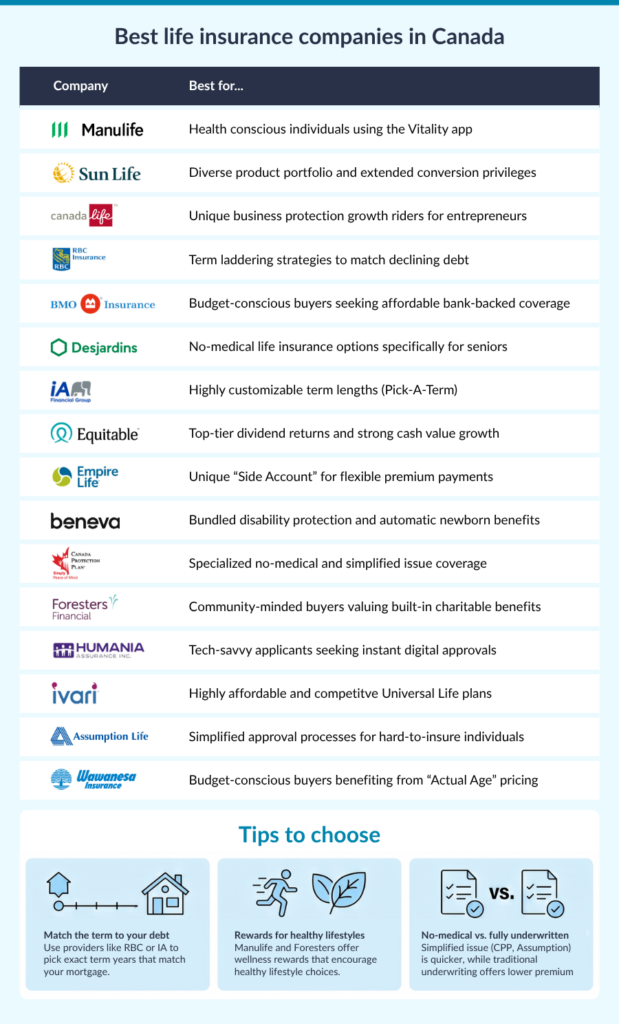

Can life insurance policies be bundled with other types of insurance for better rates?

Yes, some insurers offer bundling discounts when life insurance is purchased alongside other policies such as home, auto, or critical illness insurance. Bundling can simplify policy management, reduce premiums, and provide enhanced benefits. 

/* Custom Archives Functions Go Below this line */ /* Custom Archives Functions Go Above this line */

Best Mortgage Insurance Companies in Canada: Reviews & Ratings (2025)

There are a lot of different products on the market to insure your new home. One of those options is mortgage protection insurance through an insurance company.

We created a list of the 6 Best Mortgage Insurance Companies in Canada based on our years of expertise and research. These ratings and reviews are based on factors like type of policy, range of products, financial strength, and more.

We also give our reviews of some of the types of mortgage protection we don’t recommend. And, we show you why a traditional life insurance policy is the best coverage for homeowners. (Click here to skip to that part now)

Top mortgage protection insurance in Canada 2025

Our team of experts at PolicyAdvisor.com has picked 6 companies as having the best mortgage protection in Canada. We’ve ranked them based on different categories based on their strengths and weaknesses.

We have worked with the largest insurance companies for years, giving us insight into the best of what Canadian providers have to offer. This lets us review the country’s best insurance for mortgage protection to help you know which one you should pick.

Schedule a call for visitor insurance
Need insurance answers now?

Call 1-888-601-9980 to speak to our licensed advisors right away, or book some time with them below.

Canada’s Best Mortgage Protection Insurance Companies

best mortgage protection insurance companies in Canada list

Compare the best mortgage protection insurance companies

Here are Canada’s best mortgage insurance companies that offer diverse features. If you’re looking for the best mortgage protection plan, these are some of the companies to consider:

Insurance Provider Best for What we like Maximum Coverage
Assumption Life Simplified issue FlexTerm that lets you choose your policy term and quick electronic applications in less than 15 minutes $10,000,000
Beneva Combination coverage Offers term life insurance, disability and critical illness coverage $10,000,000
Canada Life Financial strength Wide range of policy options, strong financial stability $20,000,000
Empire Life Personalization Solution 20 rider that adds to your critical illness coverage and protects against 23 covered illnesses $10,000,000
Industrial Alliance (iA) Flexibility Pick-a-term lets you choose your term between 10 and 40 years $10,000,000
UV Insurance Riders MyUniverse portal lets you apply online and choose between different riders $500,000+

Reviews of top mortgage protection insurance companies in Canada

PolicyAdvisor Rating

Best For Simplified Issue

AM Best Rating A-

GET QUOTES

1. Assumption Life Mortgage Protection Insurance – Best for simplified issue

If you want to quickly get coverage for your mortgage without having to take a medical exam, then you should look at Assumption Life’s Flexterm plan. This is called simplified insurance. You can get approved much faster, although at a higher cost.

Assumption offers terms ranging from 10 to 35 years, as well as a decreasing term option that you can match with your mortgage.

They also have regular plans if you don’t mind doing a health assessment. And, getting a fully underwritten plan gives you far more options for premium rates, riders, and benefits:

Assumption Life Mortgage Protection Insurance Pros and Cons

Pros Cons
A built-in Extreme Disability Benefit is unique in the industry Can be expensive
Multiple term coverage options Long underwriting process
Simplified, non-medical issue options High policy fees and rider fees
Both level and decreasing options — decreasing term option can be used to match your mortgage Additional insurance options (riders and benefits) not available with simplified option
Online access to account
Digital e-policy
Ability to exchange shorter term policies into longer term policies
Several optional riders, including term life and children’s life
Critical illness rider covers 16 illnesses

Assumption Life Mortgage Protection Details

  • Available term lengths: 10, 15, 20, 25, 30, or 35 years
  • Available term types: Level and decreasing coverages. Single or joint coverage available
  • Maximum amount of coverage: $10,000,000
  • Renewability: Yes. Renewable every 10, 15, 20, 25, 30, or 35 years, up to age 85. No medical exam required up to certain limits. Premium rates are guaranteed
  • Convertibility: Yes. Convertible up to age 75

Read our Assumption Term Life Insurance Review

PolicyAdvisor Rating

Best For Combo Coverage

AM Best Rating A

GET QUOTES

2. Beneva Mortgage Protection Insurance – Best for combination coverage

Beneva’s Term Plus is a good choice for homeowners seeking an all-in-one solution for mortgage protection. It’s a multi-purpose plan that you can put to good use for several things. And, the company gives you some pretty tempting options to help maximize your coverage.

You can pick a decreasing term to match your mortgage, and get optional add-on riders at a small extra cost to create a plan with multiple types of coverage at a great price — all in one place.

Plus, Beneva has a rare Extreme Disability Benefit included for free in all of its plans. Most other companies only give you these kinds of insurance coverage if you pay an additional cost.

Add that to their riders for critical illness and disability insurance protection, and you have an easy way to tick all of your insurance boxes in one go!

Beneva Mortgage Protection Insurance Pros and Cons

Pros Cons
A built-in Extreme Disability Benefit is unique in the industry Longer turnaround times for policy approval
Optional critical illness and disability riders make for comprehensive mortgage insurance coverage Critical illness rider only 10 or 20-year term and only covers 3 conditions
Critical illness rider includes psychological assistance and second medical opinion
Several optional riders including accidental death & dismemberment and child rider
Preferred rates available starting at $1,000,000 for those in excellent health condition
Digital e-policy

Beneva Mortgage Protection Details

  • Available term lengths: 10, 15, 20, 25, 30, 35, or 40 years
  • Available term types: Level and decreasing coverages
  • Maximum amount of coverage: $10,000,000
  • Renewability: Yes. Renewable every 5 years after the initial term, up to age 85
  • Convertibility: Yes. Convertible to Beneva permanent life insurance coverage, up to age 70

PolicyAdvisor Rating

Best For Financial Strength

AM Best Rating A+

GET QUOTES

3. Canada Life Mortgage Protection Insurance – Best for financial strength

Canada Life is an excellent choice if you want to be insured with a company that has financial stability. According to our records, they’re one of the largest life insurance companies in all of Canada. You can feel secure getting coverage with them and knowing they’re probably not going anywhere anytime soon.

They also have a Business Growth Protection rider that’s particularly useful for business owners. It lets them buy more insurance coverage when their share of the business grows. So, you can get easier access to more insurance while protecting your mortgage at the same time.

You can choose any term length from 5 to 50 years with Canada Life. And, they have optional add-on riders like child’s term life insurance to let you create comprehensive mortgage insurance coverage.

One downside is that they don’t have a rider that can cover you for disability. They only have a full disability insurance policy. But, it is an amazing plan for helping to protect your mortgage in the event of disability.

Canada Life Mortgage Protection Insurance Pros and Cons

Pros Cons
Unique Business Growth Protection rider Limited additional insurance options: no critical illness or disability riders
Preferred rates available for those in excellent health condition Limited access to online account features
Accidental death and disability waiver of premium benefits
Several optional riders including accidental death and child’s term life
Digital e-policy

Canada Life Insurance Mortgage Protection Details

  • Available term lengths: Flexible terms between 5 and 50 years
  • Available term types: Level coverage. Single and joint coverage available
  • Maximum amount of coverage: $20,000,000
  • Renewability: Yes. Renewable annually until/unless cancelled. Premium rates are guaranteed
  • Convertibility: Yes. Convertible up to age 70

PolicyAdvisor Rating

Best For Personalization

AM Best Rating A

GET QUOTES

4. Empire Life Mortgage Protection Insurance –  Best for personalization

Empire Life has some of the most versatile mortgage protection insurance in Canada. They give you 6 different, customizable policies and a ton of rider options that can cover a wide range of needs. You can create exactly the kind of policy you want to get coverage for almost anything!

Their Solution 25 policy is great if you need insurance for loans. You can also apply for longer or shorter term lengths, or buy optional critical illness and/or disability riders at an extra cost to cover all of your mortgage needs.

Empire gives you two options for critical illness riders: CI Protect for basic coverage or CI Protect Plus for more comprehensive mortgage insurance coverage. And, the basic plan includes a small death benefit for free. Add their disability rider on top of that and you have a great mortgage protection strategy.

Empire Life Mortgage Protection Insurance Pros and Cons

Pros Cons
Provides some of the most innovative insurance solutions in Canada Critical Illness Protect Insurance only 10 or 20-year term
Several optional riders including accidental death & dismemberment, children’s life, and children’s critical illness rider Disability Credit Protection maximum payment period only 1 or 2 years
Ability to exchange shorter term policies into longer Empire Life term policies (20, 25, and 30-year coverage options)
Instant approval possible
Electronic contract delivery possible
Highly competitive annual or monthly premiums
Comprehensive offering of insurance riders
Online account access
Digital e-policy

Empire Life Insurance Mortgage Protection Details

  • Available Term Lengths: 10, 20, 25, 30-year term
  • Available Term Types: Level coverage. Single and joint first-to-die coverages available
  • Maximum Amount of Coverage: $10,000,000
  • Renewability: Yes
  • Convertibility: Yes, up to age 75

PolicyAdvisor Rating

Best For Flexibility Of Term Length

AM Best Rating A+

GET QUOTES

 5. iA Mortgage Protection Insurance – Best for flexibility

Industrial Alliance (iA) is a great choice if you want mortgage protection that’s flexible and gives you a lot of different options. Most mortgage protection plans are used to cover expenses. But this one is specifically meant to help you cover outstanding debts and loans, including your mortgage.

iA lets you choose from many different options, like coverage type and length. They also give you options for more coverage with a disability credit rider and critical illness transition. Both of these add-ons give you even more options so you can get exactly the type of coverage you want.

Tip: If you pick these rider options and decreasing coverage, you end up with a very strong mortgage protection plan.

iA Mortgage Protection Insurance Pros and Cons

Pros Cons
High degree of flexibility to design personalized coverage There may be less expensive alternatives available for term coverage
Pick-a-term feature has few industry parallels
Both level and decreasing options — decreasing term option can be used to match your mortgage
Optional disability rider and critical illness riders make for strong overall mortgage protection
Non-medical simplified and guaranteed product options available through Access Life product
Online access to account
Digital e-policy
iA’s underwriting can be more accommodating than other providers

iA Mortgage Protection Details

  • Available Term Lengths: Flexible terms between 10 and 40 years
  • Available Coverage Types: Level and decreasing coverages. Single and joint first-to-die coverages available
  • Maximum Amount of Coverage: $10,000,000
  • Renewability: Yes, before age 71
  • Convertibility: Yes, convertible to permanent insurance before age 71

PolicyAdvisor Rating

Best For Flexible Riders

AM Best Rating N/A

GET QUOTES

6. UV Mortgage Protection Insurance – Best for riders

Many of the mortgage protection insurance products we’ve listed as the best in Canada give you options for riders — small add-ons you can buy for more coverage. But mutual Insurance company UV takes it a step further.

Their plan, Term Superior, is also offered as an optional rider. This is on top of their wide range of rider options for credit insurance, disability, and critical illness. And, you don’t need to do a medical exam or answer extra questions for their critical illness rider. It’s easy to see why we rated them the best for rider options!

UV’s plans also cover you for severe loss of autonomy for free. So, if you cannot perform at least 4 of the 6 activities of daily living before age 60, you will get up to 50% of the amount you were originally covered for.

UV’s Term Superior is also a great choice if you have multiple financial responsibilities. It helps if you want to use a strategy called laddering to get additional coverage for a low cost.

Blue bulb

For Example

You could buy UV’s T-25 Superior term life insurance plan to cover your mortgage, and then buy a T-10 rider to cover your student debt. You could also get a rider for disability or critical illness coverage.

UV Mortgage Protection Insurance Pros and Cons

Pros Cons
Built-in Severe Loss of Autonomy benefit, at no extra charge Critical illness rider benefit period only 2 years and only covers 3 conditions
Several optional riders including credit insurance and critical illness
Preferred rates available starting at $500,000
Term 10, 20, 25, and 30 riders can be used for effective life insurance laddering strategy
Digital e-policy

UV Mortgage Protection Details

  • Available Term Lengths: 10, 20, 25, or 30 years
  • Available Term Types: Level coverage
  • Maximum Amount of Coverage: $500,000+
  • Convertibility: Yes. Convertible to up to age 70
  • Renewability: Yes. Renewable as 10-year term until death

Mortgage insurance is now affordable!

Get the best mortgage insurance rates from the top providers in Canada.

Reviews of banks and lenders offering mortgage insurance

Although we strongly recommend that you get term life insurance for your mortgage, we did some research into what lenders are offering. This will help you to understand and compare the choices.

Keep reading to see some of the biggest banks and lenders for mortgage insurance, and how we’ve ranked them.

PolicyAdvisor Rating

AM Best Rating N/A

GET MORTGAGE PROTECTION QUOTES

CIBC Insurance Mortgage Insurance Review

CIBC Insurance offers four types of coverage for mortgage insurance:

  • Life insurance (unexpected death)
  • Critical illness insurance
  • Basic disability insurance
  • Disability insurance plus (extended plan)

The first two types will make lump sum payments of either $750,000 or $500,000 (respectfully) of your outstanding mortgage balance. The two tiers of disability insurance offer different levels of coverage, and you can only apply for one.

Product details:

  • Available Term Lengths: Up to age 70
  • Available Term Types: Decreasing coverage
  • Maximum Amount of Coverage: $750,000

Pros: 

  • Additional options to cover mortgage costs: critical illness insurance, disability insurance, disability insurance plus
  • Discounts on mortgage critical illness, disability and disability plus for two approved applicants
  • 30-day free look period

Cons:

  • Only covers your mortgage, nothing else
  • Only issued between ages 18 and 64, unless the client has an existing insured mortgage
  • Only covers two people per mortgage
  • Individuals cannot be covered for both disability and disability plus/job loss on the same mortgage
  • Critical illness coverage only available up to age 55
  • Limited number of critical illnesses covered (life-threatening cancer, acute heart attack, or stroke)
  • Restrictions on coverage for disability and disability plus insurance

PolicyAdvisor Rating

AM Best Rating N/A

GET MORTGAGE PROTECTION QUOTES

Manulife Mortgage Insurance Review

Manulife offers two options for mortgage protection: mortgage disability insurance and mortgage life insurance coverage. Their mortgage life insurance policy is the default option. The mortgage disability insurance is an extra option you can pay a little more to add on.

But, there’s a reason why we rated Manulife higher than the rest although we don’t recommend lender’s mortgage insurance. They cover a high amount of your outstanding mortgage.

Manulife’s mortgage insurance plan also includes two benefits at no additional cost:

  • Waiver of premium due to job loss
  • Terminal illness benefits

The company will waive monthly premiums for up to 3 months if you lose your job, or up to 24 months if you are diagnosed with a severe illness. But you can’t access either of these until you’ve had the plan for 6 months.

Product details:

  • Available Term Lengths: Up to age 70
  • Available Term Types: Decreasing coverage
  • Maximum Amount of Coverage: $1,000,000

Pros:

  • Additional options to cover mortgage costs: life insurance and disability insurance policies
  • Added complimentary benefits: waiver of premium due to job loss and terminal illness
  • 60-day free look period
  • Competitive long-term rates compared to other lenders
  • Coverage is portable and can be changed to different lender

Cons:

  • Only covers your mortgage, nothing else
  • Only issued between ages 18 and 64, unless client has existing insured mortgage
  • No discounts for combined coverage

PolicyAdvisor Rating

AM Best Rating N/A

GET MORTGAGE PROTECTION QUOTES

RBC Royal Bank Mortgage Insurance Review

RBC Insurance offers three options to cover mortgage payments:

  • Mortgage life insurance – will pay out up to $750K in the event of death
  • Mortgage critical illness insurance – will pay out up to $300K if you are diagnosed with a covered severe illness
  • Mortgage disability insurance – will pay up to $3,000/month if you become disabled and cannot work

The mortgage life insurance policy is their default. Between the other two, you have to choose carefully — RBC Insurance only lets you get covered for one.

But one benefit is that RBC Royal Bank lets you use the payments for costs other than just your outstanding mortgage balance. You can use it to help pay off interest, overdrawn balances, prepayment charges, and other costs associated with ending your mortgage early (such as discharge fees, etc.)

Product details:

  • Available Term Lengths: Up to age 70
  • Available Term Types: Decreasing coverage
  • Maximum Amount of Coverage: $750,000

Pros:

  • Additional options to cover mortgage costs: critical illness insurance, disability insurance policies
  • Payouts can be used for fees as well as actual mortgage balance
  • 30-day free look period

Cons:

  • Only covers your mortgage, nothing else
  • No discounts for combined coverage
  • Only covers two people per mortgage
  • Individuals cannot have both critical illness and disability insurance protection under one mortgage
  • Only issued between ages 18 and 64, unless client has existing insured mortgage
  • Critical illness coverage only available up to age 55
  • Limited number of critical illnesses covered (life-threatening cancer, heart attack, or stroke)

PolicyAdvisor Rating

AM Best Rating N/A

GET MORTGAGE PROTECTION QUOTES

Scotiabank Mortgage Insurance Review

Scotiabank’s mortgage insurance will cover you in 4 different scenarios:

  • If you suddenly die (life insurance)
  • If you are diagnosed with a covered critical illness
  • If you become disabled and cannot work
  • If you lose your job/monthly income

They each will cover a decent amount of your outstanding mortgage debt. But the devil’s in the details. Only a certain amount of your outstanding debt will be covered. And only certain illnesses, disabilities, or circumstances will be covered.

Product details:

  • Available Term Lengths: Up to age 70
  • Available Term Types: Decreasing coverage
  • Maximum Amount of Coverage: $1,000,000

Pros:

  • Additional options to cover mortgage costs: life insurance, critical illness insurance, disability insurance, and job loss insurance
  • Discounts for purchasing two or more insurance types and for mortgages over $350,000
  • 30-day free look period

Cons:

  • Only covers your mortgage, nothing else
  • Only issued between ages 18 and 64, unless client has existing insured mortgage
  • Job loss insurance only available with purchase of disability insurance policy
  • Limited number of critical illnesses covered (life-threatening cancer, acute heart attack, or stroke)
  • Restrictions on coverage for disability, critical illness, and job loss

To learn more about how mortgage default insurance works and how much it costs, head to our CMHC Mortgage Default Insurance Calculator.

Explore before you invest in mortgage insurance!

Here’s everything you need to know about mortgage insurance before you make a buying call!

What is mortgage insurance?

Mortgage insurance is a type of life insurance plan mostly sold by banks. It will pay the outstanding balance on your mortgage in case you suddenly pass away.

Mortgage insurance is not the same as Mortgage Loan Insurance or Mortgage Protection Insurance. This is one of the reasons why people get roped into buying it — there are so many different names out there that it can be confusing.

Private mortgage insurance or mortgage protection insurance is a term life insurance plan. It gives a payout called a death benefit to your beneficiaries at the time of death. They can then use that money for anything — the mortgage and/or something else too.

You do need some of these insurance products to secure your mortgage, but others you do not. The chart below will help you be able to tell the difference.

Mortgage default insurance versus mortgage insurance comparison chart

How does mortgage insurance work?

Mortgage insurance is primarily sold by banks. When you sit down with your mortgage broker or lender, they’ll likely offer you insurance on your mortgage. This insurance will pay off your mortgage in the event of death.

This is mortgage insurance. It only goes toward the insured balance of your mortgage. As you pay your mortgage off, the amount this type of insurance pays also decreases.

Mortgage insurance premiums are conveniently tacked onto your monthly mortgage payments. So, it sounds like a great protection plan for the biggest purchase of your life. But there are better options out there beyond what your broker or lender has to offer.

Who needs mortgage insurance?

Mortgage insurance can be a crucial financial safeguard for certain individuals like first time home buyers and young families. Here are some key groups that should consider mortgage insurance:

  • First-time homebuyers
  • Young families
  • Single-income households
  • Homeowners with high debt
  • Elderly homeowners

Do I need to buy mortgage insurance from my bank?

No, you do not need to buy mortgage insurance from your bank or lender.

When you apply for a mortgage with a lender, it’s the mortgage broker or bank agent’s job to cross-sell their products to you. They may make it seem like you have to say yes to their insurance, but that’s not the case. You can opt for mortgage protection through life insurance instead.

Addtionally, you must remember that private mortgage insurance means the same thing as mortgage protection insurance. It’s a term life insurance product that gives a tax-free payment to your loved ones at the time of death. The payment can be used for anything, and it won’t change even if your mortgage changes.

Term life insurance is the best form of mortgage protection insurance.

Are mortgage life insurance and mortgage default insurance the same?

Mortgage life insurance and mortgage default insurance serve distinct purposes despite their similar-sounding names. Mortgage life insurance is designed to pay off your mortgage in full if you pass away during the mortgage term, ensuring your loved ones are not burdened with mortgage payments.

On the other hand, mortgage default insurance, often required by lenders for high-ratio mortgages with a down payment of less than 20%, protects the lender in case you default on your mortgage payments.

For example, think of John, a new homeowner, who decides to purchase his first home with a mortgage. Because John’s down payment is less than 20% of the home’s value, his lender requires him to obtain mortgage default insurance.

This insurance protects the lender in case John defaults on his mortgage payments, ensuring that the lender recovers their investment in the event of financial hardship.

Additionally, John decides to safeguard his family’s future by also purchasing mortgage life insurance. Unfortunately, John passes away unexpectedly during the mortgage term.

His mortgage life insurance policy pays off the remaining mortgage balance directly to the lender, relieving his loved ones from the burden of mortgage payments and allowing them to remain in their home. 

Mortgage life insurance vs life insurance: What is the difference?

Mortgage life insurance and regular life insurance policies serve different financial purposes. Mortgage life insurance pays off the remaining mortgage balance if the insured passes away during the mortgage term.

On the other hand, regular life insurance provides broader coverage, offering a lump sum payment (death benefit) to beneficiaries in the event of the insured’s death. This can be used for various financial needs such as income replacement, debt payoff, and education expenses.

Difference between mortgage life insurance and life insurance

Mortgage life insurance Life insurance
Purpose Pays off the remaining mortgage balance if the insured dies during the mortgage term Provides a lump sum payment (death benefit) to beneficiaries if the insured dies during the policy term
Coverage amount Generally matches the outstanding mortgage balance Can cover various financial needs, such as income replacement, debt payoff, education expenses, etc
Beneficiary Typically pays the mortgage lender directly The beneficiary can be designated by the insured and can use the funds as needed (e.g., family, estate, trust)
Premiums Generally fixed premiums, often based on the mortgage amount and the insured’s age Premiums can differ based on factors like age, health, coverage amount, and policy type (term, whole life, universal life)
Coverage duration Typically matches the mortgage term (e.g., 15, 20, 30 years) Policy terms can vary from short-term (e.g., 5 years) to lifetime coverage (whole life)
Flexibility Limited flexibility; coverage is tied to the mortgage and decreases as the mortgage balance decreases Offers more flexibility in terms of coverage amount, policy duration, and optional riders (e.g., critical illness, disability)
Underwriting requirements Often simplified underwriting; may not require a medical exam for approval Depending on the policy type and coverage amount may require medical underwriting, including a medical exam and health history review
Use of funds Solely pays off the mortgage balance Beneficiaries can use the funds for various purposes, including mortgage payments, living expenses, education costs, etc

Is mortgage protection insurance better than lender’s mortgage insurance?

Yes. Private mortgage insurance from an insurance company is often far better than what banks and lenders offer, for many reasons including usage, lower costs, flexibility, higher coverage and more.

  • Use — It can be used for debt repayment or anything, not just the monthly payments for your mortgage
  • Lower cost — It’s usually a lot cheaper than lender mortgage insurance from a bank or creditor
  • Flexibility — It can be changed into a permanent life insurance plan to cover you for the rest of your life
  • Portability — It’s not tied to your home, so it will still protect you even if your mortgage changes
  • Guaranteed death benefit — Your life insurance benefit amount doesn’t decrease as your mortgage is paid off
  • More coverage — Easily combine life insurance with riders to protect your mortgage in the event of disability, illness, or more

PMI does a better job at covering your family. On the other hand, lender’s mortgage insurance only goes toward your mortgage. It’s for protecting the bank or lender, not you or your family.

Mortgage insurance may sometimes have its own benefits that may make the highest cost worthwhile to you. But, in general, we do not recommend that you buy this type of coverage.

How to connect with a mortgage insurance advisor in Canada?

If you want to speak with a professional to go over your options, talk to our expert advisors at PolicyAdvisor! Unlike the banks, our interest is in helping you protect the biggest financial risk you’ll take in your life.

Let us help you find the right mortgage insurance policy to form an iron-clad financial plan. Book a call with one of our insurance experts today!

Looking for additional help?

Give us a call at 1-888-601-9980 or book some time with our licensed experts.

Frequently asked questions

Do I have to have mortgage insurance?

Not necessarily. You may need to have Mortgage Default Insurance or CMHC Insurance in some circumstances. But you are not obligated to buy the mortgage insurance your bank is offering.

Instead, you should think about getting private mortgage insurance or mortgage protection insurance. They’re two terms that mean the same thing.

Mortgage protection insurance is sold by a third party, such as an insurance company or insurance broker like PolicyAdvisor.com. It is usually cheaper, gives you better coverage, and is more flexible — you can use it for anything you need, not just the mortgage.

Is private mortgage insurance worth it?

Yes, private mortgage insurance is worth it. It gives you more bang for your buck than creditor mortgage insurance from a bank or lender does. That flexibility, the lower cost, and the better peace of mind make PMI worth it.

Plus, you can use our online platform to get personalized quotes for mortgage protection in minutes — much easier than it takes to go through getting mortgage insurance from a bank or lender!

Does mortgage insurance go away after reaching 20 percent of payment in Canada?

No, the mortgage default insurance does not “go away” automatically after reaching 20 percent of the payment. The insurance premium is paid upfront initially because your down payment was less than 20 percent. The coverage lasts for the entire duration of the loan.

However, you can cancel the coverage once your loan balance reaches 80 percent or less of the borrowed amount.

Does mortgage insurance cover job loss?

Whether mortgage insurance covers a job loss depends on the type of insurance you get. Mortgage default insurance primarily protects the lenders and does not cover job loss. Mortgage protection insurance is designed to protect buyers and covers mortgage payments in the event of a job loss. 

/* Custom Archives Functions Go Below this line */ /* Custom Archives Functions Go Above this line */